Welfare spending 2nd lowest in OECD
By Kim Rahn
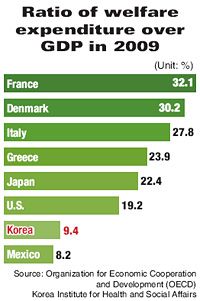
Korea spends the second smallest portion of its budget on welfare programs among members of the Organization for Economic Cooperation and Development (OECD), according to a report, Wednesday.
However, its welfare spending is growing fastest among the 30 OECD countries surveyed.
The study by the Korea Institute for Health and Social Affairs showed that the country spent some 100 trillion won on welfare in 2009, equivalent to 9.4 percent of its gross domestic product (GDP). The ratio was the second lowest following Mexico’s 8.2 percent.
The figures were based on the OECD’s report “Social Spending after the Crisis” and released on Nov. 15, comprised of data from 1980 to 2009.
“Korea’s ratio of 9.4 percent was less than half the OECD average of 22.1 percent,” institute researcher Koh Gyeong-hwan said.
France topped the ranking for welfare expenditure ratio with 32.1 percent, followed by Denmark with 30.2 percent.
Despite the low ratio, the amount of money Korea spent on welfare increased by 16.7 percent per year from 5.4 trillion won in 1990 to 100 trillion won in 2009. This was about 3.2 times the OECD’s average yearly growth of 5.2 percent.
“The amount has increased largely but the ratio is still low because Korea’s GDP has also grown,” Koh said.
OECD member states on average spent more money for cash benefits than in-kind allowances. But in Korea it was the opposite.
“Cash benefits means monetary support including old-age pensions, while allowances in kind means other government services such as the establishment of welfare centers for the elderly or the provision of gas for heating such facilities,” the researcher said.
“The former type, cash benefits, guarantees beneficiaries’ freedom for spending and is preferred by countries where welfare systems are well developed, including France, Germany, Italy and Japan. Countries preferring the latter type, such as Korea and Mexico, focus on providing public goods effectively and equally,” he said.
With regard to welfare for the elderly, people aged 65 and older took up an average of 15 percent of the OECD members’ populations. They spent about 40 percent of their welfare budgets on those people. In Japan and Italy where the elderly population accounts for over 20 percent of the total, 60 percent of their budgets were allocated for spending on senior citizens.
In Korea, people in that age group accounted for 10.6 percent of the population in 2009, and 2.5 percent of the welfare budget was used for them.