'It's still killing me'
35 years on, wife of kidnapped fisherman awaits news
By Kim Young-jin
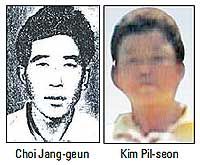
“It’s still killing me.” This is all Kim Pil-seon, whose husband was abducted by North Korean agents 35 years ago, can manage to say after decades of not knowing whether he is dead or alive, or if she will ever see him again.
The 68-year-old demurs when asked to recall May 5, 1977, when her husband Choi Jang-geun, an engineer, departed on the boat Tongyeong from South Gyeongsang Province to check on fishing activities in the South Sea and never returned.
On its fifth day out, the boat encountered two small vessels and told the crews, later determined by Seoul to be North Korean agents, to drop anchor and identify themselves. Choi boarded one of the boats, which then opened fire on the Tongyeong, riddling it with bullets and targeting it with grenades before escaping.
Choi Jang-geun is just one of 517 South Koreans abducted by the North since the end of the 1950-53 Korean War who remain captive in the Stalinist state, according to the Ministry of Unification. While Seoul has been able to verify the status of 121 abductees, families claim that the government has historically cast the issue aside, because it is stymied by cross-border politics.
“It’s been decades and I’ve heard nothing,” Kim said over the phone from her home in the southern coastal city of Tongyeong. “I just want someone to tell me if he’s alive or not.”
With the help of the Citizens’ Alliance for North Korean Human Rights (NKHR), Kim will petition the U.N. Working Group on Enforced or Involuntary Disappearances next week to press the North for information. This will be the latest example of a family member having to take their case to the international community.
The abductions, which Pyongyang denies, are a humanitarian concern not only for those abducted but for relatives and friends they left behind, who say they have been marginalized.
During the authoritarian Park Chung-hee administration, the families said they came under extreme suspicion for having ties to the North and were stigmatized. Liberal administrations that favored engagement are said to have avoided the issue for fear of scuttling rapprochement efforts.
The Lee Myung-bak administration has taken a tougher stance, launching a task force this year on the matter and working to revise a law to better assist the families. But with inter-Korean tensions running high, it has not been able to raise the issue with Pyongyang in working-level talks.
“We need North Korea’s cooperation to move the process forward,” a Seoul official said, asking not to be named.
Living for years with her mother-in-law, Kim has spent much of her time lobbying successive governments for help. But when the Koreas first began holding family reunions, she was not deemed eligible to participate. The ministry finally attempted to find out about Choi in 2009 but Pyongyang “could not verify” his status.
Other families share such frustrations.
“We face a lot of hardships,” said Choi Sung-yong, whose father, a fisherman, was abducted by the North in 1967. Children were stigmatized because their status was put into school records. “In addition, many of the abducted were heads of households. After they were kidnapped, the families had economic problems.
“North Korea took citizens from the South, and South Korea lost citizens to the North. Both should be criticized,” he added.
In one high-profile case an armed North Korean agent hijacked a South Korean airliner in 1969. Thirty-nine of the passengers on the KAL YS-11 were eventually repatriated through Red Cross channels. But seven others along with four crew members were never returned.
Choi’s case is special due to his circumstances, according to Lilian Lee, a program officer at NKHR. “The shocking thing is that it was a government employee, but they didn’t do anything about it to find out what happened,” she said.
International campaign
This week, NKHR launched a campaign on the social action website Change.org to gather 50,000 signatures on behalf of the KAL abductees, which they will use to press the U.N. Office of the High Commissioner for Human Rights (OHCHR) to take up the issue. The group previously convinced the OHCHR ㅡ which is mandated to protect universal human rights and deals with disappearances ㅡ to query the North, but it did not receive a response from Pyongyang.
“The most important goal is for regular people around the world to know about the abduction issue and think it is important enough to sign their name,” said Lee of NKHR, adding she hopes the campaign will shed light on Kim’s case as well.
The effort comes after the case of Shin Sook-ja, a 70-year-old South Korean woman stranded in the North for over two decades, has garnered international interest. After queries about her made by the UN, Pyongyang said last month she had died from hepatitis ㅡ signaling a potential channel to the international community.
Kim said her greatest wish is to meet her husband through an inter-Korean family reunion, a stalled project that last met in 2010. If not, she hoped for a sense of closure.
“All these years has yielded nothing,” she said. “I’m at my wit’s end.”
Korea Times intern Kim Susan Se-jeong contributed to this report