Globalizing Korean history archives

A view of the Jangseogak Archives in the Academy of Korean Studies in Seongnam, Gyeonggi Province. / Courtesy of Academy of Korean Studies
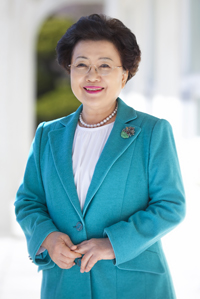
Lee Bae-yong, president of the Academy of Korean Studies
By Kwon Mee-yoo
Nestled at the foot of Cheonggye Mountain in Seongnam, Gyeonggi Province, the Academy of Korean Studies (AKS) is a repository of Korean studies resources with over 170,000 pieces in its collection handed down from Joseon Kingdom (1392-1910).
Lee Bae-yong, the 16th president of the AKS, is taking her best shot at rediscovering stories from the archive and publicizing its contents.
Lee is a historian who majored in Korean history and served as president of Ewha Womans University and the Presidential Council on Nation Branding before taking the AKS post in 2013.
"I feel like I am at the place where I am supposed to be," Lee said during an interview with The Korea Times on March 10.
Jangseogak Archives
The AKS consists of the Graduate School of Korean Studies, the Jangseogak Archive and various research centers centering on Korean studies. The Jangseogak Archive is a royal library of Joseon, launched by its 26th and final ruler, King Gojong. The royal collection of books and documents was transferred to the AKS in 1981.
"Without good storytelling, the records from Jangseogak are just ornamental old books. We have to derive stories from the archive and interact with them so not only researchers but all Korean people can know their history," Lee said.
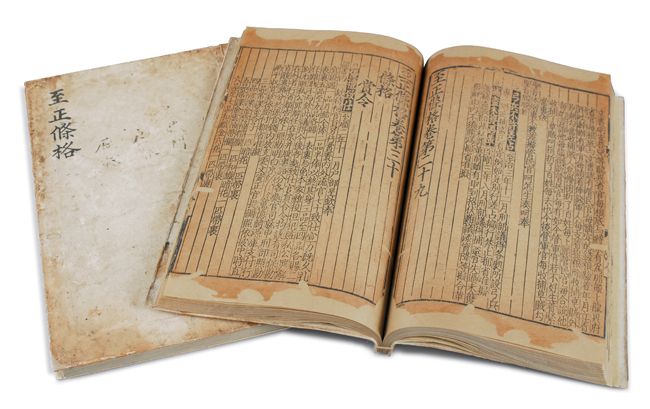
“Jijeongjogyeok” is the legal code of Chinese Yuan Dynasty which influenced the laws of the late Goryeo Kingdom and the early Joseon Kingdom. The only copy of the code in Korea is stored at the Jangseogak Archives.
"
Jangseogak resonates with the essence of archival culture. During Joseon, the archival officers wrote down not just what the king did, but also a lot about life. The National Archives of Korea can learn from Jangseogak when deciding on what to record in our history," Lee said.
One thing Lee discovered from the enormous archives of Jangseogak is Gunyeong Deungrok, which documents some 300 years of military life in late Joseon. The AKS is currently promoting it to be added to UNESCO’s Memory of the World Register.
"Gunyeong Deungrok is the history of sincerity and industriousness, written over 300 years. It contains orders from the king and commanders as well as lives of low-ranking soldiers and records of Westerners Hendrick Hamel and Jan Janse de Weltevree," Lee said. "It is the spiritual roots of Koreans. Nowadays people only type on a keyboard, instead of leaving analog records. In this era of technology, there are things to be recorded and documented by hand."
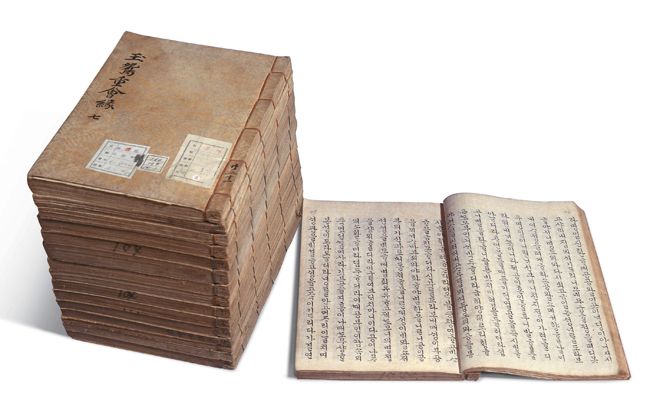
Novels written in Korean alphabet Hangeul during Joseon Kingdom are part of the Jangseogak collection
Promoting Korean studies overseas
The graduate school of AKS is popular among those who want to pursue Korean studies seriously. Currently, about 130 of the 290 graduate students are from overseas.
"We require all students to acquire Korean language before entering the school. The characteristics of language are important in Korean studies and they must speak Korean in order to study," Lee said.
The AKS also endeavors to promote Korean studies overseas. The project ranges from hosting symposiums on Korean studies to correcting erroneous information about Korea in foreign textbooks.
"We consider Korean studies scholars as colleagues and want to share our contents with them so they can research further," Lee said.
As part of its efforts, the AKS published sourcebooks on modern Korean history last month. Four volumes covering the Saemaul Movement and history of education, labor and family were first published to provide better primary resources.
The academy also plans to publish English editions of the series on Korea's 70-year history since its independence from Japanese occupation (1910-45).
Future of tradition
Lee believes that in this era of cultural enrichment, the future lies in tradition.
"The material from Jangseogak has both specialty and popularity. It should be something researchers and ordinary people and Koreans and foreigners can share," Lee said. "Hallyu is not something grand. It starts from Koreans communicating with the world with our own history."
Lee said the Jangseogak Archive can also be a great source for epic dramas, which are extremely popular both domestically and overseas.
"Most Korean historical dramas are 80 percent fiction and only 20 percent fact. Current trends twist historical facts for the sake of entertainment and it could be dangerous if people start to think they know the history only after watching the dramas," Lee said. "If the AKS researchers translate Korean classics and historical documents into modern Hangeul, it could provide good sources for television producers who seek new stories. The AKS could bridge the enormous archive and those who could make use of its historical stories."
Lee is behind the upcoming drama "Saimdang, the Herstory," starring Lee Young-ae and Song Seung-hun. "When PyeongChang was selected for the venue for the 2018 Winter Olympics, I thought an epic drama set in the region could boost interest and tourism in PyeongChang,” she said. “Shin Saimdang (1504-1551), an artist, poet and mother of Confucian scholar Yi I, was born and lived in Gangneung, a coastal city near PyeongChang, the perfect choice. I gave books and information on Shin to the writer myself.”
For producers looking for their next hit, Lee suggested digging up the first female doctor of Korea ― Esther Park. "She is the first Korean woman to receive a degree in Western medicine in 1900 and played a significant role in the modern history of medicine in Korea, saving the lives of women who could not show their bodies to male doctors. She died of tuberculosis at the age of 33," Lee said. "Her medical practice and benevolent spirit shone as Korea went through modernization. Wouldn't it be interesting to see her story adapted to the screen?"