Skin color remains big barrier
.jpg?w=728)
In the top photo, a student drapes his arm around his friend at Wonil Elementary School in Ansan, Gyeonggi Province, in this file photo taken on Oct. 26, 2011. / Korea Times files
Biracial kids still have hard time associating with classmates
By Park Si-soo
Min Kyung-joon (alias) is a “good boy” in many aspects.
The freshman at a middle school in Ansan, Gyeonggi Province, has been acknowledged by his teachers for his outstanding academic achievement and affable personality. Min is also very actively engaged in sports, which explains why he is one of the top players of an intramural soccer club.
Notwithstanding his good standing, he still has a hard time associating with his classmates, mainly because of his “exotic” appearance. The 15-year-old’s father is Pakistani and his mother a Korean native.
“That’s a huge disadvantage in making new friends among young children,” said Kim Young-im, a counselor who has interviewed numerous biracial children, including Min, in Ansan, home to one of the country’s largest population of low income immigrants.
“Children tend to get along with those who share similarity in looks and other visible characteristics. But he is different (from others) in many ways.”
For that reason, Kim added, it’s a common trend in the industrial town to see “exotic-looking” teenagers hanging out together, isolating themselves from their peers of Korean parentage.
“This is a problem that is very difficult to address,” the counselor said. “The government and school authorities have tried hard to solve this with various kinds of measures. But I think many of these programs turned out to be in vain.”
The number of biracial students like Min in Korea is estimated at 55,780 as of last year, representing 0.86 percent of the 6.53 million students enrolled in primary and secondary schools nationwide. The figure is expected to steadily increase to reach five percent by 2020, according to the education ministry.
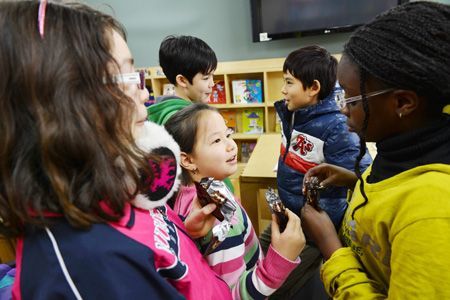
In the other photo, students at Seoul Itaewon Elementary School mingle during recess at their class in this photo taken on Nov. 27. / Korea Times files
Experts are calling on the government to come up with policies to help the early integration of biracial children to prevent them from falling through the cracks of society. They also warn that a number of studies have shown that if their alienation is unchecked it increases their chances of becoming delinquent and makes them experience learning difficulties.
It is also alarming to note that nearly 24 percent of biracial children drop out of school due to “relationship troubles” with classmates, representing the main factor behind the high dropout rate, according to a survey of 66,536 children of international couples here by the Ministry of Gender Equality and Family in 2012. The survey didn’t provide specific details of the nature of troubles they experienced as they tried to relate with others. Nearly two thirds of the dropouts attended school in urban areas, the survey found.
“More counseling programs are needed to solve the (relationship) trouble,” the ministry said in a report reviewing the survey results.
Language skill matters
Hwang Sun-kook, an official of the education ministry in-charge of student welfare and safety, also recommends improving the Korean language proficiency skills of biracial children as one of the ways to address this problem.
“Many of the students suffering from relationship problems are not proficient in communicating in Korean,” Hwang said, citing the 2012 survey, in which five percent of the dropouts were said to have poor Korean proficiency. “Let’s imagine that you are different from your classmates in looks and worse, poor in communicating in Korean. Who do you think will come to you first and try to become a friend?”
He explained that poor language skill essentially leads to poor academic achievement and this makes it all the more harder to improve relationships with others. The vicious cycle continues as long as the Korean-language proficiency remains very low, the official added.
The official insisted that the language training program should be offered not only to “segregated” students but also their foreign parents.
“Parents play a crucial role in children’s language learning,” he said.
But the complication does not end there. Even after overcoming the language challenge, multiracial families still have to contend with their low income problems. The monthly income of nearly 60 percent of multiracial families is estimated at 2 million won ($1,850) or less.
“Most of them (parents) engage in low-paid jobs. They normally leave home early in the morning and work until late at night. Despite such hard work, it’s not easy for them to escape from chronic poverty,” the official said.
“In this situation, it’s difficult to ask them (parents) to take time to learn Korean and teach it to their children.”
Experts also call on the authorities to pay greater attention to overcoming the problem of bullying faced by biracial children in school.
School violence
The 2012 survey showed 8.7 percent of them had been maltreated by their classmates. It is also believed that the actual figure could be higher, arguing that victims of school bullying normally stay silent about their experiences for fear of further retribution.
By type of bullying, verbal abuse accounted for the largest portion at 66.5 percent of bullying, followed by scoffing with 34.7 percent, violence with 16.3 percent and extortion of money or valuable products with 15.3 percent.
“Violent acts against biracial students are particularly rampant at primary and middle schools. But it sharply reduces at high schools,” the survey said. “We need to pay bigger attention to primary and middle schools.”