'Putting on gomusin backwards'

By Yoon Sung-won, Park Jin-hai, Kwon Ji-youn
Many young Korean men are ditched by their girlfriends after they join the military. They often describe the process of being dumped by their former sweethearts as “putting on gomusin (rubber shoes) backwards.”
This description has a meaning quite similar to an English expression, “writing a Dear John letter,” because both imply “leaving” or “breakup.”
All able-bodied Korean male adults are obligated to serve in the armed forces for almost two years. And young servicemen usually admit that keeping their love alive for over 20 months, even though they can see or contact each other whenever they need, is very difficult.
For that reason, the love stories of gomusin are both heartbreaking and heartwarming.
Why break up?
Hwang Jin-su, 27, confessed he had the most struggling moment of his life while in the military, when his girlfriend of three years came to visit him, with only three months of his service time left.
“Since she had waited for me while I was at the military, I was determined to be a better man for her,” said Hwang. He quit smoking and dreamed of the time they would spend together in the future, out of the military.
But on that day in 2008, Hwang’s dream was shattered because his girlfriend brought a guy during her visit, and introduced him as her new boyfriend.
Utterly shocked, Hwang couldn’t remember the rest of the day. Only the words of separation resonated within his brain, Hwang said.
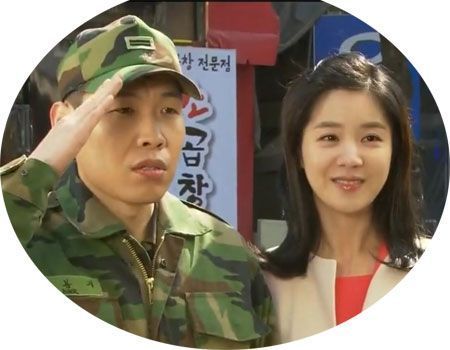
In a military sitcom “Blue Tower,” Pfc. Baek Bong-gi, left, played by the actor with the same name, salutes before leaving to spend time with his girlfriend Yu-ri, played by actress Son Seong-yun, who visited Baek’s military base. / Courtesy of tvN
After the one-sided break-up, his ex-girlfriend didn’t answer any calls he made to enquire what went wrong. Hwang said he still feels puzzled whenever he thinks about the end of the relationship.
In other cases, both soldiers who are boyfriends and “gomusin” girlfriends feel exhausted from the differences in lifestyles that they lead.
Jung Yu-ri, an office worker in Seoul, said her ex-boyfriend had a difficult time adjusting to military life. She recalled that he used to say he could endure it because he knew his girlfriend was waiting for him to begin a new chapter of their relationship, when he was done with his military duty.
The 28-year-old said that at first, the relationship was even better after he joined the forces, cherishing every conversation they shared. They were calling each other more, and spending more time together talking, getting to know each other even better.
But things started to change when he was promoted to corporal. Jung said her boyfriend began to worry about what life would be like after returning to society.
“He started talking to me non-stop about his future and about money,” Jung said. “I had recently gotten a new job, so I didn’t have time for his whining.”
When he finally returned from the army, Jung said they began fighting more than they used to.
“I wanted to make up for the time we had lost in the past,” she said. “He, on the other hand, wanted to move forward and really start building his future.”
They broke up three months after he finished his military service.
Sohn Ji-eun, 29, and her boyfriend broke up on his first vacation out of the army. As an office worker, Sohn said she experienced difficulty keeping in touch with her boyfriend while he was away.
She said that she had treated him coldly for two months prior, because he habitually called her during the day when she was busy.
“I didn’t always have enough time to chat,” Sohn said.
But she didn’t know that her boyfriend’s tolerance was running low. When he broke up with her, she just thought of it as a brief break from their relationship and hoped that he would change his mind when he returned to base. But he stopped calling.
“To be honest, it was an issue of pride,” Sohn said. “I didn’t want him to think I had nothing better to do than to just wait around for him to call.”
Apparently, the boyfriend had been determined to end things with her before he met her during his vacation.
She said he blamed the breakup on her, saying that he would rather not be with her if she wasn’t going to treat her “right.”
“By ‘right,’ he meant normal girlfriend duties, such as calling, visiting and mailing,” Sohn said. “I told him I was sick of having a boyfriend as a second job.”
Masters of waiting
Even though the stories and reasons for breaking up may vary, what’s left behind is always the same ― broken hearts.
But other couples have greater tolerance and luck. Some girlfriends not only passively wait, but also enthusiastically support their soldier boyfriends. They go as far as to influence their boyfriends’ final decision for which force to apply, and have even changed a military policy.
An unofficial history of the Korean Air Force showed the powerful presence of these enthusiastic girlfriends in Korea. In 2008, the Air Force decided to scrap a vacation system in which conscripted soldiers could enjoy a three to four day break every six weeks. After the announcement, the number of applications to the Air Force dropped significantly, seriously damaging the influx of new recruits.
Angry girlfriends, whose boyfriends were already serving their duty in the Air Force, posted tens of thousands of complaints on the Air Force’s website, requesting the revival of the original vacation system.
The online protest continued for months until the Air Force finally brought the system back.
These girlfriends, so-called “masters of waiting,” have their own secrets in dealing with the sense of emptiness.
It has been four months for Kim Ji-hyun, 20, since her boyfriend started his military service in the South Jeolla Province. She said that keeping the balance between her busy life as a junior college student and waiting her boyfriend is the key to fighting the loneliness.
“I study more as a junior, and work two part-time jobs that keep me busy,” Kim said. “I believe concentrating more on my life is the best option for both me and my boyfriend.”
While keeping busy in her daily life, Kim also gives support to her boyfriend, who is having a difficult time as a low-grade conscripted soldier. She sends a letter each day or even two. Last weekend, she paid her first visit to her boyfriend’s military base.
As it takes more than three hours by express train to get to the base from Seoul, Kim said she woke up at three in the morning and dressed up as best as she could. “I wanted to show my boyfriend my best look,” she said.
Kim introduced the term “flower shoes,” another new expression that refers to girlfriends who succeed in waiting over 20 months for their soldier boyfriends. “I’m looking forward to ‘putting on’ the flower shoes. Until that day, I’ll do my best to keep waiting,” Kim said.