Publishers focus on Syngman Rhee

Syngman Rhee, right, poses during a visit to a Korean-owned farm in Denver, Colo., in March 1920. Rhee led the Korean Provisional Government from 1919 through 1925. The photo is part of a private collection on first-generation Korean immigrants in the U.S., which was donated to the National Library of Korea last August. / Courtesy of National Library of Korea
New books revisit achievements, shortcomings of Korea’s first president
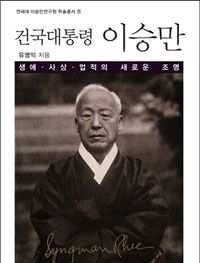
“Founding President Syngman Rhee” by historian Lew Young-ick is the latest in a series of books on Rhee published this year.
By Do Je-hae
Syngman Rhee is a major figure in modern Korean history and a continuous source of debate and historical research.
Several publishers have recently released books on Rhee, the nation’s first president who led the nation through the Korean War (1950-1953).
The new publications coincide with a heated debate among some citizens and scholars about his 12-year rule, triggered by a YouTube documentary that portrays him as a dishonest, failed politician.
There is still much division on how to define Rhee’s presidency and his role in shaping the nation before and after the end of Japan’s colonial rule in 1945. Some respect him for laying the foundations for a modern country, while others disregard him as a ruthless authoritarian.
“Few heads in international politics have been battered longer or harder than his,” his biographer Robert Oliver, wrote in 1951. “During a political career that began in 1894, Dr. Rhee has spent seven years in prison, seven months under daily torture, and 41 years in exile with a price on his head. He has directed a revolution, served as president of the world’s longest-lived government-in-exile, has knocked vainly at the portals of international conferences, and finally shepherded his cause to success.”
Among several authors that have published books on Rhee in the last few months since the documentary scandal, “Founding President Syngman Rhee” by Lew Young-ick seems to be the most comprehensive and well-researched. Lew is a recognized historian who has specialized in studying Rhee for more than 50 years.
The 432-page book from publisher Iljogak comprises a series of six theses, focusing on a wide range of Rhee’s legacy in politics and diplomacy, particularly his pro-independence activities in the United States aimed at liberating Korea from Japan.
Rhee was an autocrat and failed to unify Korea, but Lew concludes that Rhee’s presidency did more good than bad for the country by instituting modern systems of politics, education, military and agriculture.
In a previous interview with The New York Times, Lew defined Rhee as “the architect of modern Korea and the best prepared man to lead Korea through the war and into the new era of peace.”
The 77-year-old scholar has published several books on Rhee, and some of them have been published in English as well.
For foreigners interested in learning more about Rhee and modern Korean history, his English-language book “The Making of the First Korean President: Syngman Rhee’s Quest for Independence” is recommended.
The book delves into Rhee’s background and his abortive diplomatic missions, and explains why he was impeached as the head of the Korean Provisional Government in 1925. He analyzes the conflicts between Rhee and other prominent Korean leaders, including some close friends and supporters who eventually denounced him as an autocrat.
A graduate of Seoul National University, Lew furthered his studies at Harvard University before teaching in several U.S. and Korean universities.
Lew is a former Chair Professor of Korean Studies, Graduate School of International Studies at Yonsei University in Seoul.
Currently, he is T. H. Elema Chair Professor of Korean history at Handong Global University in Pohang and a senior counselor to the Syngman Rhee Institute at Yonsei University.