Glimmer of hope?

Participants in a South-North family reunion hold hands at a reunion center on Mt. Geumgang in North Korea in 2010.
'Divided Families,' a film about war-separated Koreans, nears completion
By Kim Young-jin
In moviemaking, time is of the essence due to the constant pressures of scheduling and staying on budget. But the clock may be ticking faster for “Divided Families,” a film-in-the-works about Korean-Americans separated from their loved ones in North Korea.
This is because the subjects of the film are part of an aging generation, separated by the 1950-53 Korean War, who are passing away before being able to reunite with their family in the isolated state.
There is good news, however. Led by executive directors Eugene Chung and Jason Ahn, the film recently completed a Kickstarter Campaign to raise $20,000 to fund post-production, which includes editing, sound and music.
They hope the film will soon be completed and that it will help convince policymakers to move on the issue before it’s too late.
“We’ve got an incredibly talented team of people working to finish the film,” Chung enthused in an email interview. “Once completed, we plan to screen the film at film festivals around the United States and hopefully the world. Once we do the film festival circuit, we’ll go the normal route of getting broader distribution.”
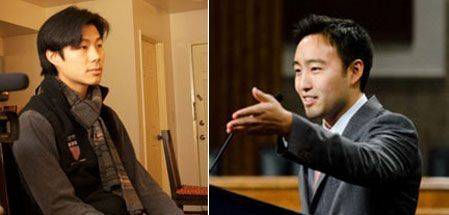
“Divided Families” executive directors Jason Ahn, left, and Eugene Chung. / Courtesy of Divided Families, Korea Times file
An estimated 100,000 first-generation Korean-Americans remain separated from their family members in the North, many of whom still yearn to see their parents, siblings or children living there. With no official channels to contact them, they have long called on Washington to act on the issue.
It is a problem shared by many ethnic Koreans, including those in the South.
The two Koreas have held more than a dozen rounds of reunions, bringing together tens of thousands of family members. Washington, which has rocky relations with the North, focuses most of its attention on ending Pyongyang’s nuclear program. Political tensions have halted formal reunions in recent years.
Robert King, the U.S. Special Envoy for North Korean Human Rights Issues raised the issue of family reunions with North Korean officials in the run-up to an aborted aid-for-nuclear freeze deal last year. But humanitarian issues have gone under the radar following the North’s recent missile launches and nuclear test, which squelched the appetite for engaging with Pyongyang.
This hasn’t deterred the “Divided Families” team. Chung highlighted the recent addition of musician Woody Pak, who will combine elements of Korean and American music for the soundtrack, as a sign indicative of the project’s progress toward completion.
Painful past
The film highlights the painful experiences of Korean American family members, who, due to language and other barriers, had difficulty raising their situation with their government. The team crisscrossed the country to gather their emotional stories.
Chun Un-chin describes a dream she had of traveling to the North to find her three children only to get caught in a blinding snowstorm.“I ran through the snow calling their names. Then I woke up,” she says.
Choe Kwang-cho has no photographs of his parents or siblings and bemoans that he has forgotten what they look like. As others have done, Choe at one point took matters into his own hands by contacting a black-market broker to connect him with his loved ones.
Some have able to obtain information and even visit North Korea to attend reunions. But the informal channel is a slippery slope because many have been swindled by brokers.
Long road
For executive directors Chung and Ahn, who both have grandparents originally from the northern part of the peninsula, the filmmaking process has been a journey of discovery. The two teamed up in 2008 after meeting through a friend.
“It was my grandmother’s last wish to see her younger sister before she died,” said Ahn, who is an emergency medicine resident at Brigham and Women’s Hospital and Massachusetts General Hospital. “Unfortunately she was unable to fulfill her wish.
“More than my personal story and the shared experience of tragedy among this generation, I will say that from a moral and ethical perspective (facilitating reunions) is the right thing to do. Something like this should have been done a long time ago.”
After its inception, the project picked up momentum after a benefit in New York in 2009, which raised over $25,000. In 2011, the film was screened on Capitol Hill.
For Chung, a managing director for startup accelerator TechStars, the process has illuminated a generation gap between Koreans who lived through the war and their offspring. “Time and time again... children of divided family members were surprised at some of the things they learned in the interviews that our team conducted with their parents,” he said.
“I think many individuals don’t realize how much parents keep from their children, and North Korean heritage is definitely something that many Korean-Americans tried hard not to talk about. Our film hopes to break that vicious cycle.”
Throughout the process, the team has been able to connect with divided family members as well as activists who have raised the issue with Washington.
In 2008, a group called Saemsori helped spearhead the first piece of binding legislation regarding divided family members, directing the President to report to Congress on the efforts of the government regarding reunions between U.S. citizens and their North Korean relatives.
Ahn said it has been fulfilling to memorialize the stories of a divided generation. But with time bearing down, he says the situation is urgent.
“Bearing witness is important in and of itself,” he said. “However, not having the capacity to resolve their situation speedily has been a challenge. I wish I could do more and I wish that more people would do more.”