Fresh out of ideas

The IBK Chamber Hall is the latest addition to Seoul Arts Center, but it is not equipped with the HD filming facilities that are necessary for the kind of screening project that was unveiled during a press conference. / Courtesy of Seoul Arts Center
New arts center president fails to convince with plan to benchmark the Met
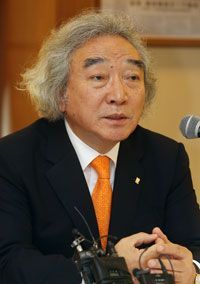
Seoul Arts Center President Ko Hak-chan speaks during a press conference in Seoul on May 14. / Yonhap
By Do Je-hae
The leader of a major cultural facility like the Seoul Arts Center (SAC) should ideally be a publicist, fund-raiser, talent scout and manager rolled into one. But is the new SAC head up to the challenge?
After a surprise March appointment from the culture ministry, SAC President Ko Hak-chan met with the press for the first time last week. The press conference left more questions than answers, as he failed to convince reporters of the feasibility of a package of new projects he hastily put together for his three-year term.
Because of his relatively unimpressive resume, the press hardly had any idea who Ko was when he was named to replace Mo Chul-min, a former culture bureaucrat. There was speculation that Ko’s appointment had been a result of his ties to President Park Geun-hye — he had served in the Institute for the Future of the State, established as Park’s private think-tank ahead of the presidential election.
At the time of his SAC appointment, Ko was leading a small performing arts hall called the Yundang Art Hall in Sinsa-dong, Seoul, which came under controversy for staging the musical “First Lady,” which covered the life of Park Geun-hye’s hugely popular mother, the late Yuk Young-soo. The musical runs until the end of this month.
The opposition party and some cultural civic groups issued statements denouncing Ko’s appointment, citing a lack of professional background required to run a major establishment like SAC.
Because of the doubts surrounding his appointments, Ko spent much of the press conference defending his appointment and explaining how his past career moves are in some way relevant to his current post.
“Among the past 13 presidents of SAC, I am the only one who has management experience of a theater of any size. This can be an advantage,” Ko said. “I will prove that someone who has run a small theater can also successfully operate a large one.”
The Jeju native and Hanyang University graduate served as producer for TBC; managing editor at Q Channel; and taught at Chugye University for the Arts and the Seoul Institute of the Arts.
SAC on screen
During the press conference, Ko’s introduction of new initiatives for the SAC did little to dispel concerns about his competence.
Benchmarking New York’s Metropolitan Opera, Ko said he will start SAC’s version of “The Met: Live in HD,” an expensive project that has been transmitting live performances to 1,500 venues in 46 countries with subtitles in English, French, German, Portuguese, Spanish, Japanese and Korean.
Of course, the SAC version, tentatively named the “SAC on Screen” is nowhere as ambitious as what has now become a trademark of the Met.
Ko is talking about a scheme that will transmit some of SAC’s key performances of ballet and opera to various venues, schools and theaters in Korea. When asked about how this could be done, he didn’t seem to have concrete solutions, particularly with regard to cost or issues of copyright.
The resident companies of SAC, such as the Korea National Opera and the Korean National Ballet, will be involved in the project. “We will start by filming operas “Turandot” in August and “La Boheme” in December,” Ko said.
By the end of the year, he hopes to produce eight films for distribution to all corners of the country.
To produce quality films, the key is to have quality content. Anyone who has ever been to performances at SAC by its resident companies will agree that they are not film-worthy material, artistically or acoustically.
The highly successful “Met: Live in HD” is the envy of many theaters around the world. But it is not done everywhere because few theaters have the production capacity and artistic excellence of the Met, the home of the world’s finest opera company the Metropolitan Opera under music director James Levine.
Lasting leadership
For a long-term project like the “SAC on Screen” to take root, it is crucial for the SAC to retain a lasting leadership with clear artistic vision. This is something the SAC has never really had in its 25 years of history.
In Korea, it’s unthinkable for the head of any cultural establishment, especially major ones like the SAC, to hold his or her post for such an extended period of time and carry out landmark projects that bring lasting impact on the cultural scene like the Met’s HD screening project.
Unlike in advanced countries, Korea’s major cultural posts like the SAC presidency are short-lived. Ko’s predecessor Mo Chul-min, a former cultural bureaucrat, served at the SAC less than a year before he was removed and ultimately appointed as Park’s senior secretary of education and culture.
Incidentally, in an interview with The Korea Times last October, Mo talked about the vision of applying the Met’s HD screening to the SAC.
“That kind of project would be like a dream for us,” Mo said. “Like many concert venues around the world, we have added more cameras for digital filming. But the primary source of such projects is the content. Our resident companies, like the national ballet and national opera, are not quite up to that level yet.”
The “Met: Live in HD,” is a capital achievement of the Met’s general manager Peter Gelb who has been serving in that capacity since 2006. Gelb, an usher at the Met in his youth and former head of Sony Classical, has revitalized the Met by applying technology to bring classical music closer to the masses.
The “Met Opera on Demand” streaming service is now available as an iPad app in stunning high quality on a subscription basis. The Met also presents free, live streaming of performances on its website once a week.
Ko is the first SAC president to officially announce that the SAC will follow in the footsteps of the Met. It will be interesting to see how much he achieves before a new president is abruptly named.