Leslie, the unforgettable

Hong Kong’s superstar Leslie Cheung in the early 1990s
Essay reveals the person behind the Hong Kong icon

By Do Je-hae
In the heyday of Hong Kong cinema, it was a regular practice for entertainers there in the 1980s and 1990s to both sing and act.
By achieving iconic status in both film and music, Leslie Cheung (1956-2003) is remembered as one of biggest superstars Asia has ever had.
Ten years after Cheung's death, his legacy in film and music still moves many fans in their 30s and 40s. For them, he remains an unforgettable “Gor Gor,” or big brother.
Fans within and outside Hong Kong are organizing various activities to pay tribute to the tragic superstar, who took his own life by jumping off a landmark hotel in the territory on April 1, 2003. For the first time, an essay on Cheung's life and work has been published in Korea. "Memories of Leslie Cheung" was released this week.
It is not surprising that Ju Sung-chul, the author, has taken up the task of tracing Cheung's life. Ju is a fantastic storyteller when it comes to Hong Kong. His books are a must-read for anyone who has a special affection for Hong Kong movies or to the territory in general.
Ju is a veteran film journalist who writes for Cine 21 and has specialized in Hong Kong cinema since the beginning of his career. The author grew up with Hong Kong films and has interviewed many star actors and directors. Cheung has held a special place in his heart because of his versatility as an actor and a captivating presence on the screen.
"Few Hong Kong actors were as convincing as Leslie Cheung in alternating between modern and ancient roles," Ju said. "After his death, Hong Kong cinema lost the energy of the past."
Ju opens the book with thoughts he had while visiting the Mandarin Oriental Hotel. He visits a restaurant there, the last place Cheung was seen before he leaped to his death. The author also takes a sentimental stroll on the "Avenue of Stars," Hong Kong's version of the Hollywood Walk of Fame located along the Victoria Harbour waterfront.
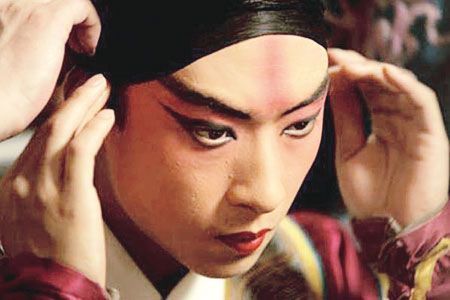
Leslie Cheung in ‘Farewell My Concubine’
The essay consists of 11 chapters, each reviewing crucial moments in Cheung's life under themes like "memory" "love" "dream" and "regret." The author interviewed Cheung's colleagues and visited places that Cheung frequented so that readers can feel closer to the person behind the icon.
The 320-page essay is written with sheer affection and admiration for Cheung, which the writer previously professed in his first book "When I visit Hong Kong for the Second Time" published in 2010.
A unique travel guide that introduces famous sites featured in iconic Hong Kong films, Ju concluded the book with a story about a old dim sum restaurant that Cheung liked to visit.
Cheung began his career as a singer and debuted as an actor in 1978. He led the golden age of Hong Kong films in the 1980s and 1990s with works like "A Better Tomorrow." He is also known as a leading man of the master filmmaker Wong Kar-Wai, who starred him in "Days of Being Wild," "Ashes of Time" and "Happy Together."
As Ju is a film writer, the essay focuses mainly on Cheung the actor. A separate book would be needed to fully do justice to the lasting impact he left in Cantopop.
Considered one of the founding fathers of the genre, he was voted the third of CNN's "top five most iconic musician of all time" placing behind Michael Jackson and The Beatles in 2010.
Those who loved Cheung the singer will never forget his final 8-month international tour in 1999-2000, singing to packed stadiums in China, Malaysia, Japan, U.S., Hong Kong.
Cheung may not have the natural singing gifts like Jacky Cheung, who is called the "God of Song" by the Hong Kong media; but he was known for a sultry voice that was quite unique compared to many Hong Kong singers of his time. Fluent in English from an early age, he also had an international appeal unlike other Hong Kong singers.
Cheung was an inspiration for many singers who came after him, including the "The Four Heavenly Kings" ― Leon Lai, Andy Lau, Jackie Cheung and Aaron Kwok. The foursome sang the theme song from "A Better Tomorrow" in a tribute concert right after Cheung's death.