a Table
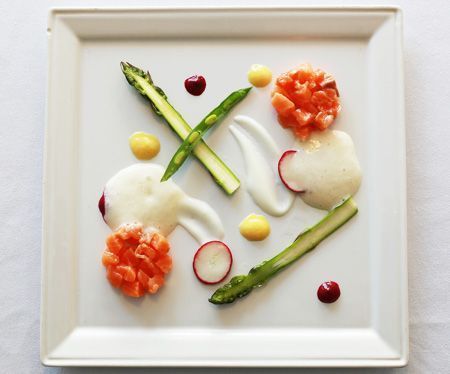
Tartare de Salmonen Printemps / Korea Times photo by Yoon Sung-won
By Yoon Sung-won
France’s haute cuisine used to be exclusively for aristocrats, but after the French Revolution in the late 18th century, royal chefs who left the court opened private restaurants in cities, allowing more people to enjoy fine dining.
Located in a quiet alley in Palpan-dong, central Seoul, French fine dining restaurant a Table is run under a motto that is in line with what French chefs from the 19th century had in mind — popularization of French fine dining.
A Table serves top-notch dishes at reasonable prices. The restaurant is frequented by fans of French cuisine, as well as businessmen, owners of corporations and their families, and government officials.
The name “a Table,” a French expression for “Let’s eat,” gives a comfortable impression. The French restaurant, built in a renovated traditional Korean house, provides a neat and cozy atmosphere.
The not-so-spacious interior is painted all white and accentuated with chairs covered with purple velvet. The simple design intends to make the food stand out, while the narrow, yet neat space allows visitors to enjoy a more concentrated service from the chefs.
“I make the utmost effort to give satisfaction to every customer, every day,” Kim Soo-mi, the owner and main chef of a Table, told The Korea Times’ Business Focus. Kim checks all the dishes after the customers finish eating to examine whether they have been satisfied with the food.
Ingredients are thoroughly managed by the chef. “Instead of using food supply companies, I choose all the ingredients myself from markets. This way, I can get products that perfectly fit the dishes I designed,” she said.
The chef patronne studied culinary arts and acquired a certificate at Ecole de Paris des Metiers de la Table, du Tourisme et Tourisme et de l’Hotellerie (EPMTTH), a renowned culinary school in France, between 1991 to 1998. After returning to Korea, she taught the subject at a local college and wrote columns for culinary magazines until she opened a Table in 2003.
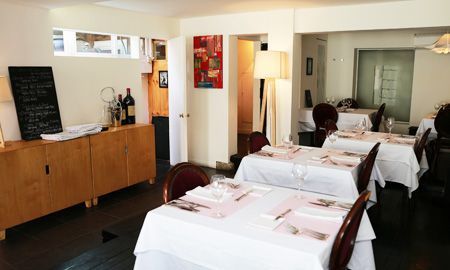
The interior of a Table
At a Table, customers don’t need to think much about what to eat, except for the main dish choices including beef, lamb chops and fish. Only one course is available at a time and the menu changes on a monthly basis. A seven-course dinner includes three appetizers, soup, main dish, and two desserts. A lunch course is made with relatively lighter ingredients, but is in larger portions.
Based on French recipes, menus are designed to evoke different seasonal impressions. In April, Tartare de Salmonen Printemps, smoked salmon seasoned with tartar sauce, is served as an appetizer for the dinner course. The flavor of beautifully-served diced salmon and sliced asparagus felt even better thanks to four kinds of home-made sauces made of beet, corn, yogurt and maple syrup. To maximize the taste and freshness, chefs make everything from sauce and bread to ice cream every day.
Some 70 kinds of French wine are available. Prices range from some 40,000 won ($36) to 200,000 won. An additional 20,000 won is charged as corkage if customers want to bring their own wine.
Another notable feature is that a maximum of 14 customer groups are received per day, seven tables each for lunch and dinner.
“We don’t receive another group of customers on the same table even when it gets empty, because we try to focus on providing the best quality service,” Kim explained.
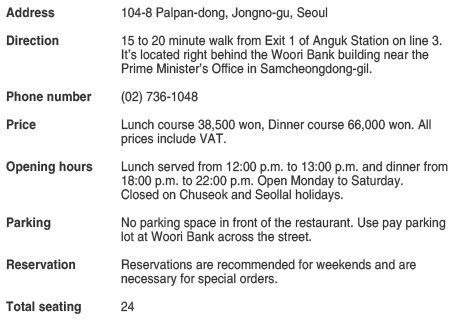
Though the prices of lunch and dinner courses are fixed at 38,500 won and 66,000 won, respectively, customers can order special dishes for special occasions at 100,000 won to 200,000 won. In this case, a reservation is required and the number of orders should exceed at least four.
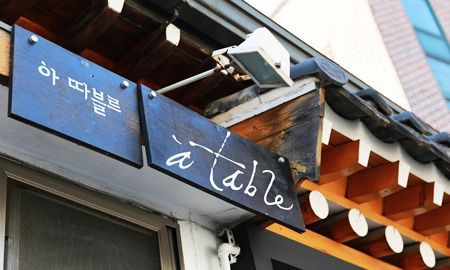
The wooden signboard of a Table exquisitely blends in with roof tiles and eaves of the traditional Korean building.