2013 and beyond ― entering post Western multi-polarity
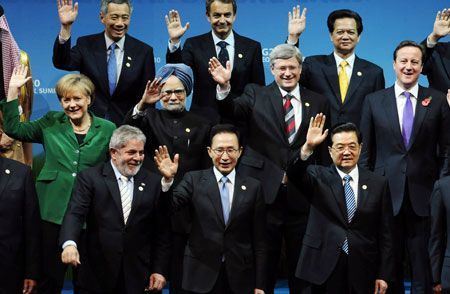
Leaders of G20 countries wave during a photo session during the Seoul G20 Summit at the COEX convention center, southern Seoul, Nov. 12, 2010. While the G7 included only developed countries, many emerging economies including China, Brazil and India joined the G20, which symbolizes the shift and redistribution of global power. / Korea Times file
By David Gosset
While the past 10 years saw the end of a West-centered global order, the coming decade will give shape to a multi-polar system in which the “Asian Mediterranean” ― the Association of Southeast Asian Nations (ASEAN) + 3 (China, Japan and South Korea) ― will affirm its importance.
In this new environment without any hegemony and characterized by a massive boom in the South-South financial, trade and cultural relations, the West, China, Latin America, the Muslim world and others will co-share the responsibility to manage a crowded and interconnected planet where the opportunities for the progress of mankind are as large as the perils which threaten it.
For the 2012 Nobel Peace Prize, the European Union (EU), still the world’s largest economic bloc, 2013 will be another year of turbulence as the political uncertainties in Italy but also in Spain complicate an already fragile financial and economic situation.
But the long journey toward the political integration of the European continent appears irreversible. The idea that, by gradually transferring their sovereignties to a supranational entity, European countries maintain a certain level of influence in a world of giants is accepted by the majority of the EU citizens.
On the other side of the Atlantic, the second Obama administration takes office in the midst of a weakened recovery. With the “fiscal cliff” avoided in the last hours of 2012, the public debt is still for Washington an enormous burden. But the vitality of the U.S. demography, the vigor of its businesses, the global capabilities of its diplomacy and military, the attractiveness of its top schools and an energy revolution ― the shale rush ― are all solid foundations of the American power.
The uncertain outcomes of the Arab Spring in Libya, Syria, Egypt as well as Tunisia add tensions in a Middle East, which is condemned to unrest without a definitive solution to the tragic Israeli-Palestinian conflict. In a region marked by volatility, the reemergence of Turkey is a strong factor of stability and a source of hope. To a certain extent, the dynamics of the Eurasian “middle country” ― Turkey ― mirror, on a smaller scale, the changes of the world’s “middle country” ― China.
The immense African continent and its 54 countries is a land of contrasts and of unparalleled diversity. With a rapidly increasing population ― 20 percent of the world population by 2050 ― Africa can be seen as the last frontier with a unique potential but progress on the continent is largely conditioned to more internal integration.
With the 2014 FIFA World Cup and the 2016 Summer Olympics approaching, international media will focus on Brazil, a giant which ensures Latin America’s rank in the 21st century. With a GDP surpassing those of Russia or India, Brazil’s output is already equal to the French or the British economy.
While the comprehensive power of Brazil is on the rise, one should also appreciate the dynamism of the Latin American Tigers or the Andean Condors ― Colombia and Chile are growing fast while Peru grew at an average of 6.4 percent since 2002.
In Asia’s Far East, the analysts should not be misled by the recurrent rhetorical disputes triggered by demagoguery and populism. In fact, through elaborate industrial clusters and economic interdependence, Northeast Asia is advancing toward more integration.
Beyond, Northeast Asia and Southeast Asia are heading toward more economic cooperation within the framework of the ASEAN+ 3. By doing so, they create the Asian Mediterranean revolving around the Shanghai-Nanjing-Hangzhou conurbation in a configuration which, mutatis mutandis, suggests the glories of the Song Dynasty.
By 2020, three years before the end of the Xi Jinping’s decade, China will become the world’s largest economy taking Asia, a more cohesive African continent, Latin America but also the Middle East at another level of development and a little bit further away from Western influence.
David Gosset is director of the Academia Sinica Europaea at China Europe International Business School (CEIBS), Shanghai, Beijing & Accra, and founder of the Euro-China Forum
.