Yoosung Global introduces antimicrobial copper brand 'Dr.Cu'

Yoosung Global’s headquarters in Ansan, Gyeonggi Province
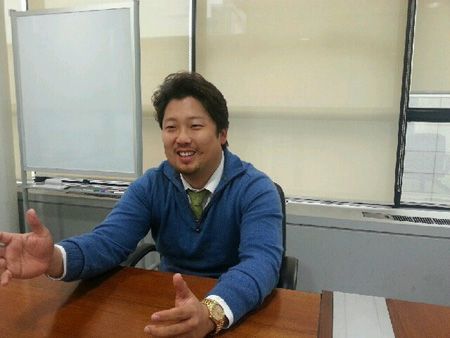
Yoosung Global CEO Yoo Seung-chul
Copper exterminates 99.9 percent of some 160 species of harmful bacteria in a matter of minutes
By Kim Bo-eun
The preservative effects of copper are familiar to most Koreans, as copper bowls were long used here to store food in hot weather to keep it from going bad. Despite the early discovery of the antibacterial effect of copper, it was only recently scientifically proven.
Yoosung Global has now incorporated the preservative effects of copper into its business. Boosted by the launch of its antimicrobial copper product brand Dr. Cu, it has taken on a mission to expand the use of copper in daily life, in order to promote health and hygiene.
Yoosung Global, an affiliate of Yoosung Metal, was founded in April 2011 as the nation’s only corporation specializing in manufacturing and selling products made from antimicrobial copper, which is made by its parent company.
“Copper is the only antimicrobial material certified by the U.S. Environmental Protection Agency,” said Yoo Seung-chul, CEO of Yoosung Global. “Its antibacterial effects are superior to that of silver nano coating.”
The company operates on three levels. It distributes raw materials; manufactures and sells antimicrobial copper products made from the material manufactured and processed at Yoosung Metal; and runs a solution system in which it provides services for customers that use its antimicrobial copper products.
Dr. Cu’s products include smartphone films, door handles, tables and bacteriostatic equipment.
Antibacterial effects of copper
Since the swine flu outbreak in 2009, hygiene concerns have escalated and interest in antibacterial products has grown accordingly. Despite the development of new medicines, cases of super-bacteria infections still make news around the globe.
Copper is easily processed, has high heat and electrical conductivity and is applicable to a wide range of sectors. Stainless steel, a widely used steel alloy, is often the material of choice because of its lower price and higher strength, but it poses risks when it comes to infections. Stainless steel has no antimicrobial properties, while copper inherently possesses such properties, effectively preventing the spread of infections. In addition, copper’s effects are semipermanent and copper material is 100 percent reusable.
A research team at the University of Southampton in the U.K. conducted an experiment in 2011 in which it contaminated copper and stainless steel with methicillin-resistant staphylococcus aureus (MRSA), strains of bacteria that are resistant to powerful antibiotics. Observation after several minutes showed that while the stainless steel remained contaminated, most of the bacteria on the copper had disappeared.
Copper emits ions that destroy the bacteria’s cell membranes and protein structure, exterminating the bacteria and suppressing its proliferation. In this way, copper exterminates 99.9 percent of some 160 species of harmful bacteria in a matter of minutes.
In order to produce antimicrobial copper products, technology to filter impurities in copper is required. Only about 10 companies around the globe possess this technology, and Yoosung Global is the only one in Korea.
Application
Now that the antimicrobial effects of copper have been scientifically proven, copper products are being incorporated into public facilities and hospitals in countries such as the U.S., the U.K. and Japan.
In the U.S., Walmart has applied antimicrobial copper to shopping cart handles, and McDonald’s uses it in its children’s playrooms. France’s high-speed rail service is gradually switching its handles to antimicrobial copper, and China is attempting to nurture it as a national industry.
Domestic restaurant chain Tosilae became the first to use products based on Yoosung Global’s antimicrobial system in its stores. Its store in Amsa-dong, eastern Seoul, now has antimicrobial tables and cutlery, as well as bacteriostatic equipment that removes infection-causing pollutants from the air. It plans to expand the use of these products that incorporate copper to its 70 stores across the nation.
“Tosilae regards the safety and hygiene of our food products as our top priority. Therefore, it makes sense that we brought in antimicrobial copper tables and cutlery, with which customers are in direct contact. We will gradually expand the application of the antimicrobial copper system to all our stores across the nation,” said Tosilae CEO Won Sun-joong.
The use of antimicrobial copper products is also increasing at public facilities where large numbers of people gather, such as airports, subway stations and libraries.
Yoosung Global is in the process of applying antimicrobial copper to household items, interior building materials and home electronics. Pad-type products can be used inside cupboards, coin types in humidifiers or toilet water tanks and stick types in drains.
The domestic antimicrobial copper market is estimated to be 1 trillion won for households and 400 billion won for medical institutions.
Recognition
Yoosung Global produces antimicrobial products certified by the International Copper Association, the U.S. Environmental Protection Agency and the Korea Conformity Laboratories. Antimicrobial copper certified by the International Copper Association earns a Cu+ mark.
The International Copper Association, an international nongovernmental organization, was established to tap into copper markets around the globe and develop related technology.
On Jun. 3, Yoosung Global CEO Yoo received an award from the Ministry of Trade, Industry and Energy at the largest annual gathering of players in the industry.
Nonferrous metal is any metal, including alloys, that does not contain iron. The most commonly used nonferrous metals include aluminum, copper, lead and zinc, and alloys such as brass.
Yoo was recognized for his contributions not only to the company’s antibacterial copper business but also to the development of new industrial material through continuous research and exploration of overseas markets.
He was also a recipient of the knowledge management award in September last year. The award is given to leaders in various sectors of society who change organizational culture by maximizing the capabilities of each of their organizations’ members.
Furthering reach
Yoosung Global is actively promoting its Dr. Cu brand. In February, it participated in the 2013 Kyunghyang Housing Fair, where it introduced its Dr. Cu line of antimicrobial interior products and household items. Kyunghyang Housing Fair is the nation’s largest exposition of interior and construction materials.
Yoosung Global will also take part in the Korea Franchise Expo 2013 to be held in October, where it will promote its business and secure distribution channels for its copper material and products.
Based on its competence built in the domestic market over the past 30 years, Yoosung Metal is preparing to expand its reach to overseas markets.
“Yoosung Metal has now begun preparing to become a hidden champion in the global market,” said Yoo. “By developing its human infrastructure and modernizing management, it will compete fair and square with foreign corporations in the nonferrous metals industry.”
Working off its parent company’s solid foundation, Yoosung Global aims to open distribution channels in overseas markets to further its reach.
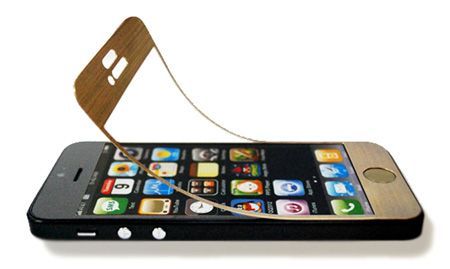
Dr. Cu’s antimicrobial copper smartphone film for iPhones / Courtesy of Yoosung Global
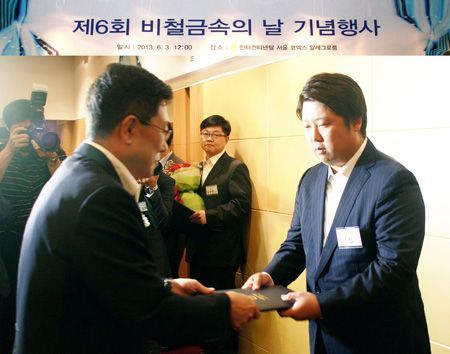
Yoosung Global CEO Yoo Seung-chul, right, receives an award from the Minister of Trade, Industry and Energy, Yoon Sang-jick, during an event at the InterContinental Seoul Coex on June 3.
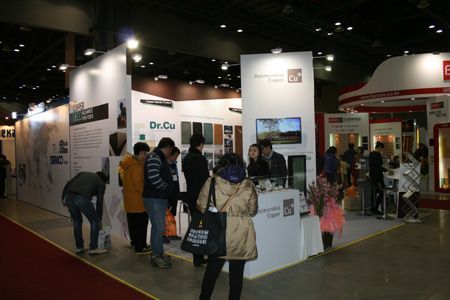
Visitors look around Yoosung Global’s Dr. Cu line of antimicrobial copper products at the Kyunghyang Housing Fair at KINTEX in Goyang, Gyeonggi Province, on Feb. 20.