2013 outlook for Seoul office market
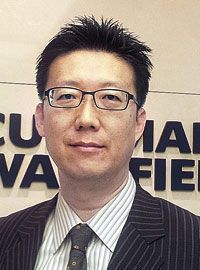
Tony Yoon is head of corporate occupier and investor services at Cushman & Wakefield Korea.
By Tony Yoon
The Korean economy is estimated to grow at an annual rate of 2.6 percent this year from a year earlier, according to data by the Bank of Korea. Given the government stimulus and improving global economic conditions, we may see even faster growth in the second half.
In the first half of 2013, the vacancy rate in the Central Business District in central Seoul, where new supply has been focused, increased to 16.5 percent; in the Gangnam and Yeouido areas, it was 7.5 percent and 22.1 percent, respectively. Monthly rent growth continued to show a weak steady trend, due to the influence of the increased vacancy rate.
A characteristic of recent leasing cases has been mainly generated by the demand from the merging and relocation of headquarter and branches due to cost saving and company restructuring. For example, most of Samsung Group’s affiliates have moved to the Samsung Global Engineering Center, which was recently completed in Gangdong-gu. LIG Group’s affiliates moved to the company’s headquarter in Hapjeong-dong. NCsoft decided to relocate from the NCsoft building in Gangnam to their name structure in Pangyo. A global IT firm will relocate its headquarters from Gangnam, taking 14,000 square meters at K twin Tower in the Central Business District.
Central Business District
The Central Business District office market during the first half of 2013 showed the characteristics of increases in vacancy rate due to new supply, despite a number of lease contracts being concluded. In the first half of the year, three projects totalling an approximate gross floor area of 161,323 square meters were introduced into the Central Business District market. State Tower Gwanghwamun, Asterium Seoul and N Tower were launched in the first half of 2013, but it has yet to attract meaningful tenants. Doryum 24 will be completed in the second half of 2013. The Doryum 24 project scheduled to sign a pre-lease contract with Kim & Jang.
Despite the 2014 scheduled new supply being much less than the figure for 2013, various Cheongjin office development plans are scheduled to come on stream in 2014. Gran Seoul (Chungjin 12-16), Chungjin 1(KT) and Chungjin 8 are scheduled to come on stream in 2014. GS Engineering & Construction as a master tenant will lease the whole of GS Gran Seoul (Chungjin 12-16), and sublease half of the building to alternative tenants in the market.
In 2015, D Tower (Chungjin 2-3), Myeong-dong 3 and Gongpyung 1,2,4 are the main Central Business District office buildings expected to be completed. Owner-occupied buildings such as Myeong-dong 3 will not have to attract new tenants but other vacant spaces will be seeking potential tenants, which will make the Central Business District market much more competitive.
Gangnam
During the first half of 2013, the Gangnam experienced an increase in vacancy rates because some IT companies are relocating to the newly built, Pangyo Techno valley. Clearly, the area reputed for its exorbitant rents is steadily losing some of its tenants. Consolidation of branches by large corporations and relocations to low-cost buildings or districts as part of cost-cutting measures are the most prudent moves to make during times of downturns.
Intercontinental Parnas Tower is the only major building in Gangnam that is scheduled to be supplied in the future. However, it is yet to break the ground. Although vacancy rate in Gangnam is forecast to increase, resulting from expected relocation of game companies in 2013, the slight increase in vacancy rate in Gangnam is expected in the second half of 2013 due to limited supply.
Yeouido
The Yeouido Business District has experienced the highest increase in vacancy rate among other districts due to the completion of the two IFC landmark towers. In the first half of 2013, the vacancy rate in Yeouido peaked to its highest level in history due to new supply.
Yeouido will continue to have new office stocks. The Federation of Korean Industries Hall (FKI), with 168,681 square meters of gross floor area, will be supplied in the fourth quarter of 2013. In Yeouido, average monthly rents are expected to decrease, despite the traditional demand for substantial office spaces by the financial and securities sector.
Lease marketing for newly supplied buildings within Yeouido will become fiercer, and as the large-sized offices set to be completed in 2013 are preparing differentiated strategies from the existing buildings in terms of building management, operation, and facilities, overall quality improvement in office facilities in Yeouido is expected to improve.
Outlook
Looking ahead, with new supply entering the Central Business District and Yeouido, we expect tenant-favorable conditions to continue in 2013. Market conditions will require landlords to continue offering lease incentives. Given the high quantity of new supply in the pipeline over the next two years, the expected new office space supply will boost the vacancy rates until 2015. Thus, the tenant-focussed market is expected to persist until 2015. Going forward, however, new supplies are expected to decrease from 2015. In addition, some new completions will be occupied by owners in the Central Business District.
From then, if the market turns into a landlords’ market, landlords will restrict rental-free incentive periods on the back of a recovery in office demand. Other promotional incentives will also be tight with a reduction in the number of new office supplies. For tenants with a long-term perspective, considering the reduction in forthcoming supply, tenants with contract expirations scheduled for 2014 should renew their contract periods on a long-term basis to take advantage of lease incentives.
Tony Yoon is head of corporate occupier and investor services at Cushman & Wakefield Korea.