President-elect urged to keep small firm-first policies

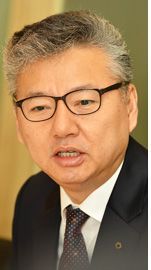
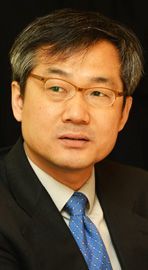
Yu Byoung-gyu, executive director at the Hyundai Research Institute
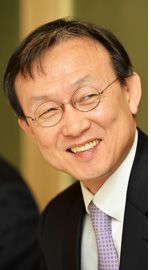
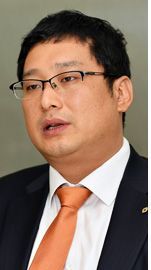
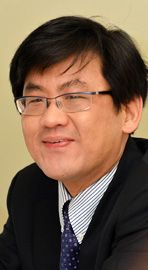
Lee In-pyo, economics professor at Ewha Woman’s University
By Lee Hyo-sik
The following is the full text of the roundtable interview about the Korean economy.
Q: President-elect Park Geun-hye will take office on Feb. 25. She faces a wide range of economic problems, including a prolonged property market slump and rising household debts. What do you think the incoming president should do to help raise Korea’s falling growth potential and revitalize the struggling economy?
A: Hong of KDB Daewoo Securities: The incoming government needs to find new growth engines and strengthen the competitiveness of the local services sector. In line with the establishment of the Ministry of Future Creation and Science, the next administration should invest more in research and development, as well as help businesses launch innovative new products such as smartphones.
A: Oh of Standard Chartered Korea: President-elect Park has said her government will scrap a wide array of tax break programs and broaden the tax base to finance social welfare programs. With the economy losing momentum, this is not the time to take cash away from businesses and households. Policymakers need to introduce expansionary policy steps and the central bank keeps cutting the interest rate. Given Korea’s relatively healthy fiscal standing, the government should spend more than it earns to prop up the economy. It should also extend greater financial and other support to households to encourage them to spend. Regarding the promotion of shared growth between large and small companies, the government must remain on the sidelines, letting concerned parties reach an agreement on their own.
Q: Park has unveiled small business-first policies in the name of ``economic democratization,’’ which she says will correct unfair business practices by family-run conglomerates. However, this policy approach has caused large firms to refrain from making investments and hiring workers to a certain degree. How do you evaluate Park’s stance toward big companies? How do you think the incoming president should deal with them?
A: Yu of the Hyundai Research Institute: Large and small companies here have created a corporate ecosystem over the years. The government’s role is to find out what is wrong with the ecosystem and fix the problems, while leaving the ecosystem evolve on its own. It should not attempt to overturn the ecosystem’s entire structure. The government has introduced tens of thousands of ways to help small businesses, and now it is finding it hard to come up with new ones. What it should do is offer tailor-made programs for each entity. Meanwhile, large companies need to realize that they cannot flourish while marginalizing subcontractors and suppliers. When small businesses fall, large companies also suffer. Big businesses should voluntarily share the fruits of their growth with their smaller partners.
A: Hong of KDB Daewoo Securities: I would like to talk briefly about Procter & Gamble and 3M. They are exemplary corporations that have shared significant portions of their profits with small business partners. To some degree, I think large companies need to change their bad practices against small partners. For example, it is absurd for conglomerates to operate tobacco stores or supermarkets. They should let self-employed people or small businesses engage in such ventures.
A: Lee of I’M Investment & Securities: President-elect Park should continue her stance of being friendly to small businesses throughout her five-year term. In the past, presidents initially stressed the importance of supporting small firms. But a year or two after the inauguration, they all became friendly to large businesses. I think the presidential office exerts the greatest power for the first two years. But for the remaining three years, the balance of power shifts toward conglomerates. I think this will also happen during the Park Geun-hye administration. It is not easy to reform the country’s large businesses. The President-elect should not forget her initiatives for the next five years.
A: Lee of Ewha Woman’s University: I think Park adopted policies friendly to small businesses solely out of political needs in a bid to garner more votes. I don’t think she has ever thought about it deeply. Nevertheless, I really hope that Park maintains this policy stance for the next five years. As far as large companies are concerned, it is in their interest to help small firms. They should think deeply about ways to coexist with their smaller partners.
A: Cho of Daishin Securities: The incoming president should extend more financial and technical support to small-and medium-sized enterprises to enable them to grow bigger. Many small firms prefer to remain small in order to continue to receive a wide range of state support. They have no incentive to become larger. The government should address this problem and offer incentives to encourage them to grow into global players.
Q: Unlike the United States, Japan and other booming stock markets, Korea has been stuck in the doldrums. This is largely attributed to the worsening performance of exporters in information technology, automotive and other industries as a result of the weak yen and sluggish global consumer demand. How do you assess the current market? Could you give us your 2013 market projection?
A: Hong of KDB Daewoo Securities: The local stock market has been excluded from the bullish global run in recent months due to the strengthening won and foreigners’ jettisoning of local shares. However, the easing of the European debt crisis and a steady economic recovery in the United States and China will improve overall export market conditions for Korean companies in the second half of this year. In line with improving macroeconomic conditions abroad, the local bourse is widely expected to head upward. Improving investor sentiments and abundant global liquidity will also keep the market bullish for at least a year.
A: Cho of Daishin Securities: The local bourse will show an upward curve toward the year’s end. Stocks will hit bottom in the first quarter and begin heading north in April as the won’s rise against the dollar and the yen comes to a temporary halt. Local shares are also expected to be more attractive for foreigners, compared to those listed in other emerging bourses. However, the market will likely resume its descent between May and July, with worries over shrinking global liquidity as a result of surging inflation, and the end of the U.S. debt ceiling extension and the maturity of Spanish bonds. But from September to the year’s end, the local bourse is projected to bounce back thanks to improving business conditions in the U.S., Europe and China. In particular, China’s facility investments will jump, in tandem with the recovery of the U.S. housing sector and the rebounding European economy.
A: Lee of I’M Investment & Securities: Local shares have remained sluggish in line with low economic growth rates. In the second half of 2012, economic output expanded only 1.5 percent from a year earlier, while the benchmark KOSPI was only about 10 percent lower than its all-time high. As long as the economy fails to rebound strongly, the local bourse will move at a snail’s pace. To sum up, things will not improve much in 2013 from last year. With the easing of the European debt crisis and the U.S. debt ceiling debacle already reflected in the market, shares won’t be able to show a significant upturn this year without fresh favorable factors. I don’t think the market will jump by more than 5 percent over the levels of 2012.
Q: Shares of steelmakers and banks which had been shunned by foreign and institutional investors have begun drawing an upward curve in recent weeks. Given business conditions at home and abroad, which sectors do you think will post bullish performances? What will be the underperforming sectors in the coming months?
A: Hong of KDB Daewoo Securities: I think all sectors are exposed to heated competition and other unfavorable business conditions. If China makes a soft landing, the chemical, steel, shipbuilding and machinery sectors will jump on the back of growing demand in China. I think investors should pay closer attention to individual companies. Businesses that are innovative and follow global trends successfully will likely outperform the overall market. There are many such companies not only in the information technology industry, but also in the consumer goods sector.
A: Cho of Daishin Securities: Samsung Electronics and other information technology firms will lead the market until April. But during the projected correction period from May to July, autos and stocks insensitive to economic conditions will perform better as the market correction will likely accompany the weakening of the won against the Japanese yen. In the latter half of the year, the local bourse will head upward, with industrial material and financial shares leading the pack.
A: Lee of I’M Investment & Securities: I think banking stocks will likely rebound on the easing of worries over the real estate market and household debts. They will also post better earnings performance. Furthermore, the chemical industry will benefit from the projected rebound in the Chinese economy. However, auto and information technology shares will continue to suffer due to the won’s strength.