Tourism takes drubbing from weak yen

By Kim Bo-eun
Kim Chang-soo has been running a stall at the center of Myeong-dong for 20 years. Ten years ago, when the TV drama series “Winter Sonata” became a huge hit, he started selling post cards and posters of Korean actors, actresses and teen idol groups. But according to Kim, since the end of last year, sales have fallen by half.
“I’ve been in Myeong-dong for 20 years, but sales have never been this low,” he said. “My business is on the verge of going broke.”
Kim says this is not only due to the depreciation of the yen but also due to the diplomatic tension between Korea and Japan arising from Dokdo as well as the North Korean nuclear crisis.
“All of these factors have escalated, and Myeong-dong took a direct hit. Not only my stall, but most of the businesses here have seen their sales decrease by half. Stalls cannot afford to hire part-time workers because their sales are so low.”
While Myeong-dong bustled with tourists from around the globe, Japanese tourists were the main sources of income for most businesses in the area. This was not only because they constituted a large portion of foreign tourists, but also because they were more apt to spend money since prices here were lower than in their home country.
“But what can I do? The only thing I can do is to wait and see, hoping things will get better,” said Kim.
Myeong-dong, the shopping district in downtown Seoul, is known as a mecca for foreign tourists. All year round tourists from around the globe bustle inside shops and fill the streets where vendors sell everything from fried snacks to accessories and bags. Eager to attract foreign customers, sales assistants at cosmetics stores stand at their entrances yelling out in Japanese and Chinese and handing out free samples to tourists.
Among all the foreigners, the Japanese have been the easiest to spot, as Korea, a neighboring country, has been a popular travel destination with low prices. To accommodate the large numbers of Japanese tourists, Japanese signs have been posted outside stores as well as on menus at restaurants. Touting is also done in the language. And with so many of the Japanese tourists speaking their language there, at times it makes people think they are in Japan rather than in Korea.
However, the scene at Myeong-dong is changing. It seems it has become less crowded, and Japanese tourists have decreased noticeably.
Japanese visitors dip
According to the Bank of Korea (BOK) Wednesday, the nation’s tourism deficit marked $450 million in April, up $350 million from a year ago.
BOK data shows that the tourism deficit from January to April adds up to $2.5 billion, a $760 million increase from the same period a year ago.
A large part of the tourism deficit is attributed to the fall in Japanese tourists due to the weak yen, which makes trips to Korea more expensive for them.
According to the Korea Tourism Organization (KTO), since the yen started depreciating around November last year, the number of Japanese tourists has shown a marked decline.
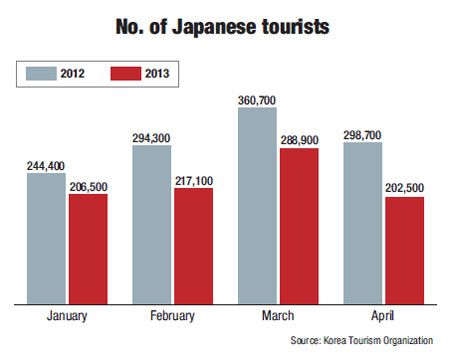
While in August 2012 the number of Japanese visitors grew by 6.5 percent compared to a year earlier, the number gradually started declining, and in November it had fallen by 24.8 percent compared to 2011. Since then the number has continued to shrink with April this year posting the biggest monthly loss of 32.2 percent.
The number of Japanese tourists fell from 288,900 in March to 202,529 in April.
Tourism suffers
Along with street vendors, major businesses in the tourism industry are suffering a blow with the loss of the steady stream of Japanese visitors. “Conditions are not very good. Japanese tourists coming to Korea have decreased by 50 percent compared to last year,” said an official at Hanjin Travel, the second-largest inbound travel agency in the nation.
“When the number of customers falls, travel agencies either devise new attractive package deals or offer lower prices, but these methods have not had much effect since the weak yen is not something we can escape from,” he said.
The situation is not much different at Mode Tour, the third-largest agency in inbound travel. “We’ve seen a 25 to 30 percent decrease in Japanese customers in the first quarter compared to a year ago,” a Mode Tour official said. “Honestly, there isn’t much we can do about the situation. We’ll just have to wait and hope the situation will improve,” she said.
In the meantime, as Mode Tour’s inbound section focuses mostly on Japan and China, it will try to attract more Chinese tourists since their numbers continue to grow.
Fewer tourists means fewer customers for airlines.
Compared to a year earlier, Korean Air saw a 38 percent decrease in passengers flying from Japan to Korea in the first five months of this year. The number of passengers fell 36 percent in January, 37 percent in February, 33 percent in March, 40 percent in April and 43 percent in May, compared to a year ago. Asiana Airlines saw a 14 percent decrease in Japanese passengers flying to Korea in the first quarter compared to a year earlier.
Fewer inbound tourists also means fewer hotel guests.
“Since October last year, the Japanese inbound tourist market shrank by around 30 percent, and there are no signs yet of a recovery,” said a Lotte Hotel official. “In response, Lotte Hotel Seoul is aiming to diversify customer segments, and in such a way is offsetting the loss in Japanese customers.”
For example, it is conducting promotions for business travelers from multinational corporations, making an effort to host meeting, incentive, convention and exhibition (MICE) events and is looking toward free individual tour (FIT) markets in China and countries in Southeast Asia.
“We will continue to diversify our business strategies, in order to make up for the loss in Japanese tourists,” he said.
Regarding the loss in customers and falling profits at hotels, some in the industry are demanding that the government revive a system that exempts 10 percent of the tax on room rates for foreign customers.
“In order to revitalize the tourism market, which has been trapped in a long-term recession, the government must re-introduce the tax-reduction system for foreign customers at five-star hotels in order to bring down the room rates,” a tourism industry watcher said.
KTO is striving to revive Japanese tourism.
For example, it created a free travel course “Golden Course” where 100 Japanese tourists visiting Korea during Golden Week are accompanied by Korean college student volunteers.
Golden Week in Japan is the longest vacation period of the year for many Japanese workers and is an extremely popular time to travel.
“The Korean travel market in Japan is mature and has a high rate of individual travelers as well as many who revisit, so there is a need for continuous development of diversified tourism contents that can meet the high expectations of Japanese travelers,” said Rhee Byoung-chan, director of the Japan team at KTO.
“We will continue to offer various new incentives such as the Golden Course and promote them online using SNS in order to attract Japanese tourists and restore the demand for trips to Korea,” he said.