Outlets emerge as mainstream

Lotte Premium Outlet in Paju, Gyeonggi Province
Lotte, Shinsegae rushing to secure upper hand in growing business
By Lee Hyo-sik
Ahn Eun-hye, 31, goes to outlet malls in Paju, Gyeonggi Province, at least once a week to purchase clothes and other accessories at lower prices or just to window shop.
This housewife, who resides in northern Seoul, used to go to nearby department stores to shop and spend time. But not anymore, according to Ahn.
“Since the opening of the Lotte and Shinsegae outlets in Paju, I have been a regular visitor. I can buy both casual and expensive fashion brands at 30 to 40 percent discounts there although they are last year’s styles. I don’t mind at all as long as I pay less,” she said.
Ahn said going to outlets is like taking a short weekend family trip. “It takes about 40 to 50 minutes to get to the mall from my house.
Besides shopping, we can eat and enjoy some fun activities there. Above all, the air is fresher than in Seoul.”
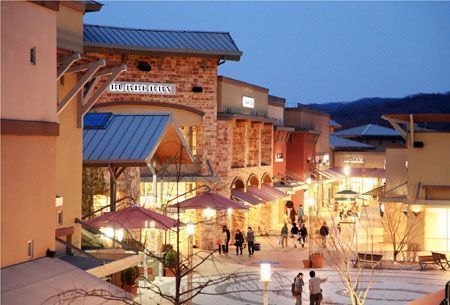
Shinsegae Premium Outlet in Yeoju, Gyeonggi Province
Like Ahn, a growing number of consumers here are shunning downtown department stores and instead heading to outlet malls located in the outskirts of Seoul and other large cities in search of low-priced goods.
To capitalize on this changing shopping trend amid the prolonged economic downturn, retailers are rushing to open new outlets.
According to the retail industry, the sales of local outlets increased by double digits last year from 2011, despite the continued consumption slump.
Lotte on expansion mode
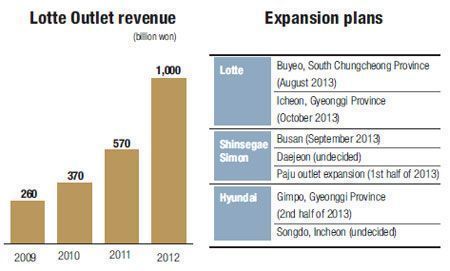
Lotte, Korea’s largest department store chain, said its outlet unit earned 1 trillion won ($910 million) in sales in 2012, up sharply from 570 billion won in 2011 and 370 billion won in 2010.
The department store currently operates seven outlet malls across the country. It just opened a premium outlet at Seoul Station on Feb. 18 in a bid to attract price-conscious shoppers who do not go to outlets in suburbs.
The seasonal sales are why customers rush to outlet stores, hoping to find some bargains before the new season starts. While prices are seen to be the biggest factor attracting shoppers to outlet malls, another reason is that people are simply looking to escape the city and relax.
“Outlet malls have been mainstream retailers in the United States for a long time. But they have just emerged as a major shopping center over the past few years. With the bad economy, consumers are increasingly seeking to buy products at reasonable prices,” a Lotte Department Store spokesman said.
On top of lower prices, shoppers can watch a movie, dine and engage in other leisure activities.
“People go to department stores mostly to shop. They are not family-friendly either. However, at outdoor outlet malls, shoppers can have quality time with their family while enjoying leisure and cultural activities. They are in search of places for outings,” he said.
Lotte will open two new premium outlets this year; one in Buyeo, South Chungcheong Province, in August and another in Icheon, Gyeonggi Province in October. But Lotte has no plan to open any new department stores in 2013.
“We will continue to expand our outlet business for the foreseeable future as long as we secure appropriate sites. We think outlets will become a mainstream retailer,” the spokesman said.
Shinsegae fights back
Shinsegae, the nation’s second largest department store, also plans to expand its outlet unit to meet growing shopping demand from increasingly price-conscious consumers.
Shinsegae Simon, a joint venture between Shinsegae and Simon Property Group, opened the country’s first premium outlet mall in Yeoju, Gyeonggi Province, in June 2007. The firm opened its second outlet mall in Paju in March 2011.
“Outlets have reshaped Korea’s retail industry landscape. Consumers increasingly flock to outlet malls that sell brand items at discounted prices,” a Shinsegae Simon spokesman said. “Besides the price factor, more Koreans seek to combine shopping with leisure and other fun experiences. Outlets are better suited than any other retailers to meet such need.”
Shinsegae and Simon also plans to open a premium outlet in Busan in September to target consumers in the nation’s second-largest city and its adjacent areas.
“We will also finish expanding our Paju outlet by 30 percent within the first half of this year, adding 55 new stores. Korea’s largest outdoor outlet will provide shoppers with more choices,” the spokesman said. “We will also enlarge the Yeoju store next year and consider opening the fourth store in Daejeon.”
The firm declined to make public its sales figures, but said a total of 5.5 million people visited its Yeoju outlet in 2012, up 10 percent from the previous year. The number of shoppers at its Paju store increased nearly 40 percent over the one-year-period.
Hyundai Department Store, the country’s third-largest chain, has also decided to join the fray by opening a premium outlet mall in Gimpo, Gyeonggi Province, in the second half of 2014. It is also considering opening a new one in Songdo, Incheon.
“We are definitely interested in starting an outlet business. We plan to set up stores in Gimpo and Songdo. We have not yet finalized a timetable,” a Hyundai Department Store spokesman said.