Price of being billionaire in China
Why China’s wealthy fear Hurun Rich List
By Oliver Rui
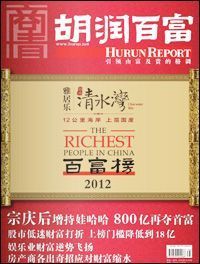
The cover of the Hurun Rich List
China’s unique culture and socialist history, including its traditional Confucian value system, differs greatly from those in Western cultures and thus makes it an ideal laboratory for examining the impact of culture on economic behavior.
Confucian egalitarianism ― “resentment against the rich” ― is quite common in Chinese society. In a poll of Chinese citizens conducted by People’s Daily, 69 percent of respondents viewed the rich “badly” or “really badly” and 91 percent held the view that the rich benefit from political connections, while only 16 percent thought their status to be based on merit.
Even though per capita gross domestic product (GDP) in China has grown by about 9 percent a year on average from 1979 to 2000, lifting a large segment of the population out of poverty, China’s income inequality has risen to become among the highest in Asia.
Besides reporting the assets of China’s billionaires, The Hurun Rich List publishes information relating to the major companies they control as well as their personal details such as age, place of birth and educational background.
Published annually in October or November, it has become one of the most important information sources for the public to get a glimpse of the wealthy class. The responses of the public, media and government to the information have placed the entrepreneurs included on the Rich List and their companies under a rather unfavorable social microscope.
In an effort to study how culture affects economic behavior, an analysis that explores the reactions of investors, governments and entrepreneurs to the publication of the Hurun Rich List, an annual ranking of Chinese billionaires according to their wealth, was done.
For the analysis, an initial sample of the listed companies controlled by the top 50 entrepreneurs on the annual Hurun Rich List for each year from 1999 to 2007 was used. The names of the companies directly or indirectly controlled by the entrepreneurs were collected by comparing the ultimate shareholder data disclosed in the company’s annual report and the names on the Rich List. The sample consisted of 117 companies, 59 of which are listed in mainland China, 46 in Hong Kong and 12 in the U.S.
The findings, published in the paper “The Price of Being a Billionaire in China: Evidence Based on the Hurun Rich List,” shows that investors react negatively to companies that are controlled by the Rich List entrepreneurs and that the market value of these companies drops significantly in the three years following their appearance on the list.
Investors in China regard the inclusion of entrepreneurs on the Rich List as bad news. Investors in the United States, who are mainly influenced by Western values, regard entrepreneurs being included on the Rich List as good news. However in Hong Kong, where Eastern and Western cultures are integrated, the reaction of investors is between that of mainland Chinese and U.S. investors.
Furthermore, due to public pressure, the government tends to scrutinize the Rich List entrepreneurs and their affiliated companies more closely. The entrepreneurs are far more likely to be investigated, arrested and charged compared to other private entrepreneurs and their companies that receive fewer government subsidies after their appearance on the list. They also tend to conceal profits through negative earnings management in order to avoid public attention.
The proportion of entrepreneurs that are charged, investigated or arrested after appearing on the Rich List is 16.95 percent, while the corresponding proportion of other unlisted entrepreneurs during the same period is only 6.84 percent.
Between 1999 and 2007, the wealth of the entrepreneurs on the Rich List increased dramatically. The wealth of the top class increased by at least four times over 10 years; from less than 2.5 billion yuan to more than 10 billion yuan. The wealth accumulation of the Chinese entrepreneurs has been much faster than that of their western counterparts.
Eighty two percent were under the age of 50 when they were first included on the Rich List and one third were under the age of 40. On average, those on the Hurun Rich List are 15 years younger than their entrepreneurial counterparts in the West.
More than 69 percent of the listed entrepreneurs have a college degree or above, which is much higher than the country average in China.
The analysis also shows that the long-term detrimental impact of appearing on the Rich List is more pronounced for affiliated firms in rent-seeking industries, due to the high level of bitterness among ordinary people towards those on the Rich List, who feel that many of the wealthy have used guanxi or official connections to enhance their wealth.
To remedy this, some wealthy entrepreneurs engage in strategic philanthropy. The Hurun Rich List also publishes an annual list of China’s leading philanthropists. When the rank of entrepreneurs on the Hurun Rich List with those on the Hurun Philanthropist List are compared, it shows that public donations can enhance a firm’s reputation and public image, leading to more favorable treatment from the market.
The findings also show that culture, social customs, religion and other informal institutions should be considered when researching the economic behavior of business enterprises.
Oliver Rui is professor of finance and accounting at China Europe International Business School (CEIBS). He co-authored the paper with Xianjie He and Tusheng Xiao of Shanghai University of Finance and Economics