More foreign students in Korean B-schools
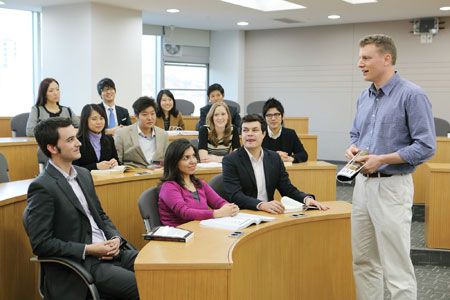
Students listen to a lecture delivered by Joel Evans, right, the professor teaching the Leadership and Career Development course at the SKK GSB, Sunkyunkwan University, northern Seoul, in this undated photo. / Courtesy of SKK GSB
By Kim Da-ye
Korean business schools admitted more foreign students in the second half of this year than a year earlier although foreigners still remain a minority.
A total of 121 foreign students started studying “Korean-style” MBA programs at 13 accredited universities this fall, and that’s 24 more than those admitted in the second half of 2011, according to the Ministry of Education, Science and Technology.
The United States sent the largest number of students at 30, followed by 17 from China, eight from Canada, six from India and six from Uzbekistan. Americans accounted for a quarter of the total foreign students in the 13 business schools while the number of Chinese students shot up to 17 from 10.
The MBA programs have become more diverse in terms of nationalities. The number of the countries where the students come from increased to 40 this year from 34 last year. As of October, there were six Saudi Arabians, four Indonesians, three Iranians and three Mongolians.
The programs defined as “Korean-style MBA” by the education ministry aim to foster managers with international management skills and good knowledge in Korean companies. Thirteen accredited institutions include Korea University, Dongguk University, Sogang University, Seoul National University, Sungkyunkwan University, Yonsei University, Ewha Womans University, Chonnam National University, Chung-Ang University, Hanyang University, Inha University, Sookmyung Women’s University and Konkuk University. The esteemed business school of Korea Advanced Institute of Science and Technology (KAIST) isn’t among the 13 schools.
SKK GSB of Sungkyunkwan University admitted the largest number of foreign students at 27, followed by Korea’s 23, Yonsei’s 21 and Seoul National’s 18.
Sookmyung had the highest portion of foreign students at over 20 percent as of October as its business school as only 54 students. Seoul National also has relatively a small student body of 97, and nearly one out of five students at Seoul National is foreigner.
Forty out of 44 programs at the 13 universities have lectures delivered in English, and 10 full-time programs and two part-time programs are conducted in English language only.
The full-time programs taught only in English language include Global MBA at Korea, General MBA at Dongguk, Global MBA at Seoul National, Asia MBA and Global MBA at Sungkyunkwan, Global MBA at Yonsei, Global Full-Time MBA at Chonnam, Global BRICs MBA at Chung-ang, Global YES MBA at Hanyang and Global Logistics MBA at Inha. The part-time programs were Executive MBA at Sungkyunkwan and Global Part-time MBA at Chonnam.
More than 53 percent of the 721 courses at the 13 universities were taught in English, and that’s up from 47.7 percent in the first half of 2012.
Nine business schools are operating a dual degree program with 24 counterparts in six countries including the U.S., China, Singapore, the U.K, Spain and France.
While the business schools are making a modest progress in attracting more foreign students, their efforts to secure distinguished foreign professors weren’t as effective. The 13 business schools now employ 82 foreign professors, down from 93 professors as of the first half. Fifty five American professors accounted for 67 percent of them.
Korean business schools continue trying to be internationally recognized, and some have succeeded. Sungkyunkwan was ranked 66 in the Financial Times’ full-time MBA ranking while Economist ranked Yonsei University at 83rd in its 2012 full-time MBA rankings. The Financial Times ranked Korea University at 12 and Yonsei at 70 in its 2012 executive rankings.
Nine business schools are accredited by the U.S.-based Association to Advance Collegiate Schools of Business with Dongguk and Chonnam newly certified this year. Two schools, Korea and Yonsei, are recognized by the European Quality Improvement System.
In the meantime, the overall competition in getting into business schools has become less intense than last year. More than 1,400 students applied for the capacity of 1,038. The 1.36-to-1 ratio of this year is lower than 1.55 to 1 last year.
Seoul National’s SNU MBA was the most competitive to get into among full-time MBA programs. A total of 130 candidates applied for 50 seats at Seoul National. Among part-time programs, Chung-Ang’s CAU Leader-MBA had the highest competition with 56 applying for 22 seats.