Vietnam - new Eldorado for Lock & Lock

Lock & Lock Chairman Kim Joon-il
Kitchenware maker to repeat China success in Southeast Asia
By Lee Hyo-sik
Lock & Lock, Korea’s largest kitchenware manufacturer, has emerged as a major brand in China since it entered the world’s fastest-growing consumer market in 2004. Its plastic containers and other household goods are now must-have items for many Chinese homemakers.
Its three plants in China produce tens of thousands of high-quality plastic kitchen containers and other household items every day. Its nationwide distribution network makes timely delivery possible, turning the Korean company into one of the most recognized and trusted consumer goods makers there.
Recently, Lock & Lock has turned focus to Vietnam and other Southeast Asian nations to find new sources of revenue.
In 2009, hoping to repeat its success story in China, the company entered Vietnam, a rapidly-growing economy with a population of nearly 100 million. Currently, Lock & Lock operates two plants in the Southeast Asian nation, producing a wide range of heat-resistant glass wares and other high-tech items.
“Despite concerns over the continued global economic downturn and geopolitical risks associated with North Korea, our business has remained robust thanks to strong consumer markets in China and Southeast Asia,” Lock & Lock Chairman Kim Joon-il said in an interview with The Korea Times.
“Our sales will continue to expand at a sustainable pace this year and beyond, making it possible for us to become the world’s No.1 household goods maker by 2020 with revenues of 10 trillion won ($9 billion),” he said.
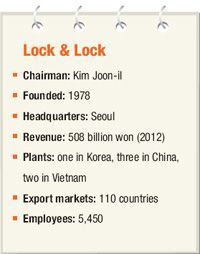
Lock & Lock, founded in 1978, earned revenues of 508 billion won in 2012, up 7 percent from 476 billion won the previous year. The company operates one plant in Korea, three in China and two in Vietnam, selling plastic kitchen containers and hundreds of other items to 110 countries.
Expansion into Vietnam
“Using our success in China as a springboard, we will seek to become a national household brand in Vietnam. Our Vietnamese plants cater to increasingly wealthy consumers there. They also act as our export base for other markets, namely Indonesia and other Southeast Asian nations,” Kim said.
Lock & Lock decided to set up manufacturing facilities in Vietnam as it had become more expensive to produce goods in China due mainly to surging labor costs. Its Chinese plants, which used to be the firm’s export base, now make goods only for the local market.
“It is about 15 percent cheaper to produce goods in Vietnam than China thanks to the lower wages,” the chairman said. “The nation is now our headquarters for Southeast Asia. To capitalize on the region’s fast-growing consumer market, which expands by 50 percent annually as China did in the 2000s, we will open dozens of flagship stores to strengthen our brand image and produce diverse, high-quality products.”
Lock & Lock also plans to advance into South Asia, the Middle East and Africa over the next decade to achieve its ambitious goal of becoming the world’s largest household goods brand by 2020.
“After Vietnam and Indonesia, we will head into Pakistan, Bangladesh, India, Turkey and the Middle East. In the end, we will move into Africa. I would like to see our products sold in every corner of the world,” Kim said.
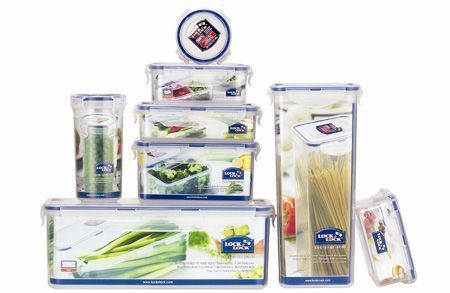
Lock & Lock’s plastic kitchen containers
Future plans for China
Lock & Lock has achieved a remarkable success in China since the company began operating its first plant there in 2004. It earned 260.5 billion won alone in China last year, up 23 percent from 2011. This accounts for 51 percent of the firm’s entire revenue.
“Our China business has been expanding at an explosive pace over the past decade. We are now one of the most trusted consumer goods brands in the world’s fastest-growing economy with a population of 1.3 billion,” the chairman said. “We expect our China operation will continue to flourish down the road.”
The company used Daejanggeum (Jewel in the Palace), a TV drama featuring Korea’s traditional costume and cuisine, as its early-stage marketing tool to create a premium brand image. It hired one of the drama’s leading actresses as a commercial model.
The drama, which aired in Korea in 2005, was immensely popular among Chinese TV viewers, giving rise to the “hallyu” boom on the mainland.
To boost its brand value as a product made by a Korean company, Lock & Lock opened dozens of stores in Beijing, Shanghai and other large cities.
Korean products often have the edge with many Chinese consumers who tend to believe made-in-China goods are less trustworthy because of the various defects and health scares over the years.
Products made by Korean firms are viewed as being safer and more reliable, making China a particularly welcoming market.
Lock & Lock markets kitchen containers and other kitchenware, but they also have introduced baby products and skincare items to diversify their source of revenue.
“Our sales in China have and will continue to increase at a robust pace. This is possible thanks to our own extensive distribution network sustained by logistics hubs in major cities,” the chairman said. “We have over 100 independent shops and an online store. We also sell our goods through China’s department stores, discount retailers and home shopping channels.”
In the end, Kim wants to transform Lock & Lock’s China business into a distribution powerhouse. “We will continue to make and sell innovative and affordable household items in China. At the same time, we will further strengthen our distribution capability so that we can help other Korean companies market their products in China.”
Cosmetics, outdoor and other Korean companies have asked Lock & Lock to deliver and market their products through its distribution network, according to Kim.
“We help deliver and sell Amore Pacific’s Innisfree cosmetics and Nongshim’s Shin Ramyeon through our distribution channel. We add two or three Korean companies to our delivery list each year. But in the future, we would like to include at least 10 new items in the list every year,” the chairman said. “Lock & Lock will do the same thing in Vietnam. Once we establish a strong distribution network, we will lend a hand to Korean companies in marketing their products.”
Maintaining status quo in Korea
However, Kim is not as enthusiastic about Lock & Lock’s business in Korea, saying it will only maintain a status quo.
“With our overseas business expanding, a portion of our local operation has and will shrink. It will soon account for less than 15 percent of our revenue,” the chairman said. “Just as with Japan, the United States and other advanced countries, doing business has become less profitable in Korea due to high logistics and sales costs.”
Lock & Lock earned only 164 billion won in Korea last year, down 17 percent from 2012.
Kim said the company has no plan to build a new plant here. “We will maintain our current operation for the sake of our workforce. But I do not want to expand domestic production.”
Kim said the company also closed its subsidiaries in Italy, Hong Kong, the United States and three other advanced markets in 2012, citing huge losses.
“It does not make sense to set up a subsidiary in advanced countries because we cannot make money due to high labor, logistics and other expenses. We will supply our goods to department stores and other retailers there to let them sell on our behalf. This makes more economic sense,” he said.
Instead, Lock & Lock plans to mobilize more resources and manpower to target emerging economies, Kim said, stressing that its future lies in rapidly growing consumer markets in Asia and Africa.
Item diversification and quality control
Lock & Lock will introduce a wide array of household goods made of heat-resistant glass, stainless steel and other high-tech materials in a bid to meet diversifying consumer needs, Kim said.
“I think kitchen containers and other items made of environment-friendly plastic will continue to remain the best-seller for us. But to satisfy diverse consumer demand, we need to make household goods using other materials,” the chairman said.
Its Vietnamese plants produce a variety of households items made of heat-resistant glassware, which are widely popular in the United States and Europe. Lock & Lock’s glass products are largely designed for consumers in advanced markets who make or warm food in a microwave oven.
“We think more consumers in Korea, China and Southeast Asia will follow the Western pattern, which will increase demand for our glassware,” he said.
The company has been outsourcing the production of a growing number of items, making quality control one of its top priorities. Kim stressed that Lock & Lock has been maintaining the quality of its products both produced at its plants and those of its partners.
“Many businesses choose to build their own plants to maintain quality control and meet the deadline for delivery. But this requires a large amount of capital. So, as long as quality is maintained and the delivery time is met, it makes more sense businesswise to outsource production,” the chairman said.
When asked about the pros and cons of taking the company public, Kim said he has to spend more time to meet with analysts, investors and other stakeholders.
“We went public in January 2010 to raise capital to finance our overseas expansion. But I have to devote more time to meeting with stakeholders who often force me to run the company in the interests of shareholders,” the chairman said. “They are mostly interested in short-term performance and stock prices, not about the company’s long-term growth. It was and still is difficult to make a compromise with them.”