Stronger presence
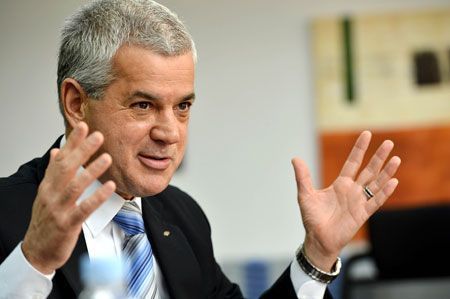
Sergio Rocha, GM Korea President and CEO / Korea Times photo by Shim Hyun-chul
GM Korea aims at 20 percent market share
By Kim Da-ye
General Motors has recently announced that it will invest about 8 trillion won in its Korean affiliate over the next five years, a clear signal of its strong commitment to the Korean market.
GM Korea President and CEO Sergio Rocha, who has recently celebrated the first anniversary of taking office, considers this investment is a strong sign of commitment. He is confident about the years to come.
The scale of investment is huge given the fact that GM has invested about 10 trillion won in its Korean unit in the past 10 years.
Rocha promised to increase last year’s 9.5 percent local market share to 20 percent in the future. “I would not predict who is going to lose (due to our growth), but I can guarantee we will work hard to increase (our market share),” Rocha said during an interview with The Korea Times at GM Korea’s headquarters in Bupyeong, Incheon.
He said some of the major local automakers’ market shares have already been decreasing, while GM Korea and foreign brands have been aggressively strengthening their presence.
Rocha has every reason to be more confident because the company has concrete plans to reach the goal step by step. In fact, the company announced an investment plan as part of its new vision, named “GMK 20XX — Competitiveness & Sustainability” (GMK 20XX).
Rocha said the blueprint reflects the automaker’s determination to continue the success of its business in the next several decades. “It has two pillars, the first of which is competitiveness and the second sustainability. And it is very simple. The more competitive we are, the more sustainable we are going to be,” Rocha said.
To achieve sustainable growth while securing competitiveness, the firm will concentrate on strengthening its Korean market base, its global design, engineering capability and global CKD (complete knockdown) capability, he said.
Better recognition
Rocha emphasized that GM Korea will continue to play an important role within global GM, and that the automaker needs better recognition given its contribution to society and the economy. “GM Korea is today probably the second-largest American business in this country. This is why we deserve better treatment. Korea was, is and will continue to be a major operation for GM,” he said.
The Korean unit of the auto giant will specialize in mini and small cars, with the GM Korea Design Center and Engineering Center developing products in those segments for GM on a global basis.
The firm operates five manufacturing facilities in Korea, with about 21,000 employees working in its core automotive business. In 2012, it sold 145,702 vehicles in Korea and exported more than 1.9 million complete vehicles and vehicle kits.
Over the past few years, GM Korea has tried to wipe out its old image associated with GM Daewoo, which it used until 2011 after it acquired troubled Daewoo Motors in 2002. GM Korea officially launched the Chevrolet brand here, saying goodbye to Daewoo, a name that had endured here for the past 28 years.
Since the launch of the Chevrolet brand, the firm developed 11 new products to provide more options for Korean customers, he said, adding that the old GM Daewoo brand was a disappointment. Now, the automaker has been building a new image for their different brands — Chevrolet and Cadillac — here in Korea.
“With Chevrolet, we want Koreans to understand its power in innovation and ingenuity. With Cadillac, we want them to see it as state of the art,” he said. “We are offering Korean consumers options to choose from. Chevrolet and Cadillac offer opportunities for them to enjoy different things.”
In line with the effort to expand its lineup here, the firm has recently launched various models. The Chevrolet Trax, introduced in February, is a totally new concept in automobile that combines the power of an SUV, a spacious interior and sedan-like comfort.
The company expects the model will create a new market for urban-life vehicles.
It has also unveiled the Chevrolet Spark, an electric vehicle that made its Asia premiere at the Seoul Motor Show last week. In January, the Cadillac ATS, a luxury compact sports sedan, was launched here as well, to compete with cars like the BMW 3 Series.
Future goal and challenges
The company plans to expand the design center at its Bupyeong headquarters in order to become GM’s third-largest globally, right after those in the U.S. and Brazil. The center will double in size, with construction to be completed by the end of this year.
The company also said it will produce six next-generation GM vehicles for global sales and power trains, including mini, small and mid-size cars, as well as GM’s first fully electric vehicle for international markets.
But GM Korea also faces challenges that it needs to overcome. One of them is the weakening yen, which can undermine the competitiveness of Korean automakers. This issue is very critical to the company, as it is one of the U.S. group’s biggest foreign units and exports more than 80 percent of the vehicles it produces.
Even after a retreat over the past two months, the Korean won has strengthened 6 percent against the greenback since late May last year. But this increase is small compared to the 27 percent rise of the won against the yen over the same period.
Rocha hopes the government will address its strengthening currency. “If we lose competitiveness here, it may impact the sustainability of the business,” he said.