Taking Korean hospitality to world

Song Yong-dok, Lotte Hotel CEO / Korea Times photo by Shim Hyun-chul
By Lee Hyo-sik
Korean hotels remain largely domestic, but Lotte Hotel, Korea's largest hotel chain, is trying to buck this trend. Under its "Vision 2018" initiative, CEO Song Yong-dok plans to enlarge its chain to 40 hotels, 15 outside the country.
This will make Lotte the third largest hotel brand in Asia, but Song has a bigger plan ― making Lotte a global brand that rivals Hilton and Hyatt.
In an interview with The Korea Times, Song unveiled his vision on how to transform Lotte into a globally-competitive hotel chain.
“Like other industries, hotels have to enter foreign markets if they want to survive in an increasingly globalized world,” the CEO said. “Local hotels cannot remain complacent only catering to locals and foreign tourists visiting Korea. They should actively pursue growth beyond our borders.”
Song said Lotte is in a much better position than its domestic competitors to move into foreign markets, adding that the success of its Moscow unit has boosted its globalization campaign.
“Our Moscow hotel, which opened in 2010, has been very successful. It is now the top hotel in Russia’s capital city. We are ready to repeat that success story elsewhere.”
Song was named CEO after successfully putting Lotte Hotel Moscow in a stable position within a year and a half of its opening. He stayed in Russia from 2008 to 2011, overseeing the construction and operation of the hotel.
According to Song, Lotte has accumulated extensive management know-how over the past three decades. He notes that it is more competitive than top global hotel chains in customer service and operational efficiency.
“Shangri-La, Mandarin Oriental and The Peninsula are Asia’s top three hotel franchises. I am 100 percent positive that Lotte will replace one of them by 2018,” Song said. “We will open more than a dozen hotels in China and Southeast Asia over the next few years.”
In March, Lotte opened its second global branch “Lotte Legend Hotel Saigon” in Ho Chi Minh City, Vietnam. The hotel is managed by veteran hoteliers from the Seoul headquarters, and provides world-class services to local and foreign customers.
Lotte plans to open a hotel in Hanoi in 2014 and in Shenyang in 2017, among others.
Domestically, it places top priority on opening new budget hotels across the country in a bid to accommodate an increasing number of foreign tourists. Lotte currently manages five five-star and two budget hotels in Korea, as well as a luxury resort hotel.
Besides several business hotels scheduled to open across the country over the next few years, a luxury hotel will be built at the second Lotte World recreation complex in southern Seoul in 2016. In 2017, Lotte will open a six-star hotel in Busan.
“We will spend more resources to finance our overseas expansion. We would like to see dozens of hotels operate under the name of Lotte all over the world. In the short term, we will concentrate on becoming one of the top three brands in Asia. We will then advance into Europe and North America,” Song said.
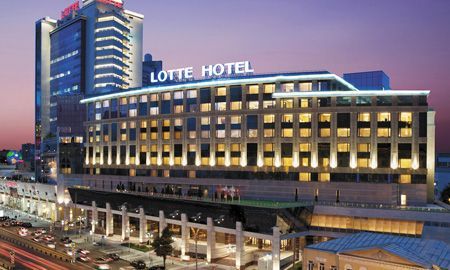
Lotte Hotel Moscow
Going beyond Asia
The CEO considers Lotte Hotel Moscow a stepping stone to entering the advanced markets, saying the hotel has attracted keen attention from the United States and European nations.
“About 50 percent of the customers at the Moscow hotel are Europeans, followed by Americans at 20 percent. They are pleasantly surprised when they learned the hotel was built and is operated by Koreans,” the CEO said. “Lotte offers what other hotels in the city don’t. On top of state-of-the-art facilities, we provide second-to-none, personalized customer services. Hoteliers dispatched from Seoul train local employees to deliver ‘Korean-style’ hospitality.”
It is not uncommon for employees to argue with, or even engage in physical confrontations with customers at Western hotels. But this would be unthinkable at Lotte and other Korean hotels.
“We rigorously train our Russian employees to offer considerate, customer-oriented services at all times, under any circumstances. But other hotels in Moscow don’t do this,” Song said. “Some of our guests are real estate developers. While I was in Moscow, some developers apparently impressed by our exceptional services asked me to place a Lotte hotel in their buildings in Europe and the United States.”
Song said Russians and Europeans do not know much about Korea, adding that the hotel acts as a goodwill ambassador for Korea. “When guests stay at our Moscow hotel, they naturally learn that it was built and is managed by Koreans. The Korean ambassador to Russia is a frequent guest. He holds all his business meetings at the hotel to let his counterparts know it is Korean. The hotel has helped improve Korea’s image in Russia.”
The CEO said Lotte will construct and operate most of the hotels it plans to build in Asia. But the company will mostly lease buildings to open a hotel or only outsource management to foreign hotels that operates under the name of Lotte.
“It costs hundreds of millions of dollars to build a single hotel. Asia is a rapidly growing market so constructing and managing hotels makes sense economically,” the CEO said. “But in Europe and other advanced markets, it is too risky to do so. We would like to create a hotel franchise that operates under the brand name of Lotte by exporting our management knowhow.”
The company plans to manage 15 facilities overseas by 2018 and dozens more in the long term, on its path to becoming a truly global player.
Recognizing customers
In order to become an international hotel brand, it is crucial that Lotte receive positive feedback from customers, Song said. “Recognizing the needs of each guest is at the core of our customer service. This means we offer customers what they are looking for before they even ask. For instance, we will have their preferred type of pillow ready in advance or we will set the room temperature according to their preference before they even arrive.”
Lotte has and will continue to build an extensive customer database so that when guests stay at its hotels, it can provide optimal services, the CEO said.
“We are making every effort to create a ‘home away from home,’ the most comfortable environment for each guest. Our goal is to be No. 1 in all international hotel rankings,” Song said. “Lotte will continue to improve in being able to offer what customers are looking for. If we take our system and passion for excellence abroad, I am positive that we will also be immensely successful there.”
Catering to Chinese tourists
Song said Lotte’s domestic chains will be reorganized to target the increasing number of Chinese tourists, indicating that it will build more low-cost hotels in Korea.
“Last year, more than three million Chinese visited Korea. The number is widely projected to reach 10 million by 2020,” Song said. “This means that hotels and other hospitality-related businesses have to cater to Chinese mainlanders. But building five-star hotels is not the answer because many cannot afford to stay at luxury lodging facilities.”
He said even its business hotels in Gimpo and Mapo, which normally charge between 150,000 won ($135) and 200,000 won ($181) per night, are expensive for many Chinese tourists. “Hotel operators need to build low-budget hotels that charge below 100,000 won if they want to accommodate the Chinese,” Song said.
The CEO said Lotte will also try to attract wealthy Chinese visitors who can afford to stay at its five-star hotels. “We will implement a two-track approach. Our low-cost facilities will cater to Chinese visiting Korea in group via travel agencies, while our luxury units will target wealthy foreign independent travelers by offering state-of-the-art customer services.”
Song also said Lotte will build the world’s largest Universal Studio theme park in Hwaseong, Gyeonggi Province, in order to attract Chinese and other Asian tourists.
“We plan to build the theme park much larger than the ones in the United States and Japan. It will have not only entertainment facilities, but also hotels, shopping malls, cinemas and other leisure amenities. It will become one of the world’s largest entertainment landmarks,” he said.
When asked about whether Korea should nurture the casino industry as a magnet for foreign tourists, Song said it is a highly value-added business and an effective tool for attracting foreign visitors.
He said it would be fine to build more casinos catering only to non-Koreans. “But building more places for Koreans will cause serious social problems.” Currently, Kangwon Land is the only casino where Koreans can gamble.