'Gender quota can change society'
Ewha President says Korean firms failed to nurture female talent
By Kim Da-ye
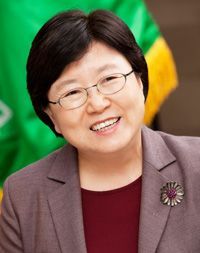
Ewha Womans University President Kim Sun-uk
When Ewha Womans University President Kim Sun-uk visited Saudi Arabia in mid-February, the Middle Eastern country was just about to swear in 30 women to the previously all-male Shura Council. The council can propose laws like a parliament but cannot pass them in the monarchical system. Women now make up one-fifth of the 150-member advisory body to the king.
In Saudi Arabia women aren’t allowed to drive or travel alone, but Kim witnessed dramatic progress in women’s rights that Korea is yet to achieve. At the heart of that progress is a gender quota.
“In the Korean National Assembly, there are only 47 female lawmakers,” Kim, a law professor and the former minister of government legislation, said in an interview with The Korea Times’ Business Focus. “To match the portion of women at the Shura Council, there should be at least 60 women out of the 300 lawmakers. In a way, it took Saudi Arabia a shorter time to achieve what we have fought for for decades.” In Korea, just 50 percent of 54 proportional representation lawmakers are required to be women.
Kim was on an eight-day trip to Riyadh, the capital of Saudi Arabia, to deliver a speech at the Women’s Higher Education Symposium hosted at King Saud University. She was also there to discuss academic ties between the universities.
Kim hopes the efforts made by the Saudi king to be replicated here, especially in business sector. The gender quota isn’t just about boosting the number of female executives in companies, Kim said. She feels it is more about changing society’s perception of gender roles.
“First, companies will try to analyze the ‘failure factors.’ They will have to figure out why the companies haven’t nurtured female leaders. There will likely be complex causes that have hindered women from getting promoted, and companies will come up with solutions. That process can have a profound impact on corporate culture and the working environment,” Kim said. “Acknowledging that there is indeed discrimination is very important. The gender quota system has a huge impact.”
Kim added that companies may complain that they lack mid-level female managers to promote to executives, but the gender quota would actually force them to begin training women for mid-level management positions.
In January, 62 lawmakers submitted a bipartisan bill that requires 28 state-owned companies and 83 quasi-government organizations to appoint women to at least 15 percent of executive positions within three years and 30 percent within five years.
This is not the first time the government has discussed the gender quota. The Lee Myung-bak administration pledged that it would introduce the quota. In 2007, the government included in the human resources guidelines for public entities a clause that recommended boosting the portion of female executives to 30 percent.
However, because it was only a recommendation, it did little to improve the representation of women in the industries. The number of female executives in public institutions actually dropped from 8.7 percent in 2008 to 8.5 percent in 2010, according to local newspapers. Now that the country has its first woman president, though, many people expect that percentage to rise.
The gender quota of 30 percent will, of course, face plenty of opposition from both men and women. Some argue that the measure constitutes discrimination against men. Others say that, due to the lack of mid-level female managers, many organizations will have to hire externally. This, they claim, isn’t fair to the women who started from the bottom and worked their way up. In Saudi Arabia, some religious leaders opposed the appointment of women to the Shura Council, claiming that it was against sharia, or Islamic law.
Korea isn’t the only country that eyes a gender quota as a solution to promote equality. The European Union (EU) is in the middle of a heated debate over whether or not all 27 member countries should adopt a law that requires companies to appoint women to 40 percent of board member positions.
Norway, for instance, imposed a binding quota law back in 2005, requiring listed and non-listed firms, and state-run companies to do so, according to a 2012 report by the European Women’s Lobby.
Despite much opposition from the industry at the beginning, the country now has the largest portion of female board members than any other country at 36.3 percent, GMI Rating’s 2012 Women on Boards survey showed.
Other EU nations including France, Italy, Belgium, the Netherlands and Spain followed suit, and firms based there are striving to meet the goal. Meanwhile, Germany has shown a strong opposition against the EU move toward a gender quota.
Kim, the country’s first female minister of government legislation, who has spoken out about women’s issues, said that the poor representation of the gender in the industries isn’t due to a deficiency among women.
“The reason many highly qualified women take state exams [to become public servants] is that there is discrimination against women in other sectors,” she said.
Furthermore, working women with children are often considered less responsible than their male counterparts because, it is claimed, they may prioritize childcare over work or cannot concentrate on work as much as men do. Kim argued against such prejudices, saying that the society should recognize that childcare isn’t just the responsibility of women.
“Women are asked to be more responsible with their work, but there should be an awareness that childcare is also the corporation’s and the country’s responsibility,” Kim said.
Korea’s first Nobel laureate will be from Ewha
Ewha Womans University has long been considered an incubator of female leaders. They include Hyun Jeong-eun, the chairwoman of Hyundai Group; Sohn Byoung-ok, the first female CEO of Prudential Life Insurance Korea; Lee Myung-hee, the chairwoman of retail giant Shinsegae Group and Romi Haan, the founder and CEO of steam cleaner manufacturer Haan Corporation. Kim, who was elected the president of Ewha in August 2010, majored in law in the same school.
In recent years, however, Ewha has faced steep competition from coeducational conglomerate-sponsored universities. In 2011, its ranking by daily newspaper JoongAng Ilbo dropped below the top 10, behind Kyung Hee University and Inha University. Ewha had traditionally been among the top 5 institutions in Korea, after Seoul National University, Yonsei University, Korea University and Sogang University.
In general, women-only universities are struggling, as the younger generations, who aren’t as aware of the gender gap, do not see an advantage to studying in a single-sex school. The underrepresentation of women across different sectors also means that women-only institutions tend to have a smaller alumni network of working professionals.
Under Kim’s leadership, in an effort to retain its reputation, Ewha has focused on two areas: scientific research and globalization.
While science is often considered to be a weak area among women, Ewha is one of the few universities with both its own medical schools and hospitals. It also, in the 1990s, launched the world’s first engineering college for women.
One of the school’s latest achievements was securing a $21.5 million investment from global chemical company Solvay to build a research facility on its Seoul campus. Solvay’s Korean Research, Development and Technology Center and the headquarters of its Global Business Unit Special Chemicals are under construction and are expected to be completed by early next year. The center will focus on electronic chemicals, lithium-ion batteries and photoelectric cells.
Kim noted that the influential Solvay Conferences are organized by the International Solvay Institutes for Physics and Chemistry, which was created by the founder of the Solvay chemical firm. The fifth conference, held in 1927, was famous because 17 of the 28 attendees were Nobel Prize winners, including Marie Curie, a female pioneer in researching radioactivity.
“The ambition we share with Solvay is that Ewha will foster the country’s first Nobel laureate in the field of science,” Kim said.
Globalization is another of Kim’s goals. Visiting Saudi Arabia is part of her efforts to boost Ewha’s global network.
Ewha sent 899 of its students to overseas partner universities in 2011, while hosting 593 from abroad. In 2011, nearly 19 percent of the foreign students came from Japan, 15.3 percent from France and 13.7 percent from the U.S. As of October 2012, students from 63 nationalities were enrolled in degree programs at Ewha.
One of the international programs Kim is proud of is the Ewha Global Partnership Program, which began in 2006. Between 2006 and October 2012, the scholarship program has provided free higher education—bachelor’s, master’s and doctoral degrees—to 140 female students from 34 developing countries.
Kim sees this outreach as a continuation of Ewha’s founding beliefs. “A woman missionary, Mary F. Scranton, founded Ewha Haktang, which became today’s Ewha Womans University,” she said. “We hope the foreign students we host at Ewha will return to their home countries and play the same role.”
Education is key
For Kim, Saudi Arabia remains a country of contrasts. When she met the chancellor of King Saud University, only male professors were present, as female professors couldn’t be in the same room with men. Further, at the opening ceremony of the symposium where she delivered a speech, men sat on the first floor and women on the second floor, she recalled.
The positive changes she saw were occurring mainly in the education sector. She said Saudi Arabia is investing heavily in education as it tries to shift from an oil-dependent economy to a knowledge-driven one. She noted that 50 percent of college students and 70 percent of doctoral students are women. The country’s Princess Nora bint Abdul Rahman University is now the world’s largest women-only university in the world—a title Ewha had previously held.
“The separation of women and men we saw in Saudi Arabia is what we might have seen 50 or 60 years ago in our country,” Kim said. “It hasn’t been that long since the patriarchal family system was abolished in Korea. Feminists fought against it for some 50 years, but it had been preserved in the name of tradition and custom. Much [unfairness toward women] in Saudi Arabia is similarly justified as tradition and custom. I wanted to tell them that these issues could be solved by educating women and with international solidarity.”