“Hard work drives creativity for success”

Korea Times photo by Shim Hyun-chul
Kolmar Chairman Yoon Dong-han stresses ‘blue-collar’ diligence
By Bahk Eun-ji
Apple founder Steve Jobs was quoted as saying “Innovation distinguishes between a leader and followers,” leaning credence to his cherished life-long belief in the power of creativity. Here in Korea, there is an individual who wants to go one step further.
He is Kolmar Korea Chairman Yoon Dong-han, who founded the Seoul-based cosmetic producer two decades ago and catapulted the company to becoming the foremost player in the industry here.
“Patience and diligence are the key to making outstanding and competitive products. When a few intelligent people come up with creative ideas, many diligent people lead it to completion by repeating the same experiments over and over again,” he said in a recent interview with Business Focus.
He added that “In that sense, research and development (R&D) is more about who is capable of carrying out long and tedious tasks rather than finding innovative ideation. That is especially the case in the cosmetic industry.”
On the strength of this approach, Kolmar Korea has remained ahead of the pack for a long time. Without its own retail brand, it churns out cosmetics to provide them to various other companies. It also deals in drugs and health food.
It is not too much to say that almost every cosmetics firm in Korea buys Kolmar’s products. More than 200 companies have signed contracts with it. Kolmar Korea has 108 of its own patent rights, 1,715 ingredients that were approved by the Korea Food & Drug Administration (KFDA) and its annual revenue is around 400 billion won.
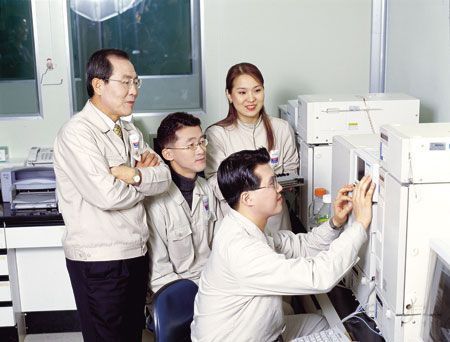
Kolmar Korea Chairman Yoon Dong-han, left, and researchers monitor experiments on a new ingredient for cosmetics at the company’s skincare research center in Sejong City, South Chungcheong Province. / Courtesy of Kolmar Korea
Cartesian solution
Although Yoon stresses the significance of “blue-collar” diligence in research, which he calls an inductive way, he does not disregard the importance of innovators, who can see the future path of an industry, such as Steve Jobs.
“A deductive approach is also significant because we need to fix the direction of our work. Then, an inductive approach should follow to fine tune the details,” he said.
“I am not saying that the former is not crucial, but saying that the latter is more indispensible in our industry.”
To gain insight into the inductive approach, Kolmar maintains a special team composed of less than 10 visionaries. They are picked among researchers and are nurtured to become foretellers of trends in corporate industry.
The specialists are those who present the “Cartesian solution,” as they grapple with the inductive mission of predicting the future of the industry _ induction was a lifetime quest of French philosopher Rene Descartes.
“There are two groups of researchers ― those with the virtues of blue-collar diligence and those with innovative insight. Innovative guys are qualified to become the select few members of the special team,’’ he said.
R&D, key to success
Without regard to whether the firm puts either innovation or blue-collar diligence on the front burner, the company’s top priority has always been R&D since its inception in the early 1990s.
Experts deem the research prowess and its resultant technological advantage as one of the primary competitive edges of Kolmar.
Yoon also acknowledged that the intensive investment in research has been the key to the success of the original design manufacturer (ODM), which refers to an entity that designs and makes products but sells them under other brand names. It is otherwise described as contract manufacturing or private labeling.
“Kolmar Korea is the first company that brought ODM as a main business model. R&D has played an instrumental role thus far and cultivating talent is also the key factor to make successful R&D,” Yoon said.
Yoon said that the cornerstone asset in research is people ― Kolmar Korea is also famous for its unique style of training and education that makes employees serve the company for extended periods of time with the aim of generating a sense of loyalty within the company.
Yoon pointed out that unlike conglomerates his company is incapable of offering huge salaries to its employees. Instead, he tries to offer his employees alternative incentives in the form of support to pursue advanced education such as Ph.D.s all with the goal of retaining them.
Currently, around 30 percent of its 600 employees or so are researchers and about 6 percent of annual revenue is earmarked to R&D.
With this budget, researchers are encouraged to take Ph.D. courses with Kolmar covering the expenses. They are not required to keep working for the firm after getting doctorates but few leave the firm.
“It is important to trust people. Although they are allowed to leave the company after getting a Ph.D. without any penalties, they hardly do so. They are the driving force of our success,” Yoon said.
There are about 30 researchers who have served more than 10 years and who received their doctorates during their period of working here.
Its unique R&D system testifies to just how much the company prioritizes investing in its employees.
“Leading companies can stand out thanks to its workers after all. The cost of educating employees is not merely a personnel expense, but a sort of investment,” he said.
Yoon noted that last month’s decision of embracing a holding company system also has to do with the desire to attract more talented people.
In order to improve the quality of researchers, Yoon also sends them to its joint company Kolmar Japan regularly for training and exchange research to build their capacities. He believes that nurturing talent takes time.
Thus, they must be given more trust over an extended period of time and then they finally make the most their abilities for the company. The core value in the manufacturing business is how much talent they can attract, not how many products can be produced.
“Mid-sized companies can grow with conglomerates, provided that they assign much more outlay to the R&D sector, which means investing in employees. It is much easier for mid-sized companies because they have a faster decision making processes than large firms,” he said.
ODM: Kolmar style
Kolmar Korea is the nation’s first cosmetic company that initially introduced and established the new business model, ODM. Kolmar Korea has stood for its technical advancement and leadership in the industry by extending its market share by to up to 40 percent and has annual sales of around 400 billion won.
ODM is a sort of “outsourcing” and manufacturing system that a company employs to design or manufacture a certain product, where a producer company like Kolmar is actively playing a leading role to develop new products, such as cosmetics, in the case of Kolmer, with its new ingredients or new technology through (R&D).
When the company develops products, sales partners usually have their own brand request manufacturing and delivery for the products. It’s similar to original equipment manufacturing (OEM) but the main difference is that OEM is just making goods in accordance to the prescription of the contractor companies.
Yoon said that ODM is one of his successful strategies for making the company an industry leader.
He tried OEM for a couple of years after the company was setup in 1990, however, he was soon to realize that it lacked the differentiated capacity to spur the company into a competitive position.
“It’s hard to be successful in a business without having technical skills especially for small and mid-sized companies. Technical development is the top priority in order to stay competitive with major conglomerates, and survive in the market,” he said.
When Kolma Korea was established, the business system of major cosmetics companies such as Amore Pacific, Hankook Cosmetics, Hanbul Cosmetics and Coreana was different from Kolmar’s.
They were directly involved in the whole process, from planning and manufacturing to delivery. By contrast, the systems of leading companies in Japan and the United States at that time were completely separated into manufacturing and sales for professionalism and efficiency.
“That’s why I was convinced that the manufacturing business held great promise for the future, provided that it was based on technology,” the CEO said.
Renaissance of brick-and-mortar firms
Yoon firmly believes the renaissance of brick-and-mortar companies is up and coming in Asia’s fourth-largest economy.
In the past, the largest market used to be the United States, but the title now belongs to China. Still the technical skills of the U.S. are more advanced and they are reluctant to work with Chinese companies due to concerns over technology leakages.
Besides, made-in-China products are generally believed to be competitively priced but lack quality.
Indonesia can be another alternative because it has emerged as a manufacturing base but the quality of its products falls short of the global norm. Overall costs are higher in Japan and the U.S., so they are certainly bound to lose price competitiveness.
Yoon said that Korea’s cosmetics and pharmaceutical industries are far more advanced than the home appliance and shipbuilding industries in China.
It would be hard to maintain the dominance of the electronics and ship construction industry down the road, but Kolma Korea would be able to beat its Chinese rivals in the future as the cosmetic and pharmaceutical industries are where technological prowess remains an indispensable factor _ he thinks that Chinese latecomers would not be able to easily copy Kolmar’s cutting-edge technologies.
Who enables so many brands?
The sluggish domestic economy has prodded consumers to buy low priced cosmetic products that resulted in the advent of many budget shops such as Missha, The Face Shop, Innisfree and Tony Moly.
Yoon said that Kolmar has enabled them to dominate the market. The corporation has developed and provided high quality products to those shops, selling them at reasonable prices that satisfy consumer’s desires.
Yoon noted that he has never thought that Kolmar Korea is competing with other cosmetics companies.
“It is not just a competition, but a ‘co-petition,’ or cooperation plus competition. If more rivals jump into the business, they will help enlarge the market size.”
Who is Yoon Dong-han?

Kolmar Korea CEO Yoon Dong-han
Yoon Dong-han is CEO and chairman of Kolmar Korea. He is also a chief vice president of the Korea Industrial Technology Association, which encourages small and mid-sized enterprises to grow through decisive investment in research and development.
He has always been far-sighted and devoted himself to achieving something. Before he established Kolmar Korea, Yoon started his career in the financial sector.
But he wanted to learn various tasks at a different position, which prompted him to move to Daewoong Pharmaceutical where he worked for about 16 years. Thanks to perseverance, he rose through the ranks to become a deputy head at Daewoong, but he felt a thirst for running his own business. Although everyone said that it was too risky to quit a stable job at the senior executive level, he decided to take the challenge and founded Kolmar Korea.
He was convinced a manufacturing business — especially cosmetics and pharmaceuticals — would be very promising, provided that it would be firmly based on high technological skills.
Kolmar Korea was founded with three employees and it now employs more than 600 people with around 400 billion won in annual sales.
“The most important thing is to have a dream and put forth ceaseless efforts to make it come true,” Yoon said.