Lessons from memory
Can solar energy be South Korea’s next semiconductor?
By Kim Da-ye
No good news has been heard from the suppliers’ side of the solar power industry for too long.
Demands from the debt-crisis-struck Europe, the largest market for photovoltaics, have shrunk while a glut of aggressively priced solar cells by Chinese companies left manufacturers in developed countries struggling. While many Korean firms including Samsung SDI and Hyundai Heavy Industries have cut their planned investment into solar power due to the persisting grim outlook, one conglomerate surprised the industry with a decision against the trend.
Woongjin Group led by Yoon Seok-keum, a former Britannia salesman who built up a conglomerate from scratch through bold decisions, announced in February that it would sell off the cash cow water purifier business Woongjin Coway in order to focus more on the solar business carried out by Woongjin Energy and Woongjin Polysilicon.
The story of a deadly cost-cutting competition that force most players to give up the business and audacious decision makers who would change the future of their firms forever may be familiar to Koreans.
The semiconductor industry, specifically the memory chips sector which Korean firms lead, has trodden a similar path. The number of survivors kept shrinking after a series of severe downturns in memory chip prices, and those who invested more in difficult times could go on.
If that history repeats itself, what can the photovoltaics businesses learn from the history of the semiconductor industry?

click/
Learning from history
In October 2010, the Ministry of Knowledge Economy announced that it would foster solar energy as Korea’s second semiconductor industry, setting a goal to achieve a 15 percent share in the global market by 2015.
Photovoltaics, the direct conversion of light into electricity, isn’t new to semiconductor component manufacturers.
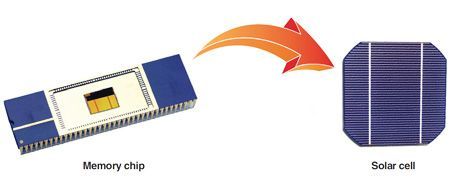
Solar cells are made of the same kinds of semiconductor materials used in the microelectric industry including polysilicon of thin wafers, according to National Aeronautics and Space Administration of the U.S. (NASA).
Apart from the physical resemblance, analysts point out to similarities between the restructuring in the dynamic random-access memory (DRAM) sector and that in the solar cell industry.
Korea first entered the semiconductor industry when Samsung Semiconductor Communication & Telecommunications, now Samsung Electronics, succeeded in making a pilot 64KD RAM, in six months after starting the development in May, 1983. Earlier in March, Lee Byung-chull, the founder of Samsung Group, announced why Samsung had to enter the semiconductor business.
Distrust against the decision was high. Japan’s Mitsubishi Economic Research Institute even retorted Lee’s announcement with five reasons why Samsung could not succeed in the semiconductor industry.
One reason said that the semiconductor requires the domestic consumption base, which Korea with the GNP of $600 back then lacked.
In December 1983, Samsung declared that it succeeded in developing a 64KD RAM, a fingernail size chip that could store some 8000 characters.
Since then, the highly cyclical DRAM sector went through a series of restructuring, but Samsung survived.
Over 25 companies existed in 1995, but the number shrank to 13 in 2000. After 2008, only five DRAM manufacturers with their own brands remained as of December last year.
Yang Seong-jin, a research fellow of LG Economic Research Institute (LGERI), said in his December 2011 report that Korean firms took the leadership in the industry by making large-scale investments in advance, expanding assembly lines and innovating production technology including enlarging the size of wafers.
“The crystalline silicon solar cell sector is expected to be restructured in similar ways as those for thin film transistor liquid crystal displays and DRAMS were,” Yang said.
“Companies that could strengthen its position through overcoming the market hit by oversupply and making aggressive investment in advance would survive. After all, large conglomerates with financial firepower would eventually enjoy oligopoly and they would earn high profits during the boom.”
Hwang Yoo-sik, an analyst of Meritz Securities, shares a similar view. As the price of DRAMs dropped for two years from 2007, only four out of 10 manufacturers remained competitive by cutting the costs and maintaining healthy financial structure, he wrote in his February report.
Since his report came out, Japan’s Elpida Memory filed bankruptcy on Feb. 27. There are now only three survivors ― Samsung Electronics, Hynix Semiconductor and Micron.
In order to pick healthy firms out of struggling ones, Hwang compared their earnings before interest, tax, depreciation and amortization (EBITDA) ― measures for a business’s profitability unaffected by other financing and accounting factors.
He said that Samsung Electronics and Micron kept healthy financial structures while the then No.3 Qimonda filed for bankruptcy after its EBITDA margin slipped to minus 27 percent. Those with stable financial structure were rewarded in 2009 when DRAMs’ prices soared. The analyst said that Hynix Semiconductor’s stock price jumped 246 percent within 2009 and Micron’s 300 percent.
Too intense competition in the solar energy industry is also leading to some firms give up their businesses.
The analyst projected that at the price of polysilicon at $30 per kilogram, many firms would turn to loss and wouldn’t be able to expand their businesses.
Those that keep investing in 2012 and improve quality would survive, and he picked OCI, the world’s fourth largest polysilicon maker, as the potential winner.
Hwang said that cost cutting for DRAMs can be achieved through reducing their sizes although it requires heavy initial investments. In case of polysilicon, increasing the output leads to smaller costs.
Yang of LGERI adds that aggressive investment into facilities and development of technology could be burdensome amid uncertainties. He advised that mergers and acquisitions could be decent alternatives to internal expansions.
“Keep an eye on companies that give up solar businesses. By acquiring these companies or buying technologies from them, a company may reach its goal easier than it can through organic growth based on its own capacity.”

Possibilities for Korean firms
There are many kinds of semiconductor products including DRAM, CPU and NAND Flash memory whose markets behave differently from each other.
While solar energy businesses tend to be categorized into one industry, their markets clearly divide according to production stages.
The base material used in solar energy generation is polycrystalline silicon, often called just polysilicon, which is extracted from sand.
The material that is also used for semiconductor products is shaped into a long, solid bar called an ingot, which gets thinly sliced into wafers.
Wafers are then processed to solar cells, which converts light into electricity. Modules are panels of many solar cells. The solar energy generating system is the end product consisting of modules.
Products on the lower part of the value chain tend to be more lucrative than modules and solar energy generation systems, the labor-intensive sectors of the industry that have little entry barriers. The market for modules is nearly dominated by Chinese firms.
Polysilicon, ingot and wafers require advanced technology in chemicals while, in case of solar cells, companies heavily invest into research and development to boost their efficiency. Entry barriers are high in those three sectors with polysilicon at the bottom of the value chain being most profitable.
Korean firms are yet to see their competitiveness in manufacturing solar cells. German firms produce highly efficient cells thanks to large investment while Chinese counterparts cut the prices and improved in technology at the same time under the government’s initiative to foster the industry.
Some believe that Korean firms should focus on “thin-film” solar cells instead of polysilicon-based cells.
Thin-film solar cells ― thin metal sheets treated with chemicals ― are cheaper to make, so are perceived to be the decent alternative to aggressively priced Chinese crystalline silicon cells.
This type accounts for some 20 percent of the solar cell market, and First Solar, a U.S. firm, has been nearly a dominating figure. Interest in thin-film solar cell technology peaked when Berkshire Hathaway’s utility arm MidAmerican Energy Holdings bought last December First Solar’s Topaz Solar Farm power plant in California. It was Warren Buffet’s first investment into solar energy.
In fact, several Korean firms entered the market for thin film cells because that for crystalline silicon cells is too heavily saturated by the Chinese.
Hyundai Heavy Industries set up last April a joint venture with France’s Saint Gobain to produce thin-film solar cells while Samsung SDI has already achieved an industry-leading efficiency.
Some industry insiders, however, are skeptical of thin film cells’ future. They aren’t as efficient as polysilicon-based counterparts while the use of toxic chemicals including cadmium makes contrast to the environment-friendly image of solar cells. After all, even if the portion of thin-film technology out of the total grows, it would always remain minor to crystalline silicon solar cells, they said.
A Beijing-based analyst, who did not want his name published due to impacts on the market, said that with a limited domestic market, Korean businesses wouldn’t be able to compete against Chinese companies in the solar cell sector, but have strengths in polysilicon because of the economies of scale.
OCI is currently the world’s fourth largest polysilicon maker in terms of capacity in 2011.
“In the case of polysilicon, all Chinese firms except one Chinese company, GCL Poli, have stopped operating,” the analyst said.
Amid the price of polysilicon continuing to plunge, OCI has pushed forward its plan to build the fourth polysilicon factories with the capacity of 20,000 tons per year, putting in 1.6 trillion won. The construction of the plant is expected to be completed in October this year and help OCI to climb up the global polysilicon maker rankings.
The largest concern on Korean businesses’ side is the lack of the domestic demand for solar energy. In addition to just an acceptable amount of sunshine and little land to have solar panels installed, electricity is cheaper in Korea than any other major solar energy adopters including California and European countries, leaving local consumers with little incentive to turn to the renewable energy source.
An official from Woongjin Polysilicon, however, finds strengths of Korean firms in financial power of conglomerates.
“In the U.S. and Europe, demands by consumers drive the solar energy industry. In China, the government leads the initiative,” the official said.
“In Korea, conglomerates can back up their solar businesses with its network of affiliates and funding power, replacing roles of the government and consumers to a certain extent.”
In fact, Samsung Electronics’ funding power has been pointed as one of major factors that helped its semiconductor business ― highly sensitive to the economic cycles ― weather through bad times.
While it is widely accepted across the cyclical industries that investment made in difficult times is likely to return a good profit in the future, Korean companies except OCI and Woongjin have been reluctant.
KCC decided in February to suspend the polysilicon business while LG Chem postponed last October a construction of a polysilicon plant. SK Chemicals cancelled the pilot program to produce polysilicon with a Taiwanese firm.
An industry insider said that it should be noticed none of Korean firms have actually quit their solar energy businesses but just shelved their investment plans or suspended operations.
That indicates that the domestic firms want to “wait and see” until they have enough time to expand right before the recovery of the industry, he said.
“We expect the solar energy industry to pick up between 2014 and 2015. Considering it takes two years to add new facilities, now may be too early. We are waiting for the right timing,” he said.
After all, the future of solar energy is bright. Helped by decrease in prices, the total installed capacity of photovoltaic systems would soar from 9.5 gigawatts (GW) in 2010 to more than 15 GW in 2015, Pike Research, a cleantech market intelligence firm, said in a report last October.
During that period, the global solar energy market would increase from $66 billion to over $154 billion, representing a compound annual growth rate of 18 percent.