Korea urged to rethink debt strategy
Country vulnerable to household debt crisis
By Kim Jae-kyoung
SINGAPORE — The South Korean government should no longer use household debt as a means to boost sagging domestic demand as record high debt could throw the Korean economy into another crisis if it is hit by external shocks.
The country may face a debt debacle similar to the one the U.S. experienced in 2008 unless the government changes its debt strategy, a noted global economist said.
“Household debt (in Korea) is high and rising faster than income,” independent economist Andy Xie told The Korea Times. Xie, a former economist at Morgan Stanley Asia, is well known for his prediction of the 1997-1998 Asian financial crisis.
“Household debt shows that there is insufficient income to cover living costs,” he added. “This is very similar to the situation in the U.S. before 2008.”
Xie said that a debt crisis can materialize if the global economy suffers a further slowdown.
“If there is a crisis, it will start with exports plunging. If the global economy tumbles, for example, and China goes into a hard landing, it would lead to an employment crisis and then an even worse debt crisis,” he said.
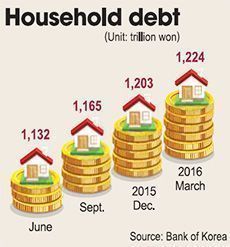
The nation’s overall household debt reached a record high of 1,224 trillion won at the end of March, up more than 10 percent from a year ago, according to the Bank of Korea (BOK). It is equivalent to around 160 percent of household income.
In particular, Korea’s household debt grew the fastest among emerging economies in 2015 with its debt-to-GDP ratio reaching 88.4 percent, the highest among 18 economies surveyed.
He explained that in the case of the U.S., wages stagnated for a decade before 2008.
“For most people, they actually declined. People didn’t want to cut their living standards and borrowed to keep them up,” he said.
“Something similar is happening in other Asian countries such as Malaysia and Thailand. This household debt boom reflects the failure to increase wages.”
Korea in Xie’s view has been facing a similar situation in two aspects — poor wealth distribution and low borrowing costs.
“Some corporate successes don’t translate into sufficient income growth, especially to catch up with the increasing costs in housing and education,” he said.
“The low interest rate and loose lending policy are enticing people into debt to keep up. But, as income continues to fall behind, the high and rising debt load is depressing people.”
Korea’s central bank slashed its key interest rate to a record low of 1.25 percent in June.
However, the economist ruled out the possibility that Korea is facing a debt crisis in the immediate future.
“The U.S. crisis was prompted by people who made low income load up on subprime debt that was traded in the market. When defaults happened, the market crashed,” he said.
“Korea’s debt is still from banks or other financial institutions. Even if the non-payment ratio rises significantly, banks won’t do anything drastic.”
Xie stressed that it is time for Korea to overhaul its debt strategy in order to keep households from borrowing further to support their spending on housing and education.
“South Korea needs to rethink its debt strategy. The right approach is to accept slower growth and stop using debt to juice up the economy,” he said.
“Instead, the government should focus on decreasing the cost of living, especially in housing and education.”