Household debt risks growing out of control
Government to reduce supply of new homes
By Nam Hyun-woo
The government said Thursday it will control the supply of new homes to curb surging household debt, retracting its earlier policy of using residential construction to boost the economy.
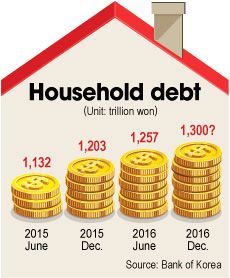
However, the latest in a series of measures to cut household debt is drawing skeptical responses from the market. The debt has kept growing and hit a record 1,257 trillion won ($1,120 billion) at the end of June, which amounts to 88 percent of the nation’s gross domestic product.
Analysts say that the effects will not be much different this time as the new package lacks substance to pull down the debt. The government can ill-afford to take aggressive measures on fears that a cool-down in the real estate market will further weaken the economy.
Finance Minister Yoo Il-ho said the government will tighten its control on the housing supply at every stage, including restricting land supply and enhancing screening on the provision of debt guarantees by financial firms to construction companies.
According to the package, the state-run Korea Land and Housing Corp. will limit the development of additional residential areas in the metropolitan region next year. Also, it will lower the number of construction approvals to curb the supply of new apartments and restrict issuances of debt guarantees.
In Korea, construction companies sell new apartments before they are completed. The buyers make installment payments for the new homes while they are being built. Guarantees for completion and distribution are required for the builder in case it goes bankrupt before completing the apartment blocks.
The government said the state-run Korea Housing and Urban Guarantee Corp. (HUG) will toughen its screening before providing guarantees to builders to prevent oversupply in advance.
However, analysts call the moves “patchwork measures,” saying they are not an effective solution.
“The package is edgeless. I don’t see any substantial impact from it,” said Lee Nam-soo, an analyst at Shinhan Investment. “That’s because the government avoided stricter measures such as keeping buyers of newly-built apartments from re-selling them.”
Oh Suk-tae, an economist at Societe Generale, said that the government is struggling to strike a balance between buoying the real estate market and reducing household debt.
“Boosting the housing market helped boost the economic growth rate, but it is also causing surging household debt,” Oh said. “The government said it will focus on controlling the supply of new homes, but the latest package may end up raising the prices of existing apartments, rather than bringing down household debt.”
The nation’s household debt in the second quarter this year climbed to 1,257.3 trillion won, up 11.1 percent from a year earlier.
To cope with the debt, the government introduced tougher regulations on mortgage lending in February. However, it only drove borrowers to resort to non-bank financial institutions despite higher interest rates.
The fresh package did not include measures to cope with soaring non-bank loans.
Also driving the debt hike was the increase in “collective loans” for new apartments. Collective loans often occur in making intermediate payments for new apartments. Loans are extended to a group of people who meet credit standards.
The share of collective borrowing for mortgages increased to 48.7 percent at the end of June this year from 12.4 percent at the end of last year.
This is because collective borrowing by buyers for newly built apartments were not included in February’s regulation enhancement.
In the package, the government decided to limit the number of guarantees for loans for apartment intermediate payments provided by HUG from four to two per person. However, the government said it believes enhancing qualification for collective loans is inappropriate because it may sap the local property market and hinder people who actually need a house from buying one.
The package was also questioned for its efficiency as it did not include measures regarding the eased regulations on the loan-to-value (LTV) and the debt-to-income (DTI) ratios. In 2014, the government eased the rules order to give home buyers greater access to mortgages and thus help boost the sluggish local housing market.
“The main culprit of the soaring household debt is easing the regulations on LTV and DTI ratios, but the latest measure did not include anything regarding that,” said Rep. Park Yong-jin of the Minjoo Party of Korea.
The government said that it has no intention to change the regulations.