KERI warns against 'another Elliott,'
Government asked to introduce ‘defensive measures’ against hedge funds
By Kim Yoo-chul
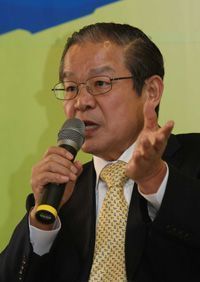
Kwon Tae-shin, KERI head
The government should introduce measures to protect local companies from attacks by big hedge funds, says the head of the Korea Economic Research Institute (KERI).
“We have no time to hesitate,” president Kwon Tae-shin said on the sidelines of the Pyeongchang Forum, Pyeongchang, Gangwon Province, on Sunday.
“The government should be quick to introduce defensive policies to protect the best interests of Korean companies under attack by influential hedge funds.”
Kwon said the latest disputes between Samsung affiliates and U.S. hedge fund Elliott Associates had awakened the appetites of influential hedge funds to twist the “ownership structure” of Korean companies with “small investments.”
“Disputes between Samsung and Elliott Associates are still going on,” he said. “Considering the amount of investment by hedge funds in top 30 Korean companies, possibilities are very high that other types of hedge fund attacks will come.”
He named Hermes and Blackstone, which have stakes in Korean companies, as “vulture funds.”
Asked what type of “defensive measures” were needed, Kwon highlighted “poison pills”
offering investors the right to purchase more shares at a discount if one shareholder bought a “certain minimum percentage” of a company's shares
and a “dual-class stock system”
giving major shareholders the right to exercise multiple votes.
He said the ownership structure that had long been used by leading conglomerates was the “right model” amid growing market uncertainties because the structure could help companies touch new businesses with a long-term strategy and investment.
“If you want to generate profits from new businesses, then you should be a long-term investor,” he said.
“Big Korean companies are positioned well for effective organizational overhaul thanks to adaptation of ownership structure.
“With the right measures, the government may encourage them to invest more in next-businesses with management stability.”
He cited Google and Facebook as global technology titans that could reduce investment risks on new business projects via a “dual-class stock system.”
“People say Google and Facebook are among the world’s most innovative firms and I believe this is the result of their effective business expansion but with management stability,” he said.
He said the advantages of the ownership structure that had long been kept by local chaebols should be credited and highlighted.
Kwon said Korean companies were on “red alert” in terms of competitiveness because the gap in total assets compared with their main Japanese, Chinese and American rivals had widened.
“Korean companies are losing their competitiveness,” he said. “This is real and very serious. Efforts to find ‘something new’ are stagnating and their conventional business models are also being challenged.
“Unlike China and Japan, Korea has failed to diversify the country’s portfolios beyond manufacturing.”
Referring to the latest Bloomberg analysis, Kwon said only two Korean companies
Samsung Electronics and KEPCO
were “top 500” global firms in terms of total asset value as at July 22 this year, as against eight in 2005.
“Sixty Chinese companies were put in the list, while Japan has 33 companies,” he said.
“The more serious problem is that Korea still has a heavy reliance on manufacturing. Chinese and Japanese companies were found to have improved their competitiveness in banking-, bio-, finance-, Internet service-related businesses.
“Today’s General Electric (GE) is not the company it was in decades ago. GE successfully diversified its portfolios. This was because of its long-term commitment to grow next businesses. Without change, you will have no future.”
KERI, founded in 1981, is a public economic research institute under the umbrella of the Federation of Korean Industries (FKI), which represents the interests of large companies.