KOSPI bubbles over 2,100
By Kim Jae-won
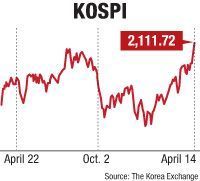
The benchmark KOSPI closed above 2,100 points, the highest in more than three-and-a-half years, with retail and foreign investors expanding exposure to stocks amid abundant liquidity and low interest rates, dealers said Tuesday.
The KOSPI closed at 2,111.72 points, up 12.8 points, or 0.61 percent, the highest since Aug. 2, 2011 when it closed at 2,121.27. The tech-heavy KOSDAQ closed lower, correcting recent steep gains, falling to 684.97, down 4.42 points, or 0.64 percent.
Most analysts said the stock market is expected to extend its gains for a while on the ample liquidity. But some disagreed, saying weak corporate earnings prospects and the sluggish economic outlook will limit upside movement.
Some expected the KOSPI to reach 2,200 by June. However, others said liquidity is not enough for the index to sustain gains, and bet the KOSPI will head down after hitting 2,150.
“We see the market positively. The KOSPI will hit the 2,200 mark easily by the end of the first half thanks to expanding liquidity from overseas,” said Park Jeong-woo, an analyst at Samsung Securities.
Foreign investors were behind the recent rally, buying a net 2.9 trillion won of stocks last month, up from 573 billion won the previous month, according to the Financial Supervisory Service. The value of their shareholdings came to 452 trillion won in March, accounting for 30.8 percent of total market capitalization, slightly up from 30.7 percent a month earlier.
The upward trend of the Seoul bourse followed an additional rate cut at home and quantitative easing measures in Europe and China. The Bank of Korea last month slashed the key interest rate to a record low of 1.75 percent, aiming to shore up the sluggish domestic economy.
However, Hyundai Securities senior analyst Ryu Yong-seok said that the index has already consumed most of its fuel, so the upturn trend will lose steam soon.
“It is time to wait, and watch the market carefully. The KOSPI Small Chips Index gained only four points Tuesday morning, moving back from previous days’ gains of 10 to 15 points. Considering the data, the KOSPI will tumble after peaking at 2,150,” Ryu said.
He said that investors need to check out the small chips index because it is a key indicator showing how the stock market will move later. The small chips index is based on small companies ranking lower than 300th by market cap, according to the Korea Exchange (KRX).
Shares of banking and automobile industries joined the upbeat mood. Top banking group Shinhan Financial Group rose 4.5 percent to close at 42,950 won and Hana Financial Group jumped 6.57 percent to 30,000 won. Hyundai Motor, the country’s biggest carmaker, increased 2.4 percent to 171,000 won and its sister affiliate, Kia Motors, advanced 4.56 percent to 47,000 won.
Observers said that an increasing number of trading accounts in the stock markets indicate that the bullish trend will continue. About 2.5 million accounts were used for stock transactions in the first quarter, up 5.3 percent from three months earlier, according to the KRX.
It was the biggest quarterly gain in three years as active stock accounts had been on the wane after peaking in early 2012 while the local equity market was moving sideways. The number of active accounts jumped 16.4 percent on-month to 1.92 million in March, marking the biggest monthly rise in three years, the bourse operator said.
“Investors who had been on the sidelines turned to active traders as the stock market has bounced back lately,” the KRX said in a statement. “Funds are flooding into the equity market on the back of stabilizing oil prices, global liquidity expansion and the Bank of Korea’s rate cut.”
Stock-rich businessmen have become wealthier as the recent bull run has sharply boosted the value of their share holdings, according to industry data. A total of 24 tycoons were estimated to have more than 1 trillion won worth of shares as of Monday, Chaebul.com said.
Stock assets held by Seo Kyung-bae, CEO of Amore Pacific, grew at the fastest pace this year as the nation’s leading cosmetic firm was expected to post strong earnings on brisk sales in China. His shares’ value soared 53.9 percent to 9.35 trillion won as of Monday compared to Jan. 2, only ranking behind Samsung Electronics Chairman Lee Kun-hee, the nation’s richest person by share value.
In contrast, Lee’s stocks declined 1.7 percent to 12.13 trillion won, while his only son Samsung Electronics Vice President Lee Jae-yong saw his assets shrink 15.6 percent to 7.82 trillion won to rank third, the corporate tracker said.
Hyundai Motor Group Chairman Chong Mong-koo took fourth place with 5.25 billion won worth of shares, followed by his son and vice chairman Eui-sun with 2.38 trillion won, it noted.