FTC to monitor patent rights abusers

Key participants of the FTC forum listen to an opening speech at the Plaza Hotel, Tuesday.
By Yoon Ja-young
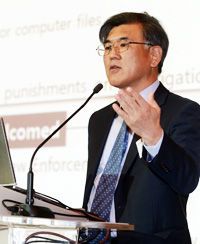
Fair Trade Commission (FTC) Vice Chairman Kim Hack-hyun speaks during the FTC Forum hosted by the Korea Times at the Plaza Hotel in Sogong-dong, downtown Seoul, Tuesday. / Korea Times photo by Kwon Yuk
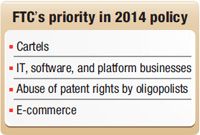
Monitoring abuse of patent rights by oligopolists and protecting consumers in electronic commerce will be the key priorities of the Fair Trade Commission (FTC) this year, according to Korea Fair Trade Commission Vice Chairman Kim Hack-hyun.
“Patents are an important device, a fair reward for the invention and a continuous driver of innovation. But abuse or exclusive exercise of the rights can limit competition,” Kim said at the Korea Fair Trade Commission Forum at the Plaza Hotel in Seoul, Tuesday.
Organized by The Korea Times and sponsored by the FTC, the forum aimed at providing global companies operating in Korea as well as Korean firms with guidelines on how to cope with regulatory issues.
At the forum, Kim said that the FTC will keep an eye on the abuse of patents rights to limit competition.
He cited unfair refusal to use standard or essential patents, continuous imposition of patent fees after the termination of the patent period and imposition of high patent fees on competitors as the kind of things limiting competition.
He said the commission will take special note of the competition related to Non-Practicing Entities (NPE), or businesses that earn profits solely by buying and managing other businesses’ patent rights, raising patent infringement suits and winning settlement money.
Recently, many global IT companies that have withdrawn from the market have transformed into NPEs, and are threatening companies like Samsung Electronics with patent suits in the global market.
“We don’t think these patent trolls have fundamental problems, but as concern is being raised over them, we are going to do research. The commission plans to continue seeking problems NPEs can cause, while keeping an eye on other authorities’ moves,” he said.
Consumer damages in e-commerce
He also picked electronic commerce as the main area of policy focus this year. “With development of the Internet and IT, e-commerce has spread remarkably,” he said.
However, due to its non-face-to-face feature, consumer protection is not fully provided, he explained.
Kim mentioned some of the latest types of consumer activities in e-commerce such as transactions on smartphones or involving mobile coupons, transactions across borders and Internet blogs as examples where consumer damages can occur.
“The FTC will enhance monitoring to make sure that businesses do not deceive consumers or deter their informed and reasonable decisions,” he said.
He added that the FTC will be fair and non-discriminatory in enforcing the law, whether domestic or global firms. “We are reviewing cases of marine transport, mobile phones and M&As on semiconductor devices. We confirm that the cases will be treated in as swift and fair manner as possible,” he said.
Fair competition in IT sector
Overall, the IT industry, including software and platform businesses, will receive policy priority, according to the vice chairman. “With rapid innovation based on knowledge and technology, the industry is driving the growth of the world economy. On the other hand, it is highly likely to hamper technology development and market entry of second-runner businesses in this sector,” he said.
The commission will examine those blocking entry of a new business and trying to deter fair competition in this sector, according to the vice chairman.
Meanwhile, the commission will also strengthen its monitoring of cartel cases this year, the vice chairman said. He said cartels are the sectors where consumer damage from anti-competition activities are most evident.
“For this sector, the FTC is enforcing the law sternly on global businesses as well as Korean businesses,” he said. Since 2002, the commission has imposed 6.43 billion won in fines on some international cartel cases, including those involved in raw vitamin material, copying paper, air cargo and LCDs. He asked global companies to be cautious to avoid cartels.
Drive for deregulation
Recently, President Park Geun-hye has been pushing for deregulation as a key agenda of her administration.
Kim said the commission will abolish unnecessary regulations or rationalize unreasonable ones. “The targets will be regulations unfit for the current market condition, or the ones being eased in other countries.”
He also pointed out that the commission has completed legislation for major laws aimed at so-called “economic democratization,” to promote fairer distribution of benefits between conglomerates and small businesses. It was one of the main campaign pledges of President Park.
Kim said that the commission will focus on its remaining tasks regarding economic democratization, which includes preventing holding company’s cross investment between non-financial and financial arms.
He added that it will keep an eye on unfair trades between conglomerates and small businesses in the sectors of retail, franchise, dealership and subcontracts.