Firms on alert over NPS' move

Pension fund may interfere with boards’ decisions
By Yi Whan-woo
The National Pension Service (NPS) is making major Korean companies sweat as the pension fund operator is expected to raise its voice at its upcoming shareholders’ meeting.
Market participants are paying attention to whether the NPS will exert its voting rights against key issues of affiliates of major conglomerates, such as the appointments of the companies’ board of directors and compensation for executives.
The operator of the public pension fund under the Ministry of Health and Welfare owns over a 5-percent share each in more than 200 firms, many of which are conglomerates or their affiliates.
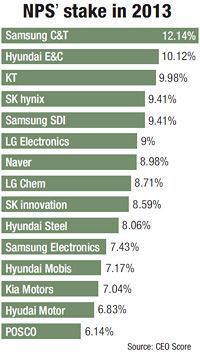
For instance, the NPS has a 7.43-percent stake in Samsung Electronics, a 6.83-percent stake in Hyundai Motor, a 9.41-percent stake in SK Hynix, a 9-percent stake in LG Electronics, a 6.14-percent stake in POSCO and a 9.98-percent stake in KT, according to CEO Score, a website that provides information on corporate productivity.
Samsung Electronics, LG Electronics and Hyundai Motor will hold a shareholders’ meeting today, while SK, SK hynix and Hyosung are scheduled to have their meetings on March 21.
Experts point out that the NPS’ veto rarely affects the firms’ board decisions because it is not the majority shareholder in many cases, but it is important that the pension fund has started raising a red flag against some decisions that may damage shareholders’ values.
Anxiety among these firms is particularly high as the NPS recently voted against some mid-size conglomerates’ moves to select board members.
Between January and February, the NPS voted against the board members selected by Sebang Group and Mando.
The NPS owns a 10.33-percent share in Sebang Group, a mid-sized conglomerate specializing in logistics services, and a 13.41-percent share in Mando, a leading auto parts manufacturer under Halla Group.
The shareholders of Sebang Group and Mando approved the appointed board of directors despite the NPS’ objection. However, a lobby group for local enterprises said the NPS’ veto should be considered separately from those of other shareholders’ when selecting the firms’ board of directors.
“The NPS is a state-run organization that can be affected by the government and politicians,” said Choo Kwan-ho, leader of the corporate policy team at the Federation of Korean Industries (FKI). “And its decisions as a shareholder of a firm can be very politically biased.
“Because a considerable part of the NPS’ investments are financed by the taxpayers’ money, it is crucial to make sure that the NPS exercises its shareholders’ rights in a fair and objective way.”
The NPS manages 424 trillion won ($399.35 billion) in investments as of November last year, according to the state-run organization. Some 19.7 percent, or 83.93 trillion won, of the investments was poured into the domestic stock market.
The NPS, however, dismissed speculation about political bias in its decisions.
“We’re responsible for yielding returns for the taxpayers in the long-term, and in order to do so, we have the right to make sure that the companies in which we own shares are being managed properly,” said Lee Chul-hee, an NPS spokeswoman.
She said the NPS disapproved of Mando’s re-appointment of CEO Shin Sa-hyeon to the board because he “damaged the corporate value of the firm with unfair business practices.”
In a statement, the NPS said it decided to vote against Shin because he actively took a part in funding Halla Meister with 378.6 billion won. Halla Meister is a wholly owned subsidiary of Mando Corp.
According to the NPS, Halla Meister spent the money to support the poorly performing construction affiliate, Halla Corp. The construction company is the largest shareholder of Mando Corp. with a 17.29-percent share. The NPS also claimed Shin was involved in a scheme to fund the builder through irregular business practices.
Kang Jeong-min, a researcher at civic watchdog Solidarity for Economic Reform, said the NPS should push to exercise its voting rights to correct the unfair business practices of enterprises.
“Most of the board of directors are merely puppets of the firms for which they’re appointed,” he said. “That’s why illegal business practices committed by CEOs are prevalent.
“For this reason, I’d say the NPS should be more active in persuading other shareholders to take action against incompetent board members.”
He also said the FKI’s claim the NPS could be politically biased is wrong.
“To prevent such politically biased decisions, the NPS runs a committee comprised of civil experts such as professors, so I don’t understand where the FKI’s argument comes from.”