'K-food expo to benefit SMEs'
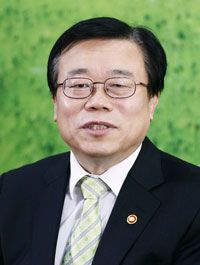
Lee Dong-phil, Minister of Agriculture, Food and Rural Affairs
By Yi Whan-woo
The Korea Food Show (KFS) 2013 will give an opportunity for small and medium-sized enterprises (SMEs) to become global players, Agriculture, Food and Rural Affairs Minister Lee Dong-phil said Monday.
Lee said the four-day exhibition, which will start at KINTEX in Goyang, Gyeonggi Province, today, will allow SMEs to network with bigger firms here and overseas.
“I’m sure small food firms and the conglomerates will be able to find a way to grow in harmony,” he said in a written interview with The Korea Times. “In that way, they will be able to increase exports and enhance sales on the domestic market.”
The KFS has grown into the country’s biggest food exhibition since it was launched in 2008. This year’s show features a number of programs that highlight President Park Geun-hye’s vision for joint growth of family-owned conglomerates and SMEs.
The number of participating firms from Korea and overseas is a record-high 1,150 this year. They include five conglomerates ― CJ Group, Daesang, Nongshim, Maeil Dairies and SPC Group. A number of international firms such as Skylark, Co-Op Sapporo and Itochu-Shokuhin from Japan, and Green Mushroom Farm and Trefle from the Netherlands also will be present.
For the first time in the event’s history, the ministry set up booths exclusively for over 200 self-employed people and SMEs, officials said.
Lee said, through the fair, “Producers, manufacturers, distributors, retailers, as well as restaurant chains worldwide can learn business plans and strategies of competitors.”
“I’m looking forward to seeing Korean food service professionals distinguish themselves as global leaders. This fair will provide such opportunities.”
He said he will help Korean firms through the “Buy Korean Food” program, a one-on-one consultation service for 220 international buyers who are interested in Korean food products and related know-how.
“The food show will be especially beneficial for franchise restaurants as their overseas counterparts will be present to grasp a better understanding of Korean food,” the minister said. “The SMEs will have a chance to expand to international markets.”
The minister said the KFS will set an example for similar food shows, such as the Seoul Food Fair, hosted by the Korea Trade-Investment Promotion Agency (KOTRA).
For this year’s event, KOTRA invited companies from 38 countries including China, Japan, Taiwan, the United Kingdom, Spain, Denmark and Brazil.
“I hope visitors to the two exhibitions will be able to interact, creating more chances for SMEs to promote themselves, locally and internationally,” Lee said.
Separate to the exhibition, the ministry plans to build a food industry cluster for SMEs, named “Foodpolis,” in line with the Park administration’s “creative economy” initiative, aimed at creating jobs in the fields of science and technology, food and tourism.
“Food and beverages people eat and drink represent their social status, age and gender,” Lee said. “Consumers tend to distinguish themselves from others through premium or high-quality food. The cluster will be home to many firms that want to produce such products.”
The cluster, which will be set up in Iksan, North Jeolla Province, by 2015, will play a central role in boosting exports of a wide range of value-added, processed food products, Lee said.
The government plans to attract over 150 local and international food companies and 10 research centers to the cluster, which will make an annual output of $15 billion and generate 22,000 new jobs, he said.
The ministry will invest $500 million to build the cluster on 3.58 square kilometers.
“We decided to set up the food firm complex to increase the nation’s food exports to Japan, China and other Asian nations,” he said. “Our ultimate goal is to create a food center similar to the Food Valley of the Netherlands and nurture it into a new growth engine for the food industry.”
“Foodpolis will create a comprehensive research and development (R&D) center where companies can use expensive equipment free of charge. We will open our research center to all firms operating in the food cluster. We will also offer them R&D funding,” Lee added.
The minister added several multinational food firms have begun to establish a foothold in Asia’s fourth largest economy.
The ministry’s latest data shows a total of 62 companies and research institutes, including 19 from abroad, have expressed interest in establishing a presence in the food cluster.
Canadian food company SunOpta, U.S. bio research firm Instant Labs, Japanese food firm Jalux have signed agreements to build facilities there.
“Local conglomerates have also shown interest, and what will happen is that they and SMEs will have more chances to work together at the cluster,” he said.
Among domestic companies, Dongwon F&B, the world’s largest canned tuna producer, pledged to build a processing plant and a research facility on 66,000 square-meters of land inside Foodpolis.
The ministry also received a much-needed boost from CJ Group, the country’s largest food company which participated in the KFS. It has promised to invest over $18 million to build state-of-the-art production and research facilities.
The firm aims to set up operations in the Foodpolis as an export base targeting China. A growing number of wealthy consumers there consume high-quality food items produced here, according to the ministry.
“CJ’s planned investment is widely expected to encourage more food firms at home and abroad to come to Foodpolis,” Lee said.