Breakthrough not in sight for Yongsan project
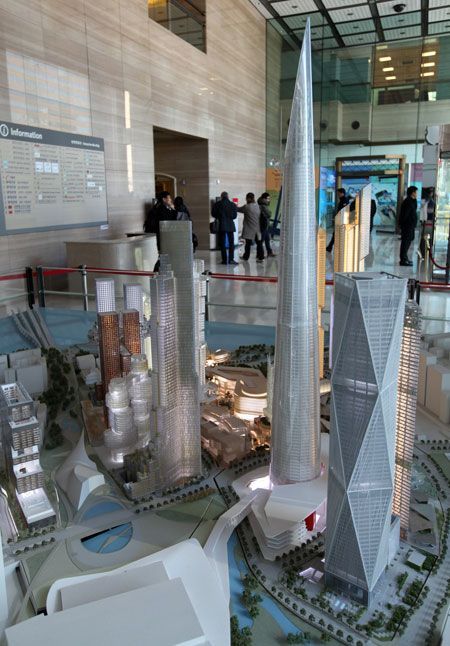
Miniatures of buildings to be constructed in the Yongsan International Business District are displayed at the lobby of Dream Hub PFV, a special purpose company set up to implement the project, in Jongno-gu, Seoul. The country’s largest-ever development project, valued at $28.7 billion, is on the verge of bankruptcy due to disputes among major shareholders over how to finance it. / Yonhap
By Na Jeong-ju
The fate of Korea’s largest-ever urban development project to build an international business district in the heart of Seoul is at stake.
Major stakeholders have been in conflict for more than two years over how to finance the project, valued at 31 trillion won ($28.7 billion), amid an uncertain outlook for the real estate market.
An increasing number of residents, fed up with irresponsible developers and administrators showing “none-of-my-business” attitude, are now demanding the cancellation of the project.
More than 2,300 households are banned from selling and renovating their properties in the areas since the development scheme started in 2007 with big fanfare.
Against this backdrop, the capital the investors raised for the project has been quickly drying up. According to Dream Hub PFV, a special purpose company set up to implement the construction, shareholders raised some 1 trillion won in 2007, but they have less than 500 million won as of Wednesday. Without a capital increase, Dream Hub will go bankrupt.
The firm recently asked KORAIL, its largest shareholder, to provide collateral so that it can issue bonds and secure additional capital of 307 billion won. The state-run rail firm, however, rejected the demand, saying the financial burden should be shared equally by all investors.
“Dream Hub needs 30 billion won in March to cover expenditures and to keep the project afloat. Without fresh money, it will have to file for bankruptcy,” a Dream Hub spokesman said, asking not to be named.
A bankruptcy will have grave consequences for the companies involved, the property markets in and around the development zone as well as the national economy.
The project’s shareholders have so far spent a total of 1.4 trillion won in operational costs, believing that it was worth such an investment. In the worst case, however, they will blow all the money.
Damage for residents could be much larger. Home and land prices around Yongsan Station have doubled since 2007. If the bubble bursts, the impact will be huge not only on the property markets, but also on people’s lives.
It is not hard to imagine that a bankruptcy will trigger a string of legal battles among stakeholders, residents and Seoul City, which approved the project.
To avoid this scenario, the stakeholders must settle the financing issue first.
Industry watchers say the recent case represents a deepening “brinkmanship” among investors as the project’s future has become increasingly uncertain. Many predict they will be able to settle their dispute through last-minute negotiations because they all know what the consequences of a failure will be.
Structural problem
Under the development plan, about 560,000 square meters in Yongsan will be transformed into a business district that will feature a 665-meter-tall, 150-story landmark building named Dream Tower and a wealth of riverfront business and tourist venues.
When investors committed to the project in 2007, the country’s real estate market was at its peak. They said at the time that the Yongsan business hub will attract 140 million people every year, create up to 360,000 new jobs and generate 67 trillion won in product value. The project is supposed to be completed in 2016, but no one now believes that will be possible. Developers haven’t even broken ground for the Dream Tower.
The conflict between KORAIL and other investors stems from the strange funding structure.
The project was initiated by the government to settle the state-run firm’s heavy debts. KORAIL provided its land for the project and invited 29 other investors to set up Dream Hub.
KORAIL has a 25-percent stake in the firm, with Lotte Tour Development holding 15.1 percent. The remaining shares are held by construction firms and financial investors.
Dream Hub established an asset management company (AMC) to secure funding for the Yongsan project. KORAIL, however, didn’t own the company. Under the contract it signed with other investors, KORAIL is not allowed to own more than a 29.9 percent stake in the AMC. Samsung C&T used to be the largest shareholder with a 45.1 percent stake, but it withdrew from the project in 2010. Lotte then took over Samsung’s shares and became the largest shareholder with a 70.1 percent stake.
KORAIL claims private investors are trying to avoid taking the risks.
“Private investors are asking us to inject more funds without sharing responsibility. We already provided 78.4 percent of the capital for the project,” a KORAIL official said. “Currently, 28 of the Dream Hub’s 30 shareholders are private companies, but they don’t want to share the financial burden.”
The two sides are also at odds over various other issues.
The railway firm wants to raise the capital of Dream Hub up to 3 trillion won by attracting investments from current stakeholders and others interested in taking part in the project. Lotte opposes this.
They have also differed on how to implement the project.
KORAIL wants to develop the area by stages, given the shortage of funds and the unfavorable market conditions. However, Lotte wants to complete construction as quickly as possible, alleging that KORAIL is seeking to develop the land it owns near Yongsan Station first.
Challenge for Park’s administration
Many market watchers say the government should step in to put the project back on track.
On Monday, Jin Young, vice chairman of the presidential transition team and nominee for minister of health and welfare, indicated that the Park Geun-hye government will intervene in the dispute between shareholders and help them find common ground.
“The Yongsan project will never be as profitable as originally thought. All parties concerned should understand this,” Jin told reporters. “The government needs to arrange discussions between firms and the municipal government to find a breakthrough.”
As Jin stated, growing doubt over the profitability of the project amid the protracted downturn in the real estate market is a big challenge for the project. According to KB Kookmin Bank, prices of apartments in Seoul saw the sharpest fall last year since the 1997-98 Asian financial crisis. Some Analysts cautioned that the housing market will be even worse next year due to decreasing demand and weakened consumer sentiment.
The murky prospects for the property market suggests that developers of the Yongsan district won’t be able to sell offices and apartments in time even if they are constructed as planned.