Korean, Canadian artists, scientists explore concept of time

Gabriel Menotti of Canada gives a presentation during an event to mark the beginning of the “The Blind Watchmaker” artistic project at the Youth Art Administration in Seoul's Chungjeongno area, July 16. Courtesy of Bereket Alemayehu
By Bereket Alemayehu
“The Blind Watchmaker” artistic project began with a thought-provoking hybrid event that merged the realms of digital art, science and philosophy at the Youth Art Administration in central Seoul's Chungjeongno, July 16. The collaborative project involving Korean and Canadian artists and scientists revolved around the enigmatic concept of time, exploring its depth, significance and subjectivity, applying AI, digital art, astrophysics and sound effects.
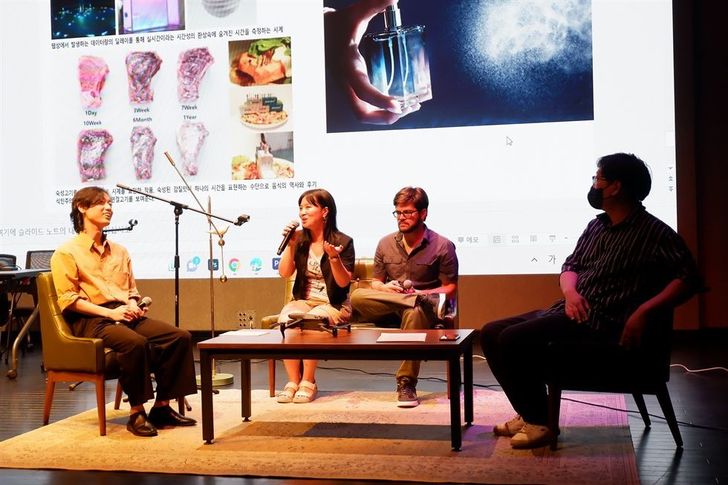
From left, Jeong Man-keun, Sojung Bahng, Gabriel Menotti and Shin Je-hyun participate in a roundtable discussion during an event to mark the beginning of the “The Blind Watchmaker” artistic project at the Youth Art Administration in Seoul's Chungjeongno area, July 16. Courtesy of Bereket Alemayehu
For Korean multidisciplinary artist Shin Je-hyun, time has been the central interest of his creativity since 2013. He has been asking why we did ended up living with a unified time system around the world. “Some may wonder what this means in a world where clocks, calendars and time differences are clear, but in fact, there is a history of time that we do not know well,” he said.
He tracked the philosophy and concept of time before colonialism, exploring the concept that has been taken for granted by many. He explained that in the late 16th century, the British Empire used the Meridian or Greenwich Mean Time (GMT) that passed through the Greenwich Observatory in its territory, which was eventually designated by the International Meridian Conference in 1884, and forced less powerful countries to follow it.
“I have to think about a better time for me,” he said. “We live in an urban society too time-bound, which can become obsessive and lead to mental illness. Looking at cosmic time, AI time, small grass time and star time, many scientists say that time is not finite, fixed or flowing. We must now be more free from time.”
Sojung Bahng, a multidisciplinary artist, filmmaker, researcher and assistant professor in media and performance production at Queen's University in Canada, introduced her “{[Digital Flesh 1: Scar in Data]}.”? The multimedia art project combines live cinema and experimental sound with installations, printmaking and augmented reality, to investigate how representations of our bodies and physical sensory information can be de- or rematerialized through digital audiovisual media. She spoke at the event about how she used time-based media as a reflexive device by using the generative, interactive and immersive elements of digital media.
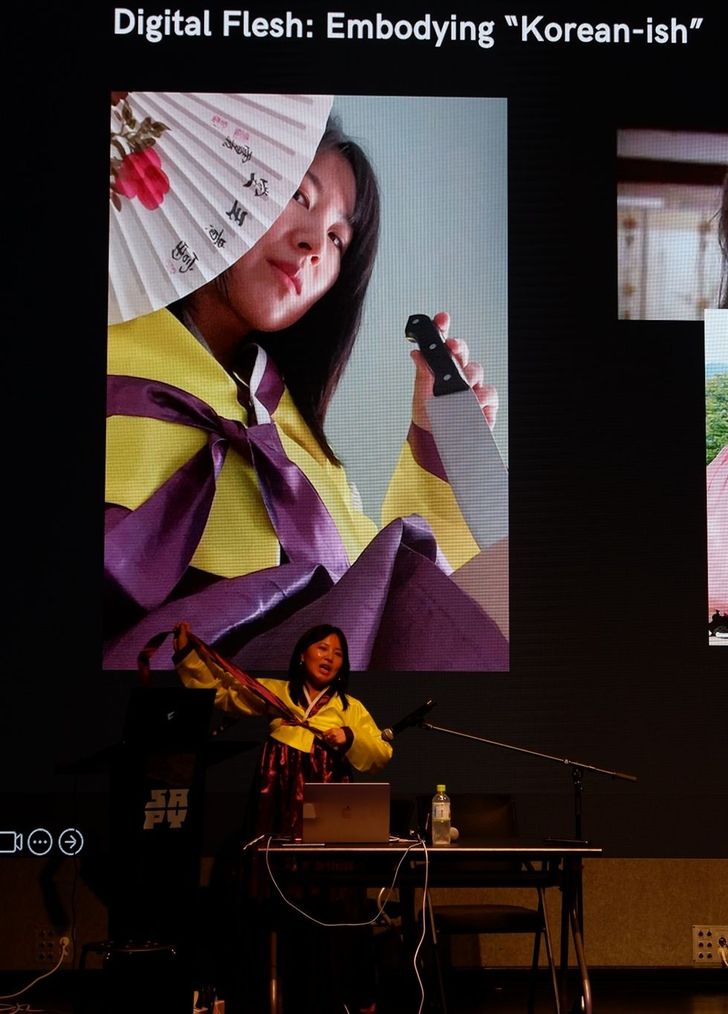
Sojung Bahng performs during an event to mark the beginning of the “The Blind Watchmaker” artistic project at the Youth Art Administration in Seoul's Chungjeongno area, July 16. Courtesy of Bereket Alemayehu
She gave a performance wearing hanbok titled “Digital Flesh: Embodying Korean-ish De/re-materialise my digital flesh as a Korean woman in the context of Canadian society,” an interesting piece of performance in which audience members participated joyfully.
Bahng explores cinematic media via digital technologies to reflect aesthetic and narrative experiences in cultural and philosophical contexts. Her award-winning, reflexive cinematic VR works and multimedia installation and performance series have been shown at prestigious festivals and symposiums worldwide, including FIVARS in Toronto, TSFM in Torino, TIAF in Tbilisi, ANIMAZE in Montreal, SIMA in Los Angeles, Heide Museum in Melbourne, ICLC in Barcelona, ICMC in New York and ISEA in Dubai.
Canadian Mike Lukaszuk, an experimental music composer and sound artist based in Canada, collaborated with Bahng on interactive audio-visual tools.
“This work is part of an ongoing interest of mine in which I like to explore artificial?intelligence, not only as a hidden/mysterious technical feature that produces elaborate sounds/images with little interaction, but instead as something at the foreground of the artwork/acting as subject matter,” he said.
Much of his creative and scholarly output explores the idea of generativity through the use of improvisation with digital devices, musical AI and sound spatialization. His work has been played and presented across Canada and the U.S., in addition to appearing at festivals in Poland, the Netherlands, Korea, France, the U.K., China, Australia and Romania, and he has received awards from arts and research organizations such as Canada's SOCAN Foundation and Mitacs.
During the event, Jeong Mankeun, an astrophysicist Ph.D. course student at Seoul National University, gave a lecture on experiencing time in the sea of data, based on his exhibition artworks titled “As I become lighter, time flows slower.” He emphasized his concern about information consumption, that as computational processes become more advanced, the processes of interpretation and reasoning are blocked, turning the algorithm into a black box.
As modern humans struggle to keep up with the amount of information demanded by society, he said, they become increasingly dependent on such black box, eventually at risk of becoming machine-like beings that operate only on given inputs. In that sense, as machines become more human-like, humans have unwittingly become more machine-like. He asked whether modern humans will also experience time like machines.
Canadian Gabriel Menotti, one of the exhibitor artists who came to Korea to join the project, displayed a series of 3D-printed figures of famous landmarks from different places in the world, including a 3D model of central Seoul's iconic N Seoul Tower. “I believe the main idea of my presentation is that time-based artforms ― such as film, video, new media ― remind us that objects are alive,” he said. “Artworks participate in history, and history leaves its marks in the artworks. What we normally see as deterioration can be also seen as a slow process of transformation and change.”
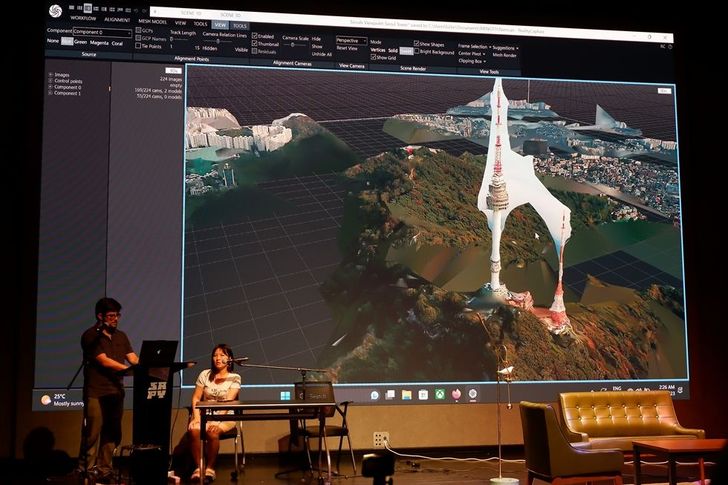
Gabriel Menotti of Canada presents a 3D model of central Seoul's N Seoul Tower during an event to mark the beginning of the “The Blind Watchmaker” artistic project at the Youth Art Administration in Seoul's Chungjeongno area, July 16. Courtesy of Bereket Alemayehu
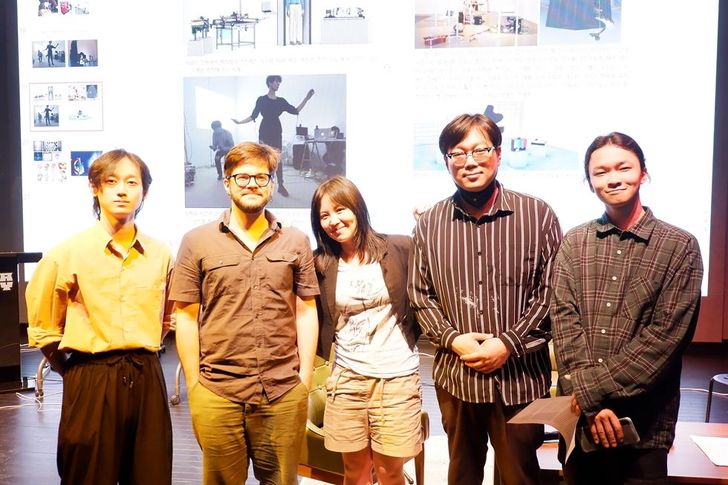
From left, Jeong Man-keun, Gabriel Menotti, Sojung Bahng, Shin Je-hyun and Kim Mango pose together after an event to mark the beginning of the “The Blind Watchmaker” artistic project at the Youth Art Administration in Seoul's Chungjeongno area, July 16. Courtesy of Bereket Alemayehu
Bereket Alemayehu is an Ethiopian photo artist, social activist and writer based in Seoul. He's also a co-founder for a social initiative called Hanokers and freelance contributor for Pressenza Press Agency. Visit?
?for more information.