Korea seeks US expansion of key minerals supplier list under IRA
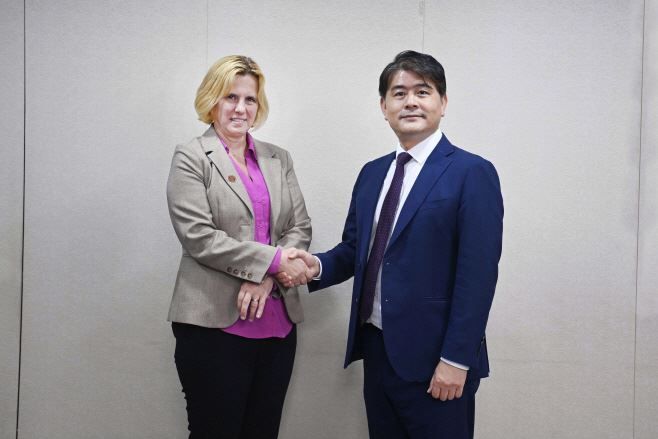
Joo Young-jun, right, director general for industrial policy of the Ministry of Trade, Industry and Energy, shakes hands with Deputy United States Trade Representative Sarah Bianchi at the Korea Trade Insurance Corp. in Seoul, Thursday. Courtesy of Ministry of Trade, Industry and Energy
Korea has asked the United States to expand the list of nations that provide electric vehicle (EV) battery makers with critical minerals affecting eligibility for credits under the Inflation Reduction Act (IRA), Seoul's industry ministry said Thursday.
The Korean government made the request in its public comments sent to the U.S. earlier this month on the new guidelines that the U.S. Treasury Department announced in March on tax credits for EVs under the act.
The IRA offers tax credits of up to $7,500 to each buyer of a new electric vehicle assembled in North America and with batteries made of a certain amount of critical minerals produced in the region.
The new guidelines said that critical minerals from 21 nations with which the U.S. has a free trade agreement will meet the IRA requirements.
But Korea has said the countries' current supply capacity is far from sufficient to satisfy all the requirements and some minerals are only available in specific areas, calling on Washington to expand the list.
The issue was a key agenda item during a meeting between Joo Young-jun, Korea's Director General for Industrial Policy of the industry ministry, and Sarah Bianchi, Deputy United States Trade Representative, held in Seoul on Thursday.
"The two sides have managed well the IRA-related issues by maintaining close consultations through various channels. But there are some remaining issues, and we called for the U.S.' close review," Joo said.
Korea seeks to have Indonesia, Argentina and several other nations be recognized as minerals suppliers under the IRA.
The Seoul government also called on the U.S. to clarify Chinese companies from which Korea should not buy key battery materials starting in 2025 to receive subsidies under the U.S. act.
"It is important to consider the unique complexities and global interdependency within the battery supply chains ― from extractions of critical minerals to cell productions," the ministry said, calling on the U.S. "to fully take into account the intricacies of the battery supply chains when formulating the regulations on a Foreign Entity of Concern."
"Bianchi said that Korea is one of the most crucial partners for the U.S. regarding the battery supply chain policy and Washington will continue communications with Korea over the course of the implementation of the IRA," the ministry said in a release. (Yonhap)