INTERVIEW Unorthodox refugee support group pushes the envelope

From behind left clockwise, Bereket Alemayehu from Ethiopia, Yu Yuri, Han Na-hyun, Dorcas from Congo and Kang Eun-sook are members of Active Refugee Korea. They gathered for an interview with The Korea Times at Dongjak FM in Seoul on April 17, a rare gathering for the members who often meet online via video conference calls. Korea Times photo by Ko Dong-hwan
Active Refugee Korea launches fresh campaigns this year
By Ko Dong-hwan
When the seven members of Active Refugee Korea (ARK) started their campaign last year, they agreed on one thing: to be more aggressive than existing refugee advocacy groups in Korea, one of the strictest nations when it comes to accepting asylum seekers.
That was the only way the activists figured they would succeed in improving the chances of asylum seekers and refugees in Korea find a better life.
And their first opportunity came in May, when the inauguration of President Yoon Suk Yeol took place. As Yoon set up his new office in front of the War Memorial of Korea in Yongsan, Seoul and interviewed candidates for ministerial positions and other key posts, the refugee advocacy group did not waste any time.
It sent a letter to the country's new leader and did not mince any words.
“We trust that Republic of Korea, one of the wealthiest countries in the world, can protect more asylum seekers and refugees if it had more political will and practical efforts to do so,” the letter read.
The letter was read aloud in English, Korean, French and Arabic before being handed in-person to an official at the Presidential Transition Committee on May 4, 2022.
“But it's truly regretful that Korea so far hasn't carried out an inclusive, consistent set of refugee policies,” it added. “We sincerely wish that the new Korean government comes out as a more active member of the international community that increasingly requires humanitarian responsibilities, including protecting asylum seekers, amid the intensifying local conflicts and wars across the world.”
That message did not go unnoticed.
The transition committee responded on May 21. It said, “Bearing your valuable opinion in mind, we will humbly and responsibly do our best to reflect your opinion into making future-oriented and innovative national-unity government.” ARK,
sharing the letter on Facebook,
said it was a “small but important step forward to establishing a channel of communication and dialogue with the president and the government to fulfill the demands.”
The seven members of ARK ― from the Congo, Egypt, Ethiopia and Korea ― continued their campaign here that year, hosting awareness-raising outdoor events and calling for participation by asylum seekers, refugees and supporters on Facebook. Comments showing interest followed the posts.
The organizers and supporters also went to street gatherings in Seoul for World Refugee Day in June and United Nations' International Day of Peace in September, demanding the rights of asylum seekers and refugees in Korea be properly acknowledged and served.
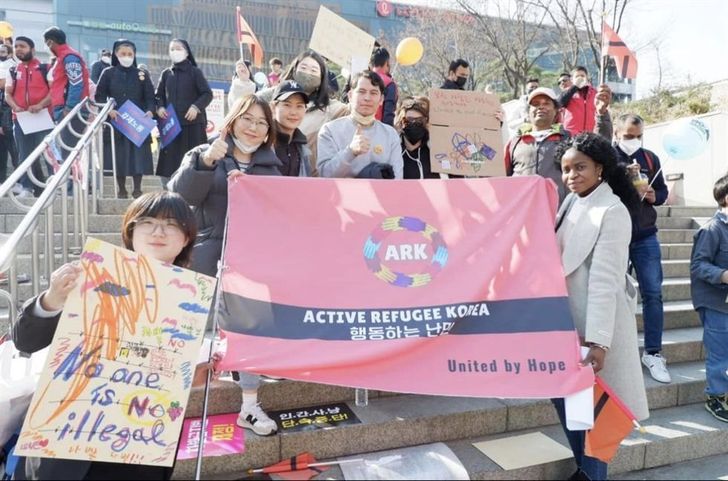
Members of Active Refugee Korea rally in front of Seoul Station on March 19 to commemorate International Day for the Elimination of Racial Discrimination. An Afghan refugee, center behind the flag, who met the activist group for the first time at the event, joined the rally. Courtesy of ARK
Social networking sites are ARK's main communication channels with the public. The three Korean facilitators from ARK posted an ad on Facebook looking for foreign activists and met Bereket from Ethiopia, Dorcas from the Congo and Musab and Mariam from Egypt in 2021.
“We work as a team so everyone participates and shares ideas,” Dorcas told The Korea Times at Dongjak FM, a public underground space run by Seoul's southern district office of Dongjak where, according to Bereket, foreign residents of the city often visit for private meetings. She declined to share with The Korea Times why she came to Korea 13 years ago, because she was “tired of repeatedly speaking about her dark past publicly.”
Stand up and fight
ARK, which describes itself as an “ark for refugees from different countries,” stands up to fight for their rights rather than conform to Korea's immigration system and local society, which can at times be relatively unaccepting and difficult to assimilate into.
“This is probably the first initiative in Korea which is jointly laid out by refugees and local Koreans,” said Bereket.
A professional photographer and a freelance journalist for Pressenza, an international press agency, Bereket fled political usurpation in Ethiopia where he took part in a movement against a rising faction and came to Korea in 2014.
The Koreans and the foreign activists have different roles. The facilitators, using their familiarity with the country, arrange an “empty space” in the country, like a framework, for the rest of the members to fill with their own perspectives and values. This is how ARK strives to be strictly refugee-oriented instead of being planned and orchestrated by Koreans who support refugees.
“Sometimes it feels time-consuming, but we make some consensus where we can all do it together,” Kang Eun-sook, one of the facilitators for ARK, said. “It's very important because without ARK, there's probably no space in the country where refugee activists (from diverse backgrounds) can get together apart from specific ethnic communities or origin of country.”
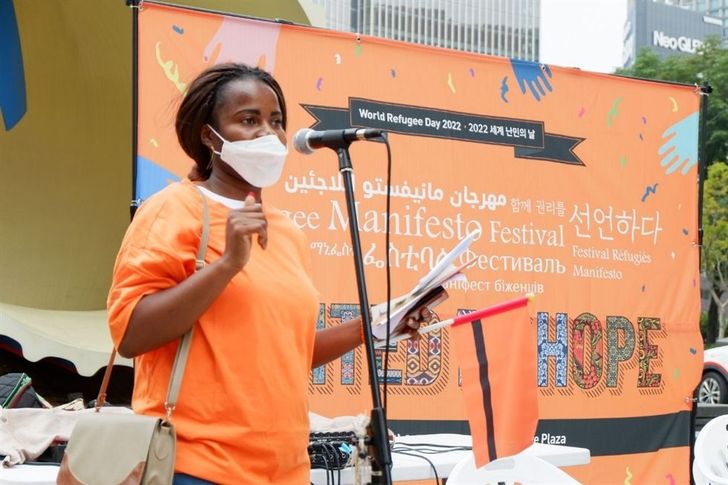
Dorcas, one of the members of Active Refugee Korea, speaks during “Refugee Manifesto Festival, United by Hope” at Cheonggye Plaza in Jongno District, Seoul, on June 19, 2022. The group declared its manifesto on World Refugee Day. Courtesy of ARK
One of ARK's pillars is self-empowerment. It's the group's attempt to shatter the traditional image of refugees as victims of aggression and passive beneficiaries of humanitarian assistance. It is how refugees in the country have so far seen themselves and how the country expected them to be.
The group deems it as a form of entrapment, which negatively impacts them, robbing them of their right to publicly speak up and make demands. The group engages in various workshops inviting lawyers and other local experts. This is done as a way to learn and understand more about the country, which leads the group to position itself better in Korean society and come up with demands within legal boundaries.
“Bereket and Dorcas have lived in Korea for about 10 years, but they haven't had a chance to learn about exactly what's happening in the country,” said Kang. “So we needed to educate ourselves and learn about this society.”
Another pillar is networking with refugees in the country so that ARK can become a bigger ark for more of them regardless of their ethnic, religious and racial backgrounds. The biggest hurdle so far has been that refugees never had a common platform and could not make a united voice.
The Korean government should learn from other countries regarding how they acquire leverage from refugees, ARK said. Although the country has policies designed to help multicultural families and operates local cultural centers for refugees and migrants, it still considers the foreigners as a burden ― when they should be the subject of more inclusive policies, the members added.
“Unlike European and North American countries, the Korean government doesn't have many strategies to integrate and assimilate refugees into Korean society. The government isn't using its power or energy to advocate such initiatives. They don't appreciate such diversity and try to reverse some of the laws to misuse propagandas and use them against refugees,” said Bereket. “Refugees can still engage in economic activities and contribute to the country with whatever they're capable of. They should be considered cultural migrants with wills to survive in this country.”