Yoon says ROK-US alliance undeterred by spying allegations

President Yoon Suk Yeol speaks during a Cabinet meeting at the presidential office in Yongsan District, Seoul, Tuesday. Joint Press Corps
By Nam Hyun-woo
President Yoon Suk Yeol said Tuesday that the U.S. and Korea share “a resilient, value-based alliance” which can “address any problem” between them. The latest comments appear to be an effort to downplay possible friction with Washington stemming from allegations that the United States may have spied on Korea's presidential secretaries.
“The relations between Korea and the U.S. do not realign depending on benefits,” Yoon was quoted as saying by presidential spokesperson Lee Do-woon. “It is an alliance which is based on the universal values of liberal democracy and market economy, and it is a resilient value-based alliance which can address problems in their relations.”
The remarks were aimed at criticism that Korea's presidential office is downplaying the seriousness of the spying allegations, which were revealed in leaked Pentagon documents, because Seoul does not want to spoil the mood for Yoon's scheduled state visit to the U.S. next week.
Multiple presidential secretaries and ministers have spoken about the Yoon administration's stance on the spying allegations, but this is the first time that the president has commented on the issue.
“Brothers may fight each other for various reasons, but that does not mean they are no longer brothers or family,” an official at the presidential office said. “Even allies can experience contradicting economic or other interests. However, if they can narrow their differences through trustful conversations and negotiations, the problem can be solved within the framework of the alliance.”
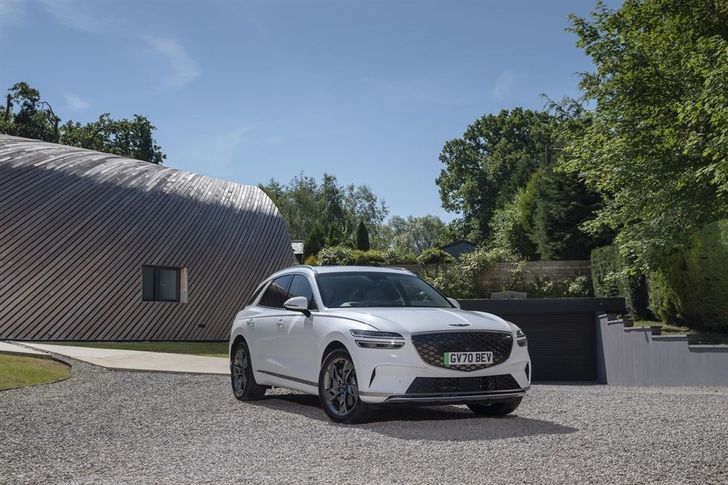
The electrified GV70 / Courtesy of Hyundai Motor Group
Along with the spying allegations, Yoon's comments are also interpreted as a response to the U.S. Treasury Department's announcement, Monday (local time), that Hyundai Motor's electric vehicles (EVs) will not be eligible for a $7,500 tax credit under new rules for battery sourcing.
The rules, which were announced among provisions to last year's Inflation Reduction Act (IRA), included 22 models manufactured by seven carmakers as being eligible for the tax credit, since the vehicles were assembled in North America and their rechargeable batteries met the requirements on the origin of manufacturing and key mineral components.
Hyundai's electrified GV70 is manufactured at the carmaker's plant in Alabama, but was excluded from the tax credit, because the model uses batteries produced in China.
Despite concerns over the Korean carmakers' U.S. sales, the presidential office said the damage is not as serious as feared, while the new rules provide greater opportunities for Korean battery makers.
“In December, EVs that are leased and used as rental cars became eligible for the $7,500 tax credit whether or not they are finally assembled in the U.S.,” senior presidential secretary for economic affairs Choi Sang-mok said. “As a result, Hyundai Motor Group's U.S. sales continue to expand compared to August of last year (when the IRA was first implemented).”
“If Hyundai Motor's EV plant in Georgia begins mass producing EVs in the second half of next year, the company will be able to meet the first requirement of manufacturing vehicles in the U.S…. Given the number of models receiving tax credits has declined, it is not as bad as it seems for Korean carmakers in the U.S. market.”
Choi added that 17 out of 22 models that became eligible for the tax incentive use batteries produced by Korean companies, thus the new rules have become “a huge opportunity” for them.