Will Yoon visit Japan for summit to mend frayed ties?

President Yoon Suk Yeol shakes hands with Japanese Prime Minister Fumio Kishida during their summit in New York, Sept. 21, 2022. Courtesy of presidential office
Seoul plans to suspend WTO dispute settlement process to reach agreement with Japan
By Nam Hyun-woo
As the South Korean government announced its resolution on the wartime forced labor issue, Monday, chances are growing that President Yoon Suk Yeol will visit Japan within this month and consolidate his idea for trilateral security cooperation between Seoul, Washington and Tokyo to be the linchpin for countering North Korea's nuclear and missile threats.
There is growing expectation for a summit with Prime Minister Fumio Kishida after the Korean government proposed Monday to compensate South Korean victims of Japan's wartime forced labor via a Seoul-based public foundation, which Kishida welcomed saying the move will help mend relations between the two neighbors.
According to government sources, the South Korean presidential office and diplomatic authorities of Seoul and Tokyo are coordinating on Yoon's visit to Japan, which could happen as early as this month.
Given that Japan is about to pass its government budget for the 2023 fiscal year, and Prime Minister Kishida is planning a three-day visit to India from March 19, Yoon's visit to Tokyo, if it takes place, will likely be during the last week of the month.
An official of the presidential office said talks have not begun for a South Korea-Japan summit, but chances are high.
“After former Japanese Prime Minister Yoshihiko Noda visited South Korea in November 2011 and former President Lee Myung-bak visited Japan the following month, the reciprocal visits between the two countries' leaders have been suspended for 12 years,” the official said. “With the two countries' governments acknowledging this, chances are open for negotiations on this matter.”
“Consultations between diplomatic authorities of South Korea and Japan are now in their final stages,” Korea's National Security Director Kim Sung-han told reporters Sunday. “There will be an official announcement at the appropriate time, if important measures for opening a new era in Korea-Japan relations are established.”
Kim continued that if the forced labor issue is addressed, the two countries will be able to improve bilateral ties and trilateral cooperation involving the United States. “For this, the two countries' leaders should meet and cut the Gordian knot, and then take care of pending issues in a prompt manner,” Kim said. Cutting the Gordian knot refers to solving intractable problems in a quick and decisive manner.
One of the Seoul-Tokyo frictions that can be resolved is Japan's export restrictions on key industrial materials to South Korea.
In protest to Seoul's Supreme Court ruling in 2018 ordering Japanese companies to compensate forced labor victims, Japan removed South Korea from its list of fast-track trade partners and restricted the exports of materials vital for the semiconductor industry. South Korea filed a complaint against the restrictions with the World Trade Organization (WTO) in 2019.
Hours after the South Korean government announced the resolution, its Ministry of Trade, Industry and Energy announced that it will suspend the WTO dispute settlement processes it initiated and the two countries' governments will engage in discussions in order to “return the current trade status back to that of July 2019.”
This is another conciliatory gesture given that Japan intends to lift the trade restrictions depending on Seoul's gesture. Japan's Yomiuri Shimbun reported that the Japanese government is considering lifting its export restrictions if South Korea drops its WTO complaint. The Nikkei also reported that the Japanese government may lift the restrictions if the forced labor issue is addressed.
Outlook is also positive on getting the two countries' General Security of Military Information Agreement (GSOMIA) back on track.
The GSOMIA is a bilateral security agreement between South Korea and Japan to share sensitive military and intelligence information. The former Moon Jae-in administration nearly let the pact expire in 2019 in response to Tokyo's tightened controls on exports to Seoul.
However, South Korea conditionally suspended the decision to terminate the agreement, following a resolution passed in the U.S. Senate calling on Seoul to renew it, leaving the pact in a somewhat unstable state, as the South Korean government had said that it could scrap the GSOMIA at any time.
If the agreement returns to its previous status, it will come as a boost for Yoon's aim of taking advantage of the Seoul-Washington-Tokyo trilateral security cooperation as an important framework to counter Pyongyang's threats.
If those matters show signs of progress, observers said the two countries leaders may resume visiting each other regularly. In 2004, then President Roh Moo-hyun and then Prime Minister Junichiro Koizumi agreed to visit each other's country every year, but this has been halted and resumed depending on the status of bilateral relations at any given time.
Even if Yoon and Kishida do not meet later this month, chances are still open for them to have a meeting on the sidelines of the Group of Seven Summit scheduled for May. South Korea is not a member nation of the organization, but Yoon is anticipated to receive an invitation as the leader of an observer country.
The U.S. would likely see improved Seoul-Tokyo relations as desirable progress, as the superpower has been signaling that it wants to use the Seoul-Tokyo-Washington security cooperation as a tool to contain China's assertive territorial claims and advances. Yoon is anticipated to visit the U.S. in late April.
“Today's announcements between the Republic of Korea and Japan mark a groundbreaking new chapter of cooperation and partnership between two of the United States' closest allies,” U.S. President Joe Biden said in a statement. “When fully realized, their steps will help us to uphold and advance our shared vision for a free and open Indo-Pacific.”
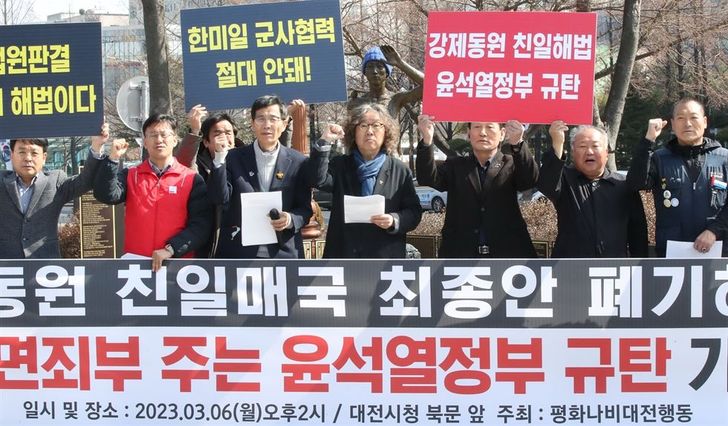
Civic group members stage a rally denouncing the Korean government's resolution on compensating South Korean victims of wartime forced labor by Japanese companies, in Daejeon, Monday. Yonhap
However, it remains uncertain how Yoon's efforts to improve ties with Japan will affect South Korea's domestic politics. The main opposition Democratic Party of Korea (DPK) is slamming the resolution, calling it “a surrender to Japan,” while Tokyo is still showing a lukewarm response.
While appearing at Japan's House of Councilors Budget Committee, Monday, Kishida said that his administration has succeeded former Japanese administrations' perceptions on history.
This is interpreted as meaning that Japan will uphold the 1998 joint declaration issued by then President Kim Dae-jung and then Prime Minister Keizo Obuchi, which contains Tokyo's "deep remorse and heartfelt apology" over its colonial rule of South Korea, but will not make new apologies reflecting its imperial history.
Given the South Korean public's anti-Japan sentiment, Yoon's overture to Japan is not likely to help his approval ratings. An official at the presidential office said, “We are already expecting a public backlash or a drop in the approval rating, but the president believes it is time to make a decision for the sake of the country's future.”
In 2019, the conservative Liberty Korea Party, a predecessor of the current ruling People Power Party, saw its approval rating plunging after calling for a negotiation-based dovish approach.