Gov't to boost visa issuances to foreign workers to meet labor shortage at small businesses
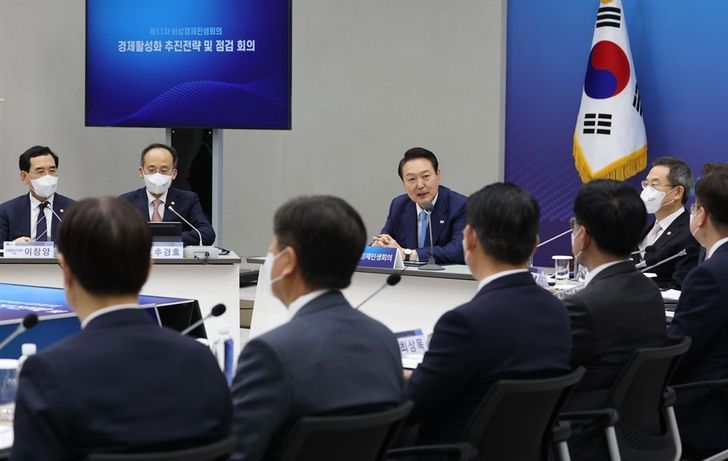
President Yoon Suk-yeol speaks during an emergency economic meeting with economy-related ministers and presidential secretaries at the presidential office in Yongsan District, Seoul, Thursday. During the nationally televised meeting, Yoon stressed the government's efforts to reinvigorate the economy and people's livelihoods. Yonhap
Yoon stresses government's full-fledged efforts to reinvigorate economy
By Nam Hyun-woo
The government will expand the issuance of work visas to foreigners to a record high next year, in an effort to assist small businesses suffering from a shortage of workers, the labor minister said during a presidential meeting on the economy, Thursday.
During the emergency meeting at the presidential office in Seoul, Minister of Employment and Labor Lee Jung-sik said the government will issue E-9 visas to 110,000 foreigners next year. The E-9 visa is given to foreigners seeking manual jobs at small- and medium-sized businesses here.
“As far as I know, small enterprises are suffering from a serious shortage of workers,” Lee said. “This year, we allowed 70,000 foreign workers to enter, and the number will be expanded to 110,000 next year, which will be the largest since the country introduced the work permit system,” he added.
According to the ministry, the number of foreign workers holding E-9 visas stood at 277,000 in December 2019. But the number declined to 218,000 in December of last year largely due to the COVID-19 pandemic.
Out of the 110,000 new work permits, 75,000 will be distributed to the manufacturing industry, 14,000 to the agriculture and livestock industries, 7,000 to the fisheries industry, 3,000 to the construction industry and 1,000 to the service industry. The remaining 1,000 will be allocated depending on demand.
Along with the employment ministry, the economy and industry-related ministries also proposed policies to reinvigorate the country's economy during the emergency meeting presided over by President Yoon Suk-yeol.
“The public is asking about the government's policies and action plans to reinvigorate the country's economy and investments, which slowed because of high interest rates,” Yoon said during the nationally televised meeting. “The government should come up with thorough measures to revitalize the economy, to provide better uniforms and running shoes for the private sector so they can run faster.”
During the meeting, Deputy Prime Minister Choo Kyung-ho said boosting the country's exports is the key to resuscitating Asia's fourth-largest economy and the government will focus on the semiconductor, rechargeable battery, shipbuilding, nuclear power, defense and construction industries.
Land, Infrastructure and Transport Minister Won Hee-ryong pledged to ease the country's loan-to-value (LTV) ratio regulation and allow people to obtain mortgage loans when purchasing apartments worth more than 1.5 billion won or $1.05 million. The LTV ratio is used by banks to determine the risk of offering loans. Aiming to curb real estate speculation, the previous administration prohibited banks from offering mortgage loans to people purchasing apartments worth more than 1.5 billion.