SK E&S' partner firm in Australia faces legal dispute over gas drilling project

Denis Tipakalippa, a senior lawman on Tiwi Island, represents the Munupi clan that filed a lawsuit against Australia's regulator over the planned Barossa gas field project. Courtesy of Solutions for Our Climate
Munupi natives worried drilling near Tiwi Islands will disrupt maritime ecology
By Ko Dong-hwan
Korean energy firm SK E&S' drilling project in Australia is facing a hurdle, as its partner company there has become embroiled in a legal dispute surrounding the development.
Indigenous Australians in the northern Tiwi Islands have challenged the country's environmental regulator for allowing Santos, an Australian energy firm and the partner of SK E&S in the planned project at Barossa gas field, to drill for gas near the islands despite environmental concerns.
The Munupi people argued that they were never consulted by Santos even though they live just five kilometers away. They fear that the drilling operation could seriously disrupt the marine ecosystem in the area.
The National Offshore Petroleum Safety and Environmental Management Authority (NOPSEMA), an Australian independent regulator, authorized Santos in March to drill up to eight gas wells off the northern coast of the islands. NOPSEMA, in accordance with Australia's Offshore Petroleum and Greenhouse Gas Storage Act of 2006, is required to listen to the voices of Indigenous people and take into account their concerns before approving any offshore energy-extracting operations.
Denis Tipakalippa, the island's senior lawman who represents the natives, said his people were never given an opportunity to question the firms over the environmental risks of the project.
“Santos say they did consultation for this drilling project, but no one spoke to me as a traditional owner and senior lawman for the Munupi clan,” Tipakalippa said. “My clan, the Munupi, owns these Northern Beaches. It's our land that's closest to the drilling site. We are the ones who are going to be affected. They never came to me in person or face to face.”
The islanders say the drilling proposal poses a fundamental threat to their food sources, culture and way of life. Tipakalippa and his community are particularly concerned by the impact on the maritime community if an oil spill occurs. He is also worried that increased shipping may interfere with the breeding patterns and nesting grounds of turtles, dugongs, whales and other marine species essential to Tiwi ceremonies and culture.
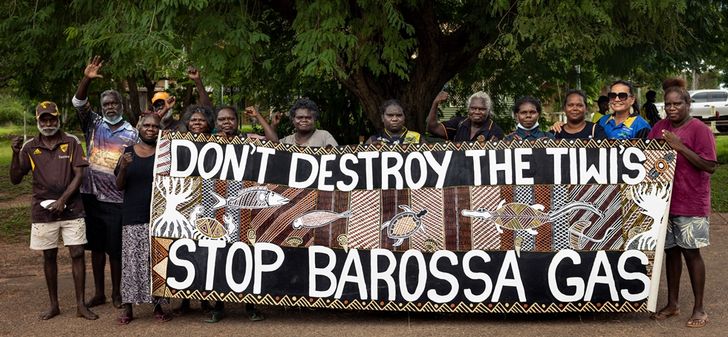
Tiwi islanders in Australia hold a banner they made to protest the Barossa gas field project in waters north of Australia in May. Courtesy of Solutions for Our Climate
“The drilling may be out in the ocean, but that's our sea country and we know how the waters move. I'm also worried about all the noise from the choppers overhead and all those big ships going by. The turtles could be killed by those ship propellers, their shells all chopped up. Or they will be scared away and not nest here anymore,” Tipakalippa said.
Alina Leikin at Environmental Defenders Office based in Australia, who advocates for the Indigenous people, said Santos had a legal obligation to consult with residents who might be impacted by the drilling.
“The stakes couldn't be higher for the Tiwi community,” Leikin said. “Their food source, their traditional practices, their culture and the country they've protected for millennia will be at risk if this drilling goes ahead. These waters and the life within them mean everything to Dennis and his community, but they didn't have a chance to voice their concerns before the drilling was approved. They were sidelined from the consultation process.”
Leikin said this case could establish what constitutes adequate consultation with First Nations people in relation to offshore gas developments.
“It could have significant implications on how mining companies view their consultation obligations with First Nations people,” she said.
This isn't the first time that the Barossa gas operation was faced with a lawsuit.
In March this year, indigenous people from Jikilaruwu, some 40 kilometers southwest of Munupi, filed an injunction application to a Korean court to ban Korea Trade Insurance Corporation and the Export-Import Bank of Korea from financially supporting the Barossa gas operation. The two Korean financial entities said last year they were going to invest $700 million in the drilling project. SK E&S said they were going to invest $1.4 billion in the project and start gas production in 2025.
But the court in May dismissed the application, saying the Korean financial entities did not seem to cause direct harm to the Indigenous people, since their human and environmental rights can be redeemed later by the Australian authorities.
“Korean courts have long been passive to acknowledging environmental rights,” Solutions for Our Climate (SFOC), a Seoul-based climate activist group, said following the court's “disappointing” decision. “During the past decade, Korean public financial entities have been investing over 141 trillion won ($110 billion) in overseas fossil fuel extraction operations, the top amount among G20 nations, fueling the global climate crisis.”
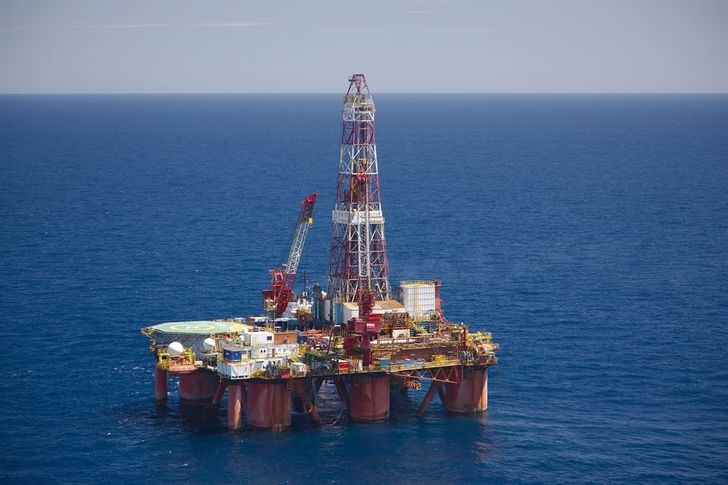
Barossa-Caldita offshore gas field underwater is being explored in March 2021. Barossa and Caldita are two regions where gas fields are close to each other. Santos, SK E&S and JERA invested in gas extraction projects in these regions. Courtesy of SK E&S
International observers have also criticized the Barossa prject as SK E&S' greenwashing business. The firm promoted the project as “carbon neutralized liquid natural gas” (LNG). But according to a document submitted by the Export-Import Bank of Korea to the National Assembly of Korea, the carbon capture and storage (CCS) technology the firm plans to use in the gas field will reduce only 16 percent of greenhouse gases generated during the operation.
“The operation includes transporting collected carbon emission along a 900-kilometer-long pipeline, which is rare in a CCS project,” SFOC said. “The job will generate extra greenhouse gas, making the CCS technology actually ineffective and useless in this particular project.”
SK E&S said it hopes the ongoing dispute between Santos and the Indigenous people is resolved as soon as possible. Santos is the biggest shareholder in the Barossa gas field project, while SK E&S owns a 37.5 percent stake and some is also owned by Japanese energy firm JERA, according to the Korean firm.
“We understand that Santos keeps trying to communicate with the natives,” an official from the company told The Korea Times. “Their discussion will continue as the planned project will obviously have to take into account environmental protection issues.”
The official disagreed with the criticism that the project is greenwashing. Out of 40 million tons of LNG Korea will import from the project's production, 1 million tons will be used for blue hydrogen production, which is the environmentally cleanest form of hydrogen, once the gas field starts pumping in 2025.
“There are many LNG projects going on around the world, but very few of them are employing CCS right now,” the official said.
The official said Korea needs LNG for energy security, especially amid the current global situation where energy-exporting countries, including war-torn Ukraine, tend to not export their energies in favor of their own domestic consumption.
“LNG contributes to national greenhouse gas reduction. Besides, without LNG imports, a country like Korea without much energy resources to harvest domestically will face an energy shortage crisis,” the official said.