Israeli dancer explores human nature

Israeli dancer and choreographer Oded Ronen performs “More than Human” with Tav Zfania on an outdoor stage at Haeundae Beach in the southern port city of Busan, June 4, as part of the 2022 Busan International Dance Festival. Courtesy of BIDF and Ha Bonggeol
More Israeli dance works to come to Korea later this year
By Kwon Mee-yoo
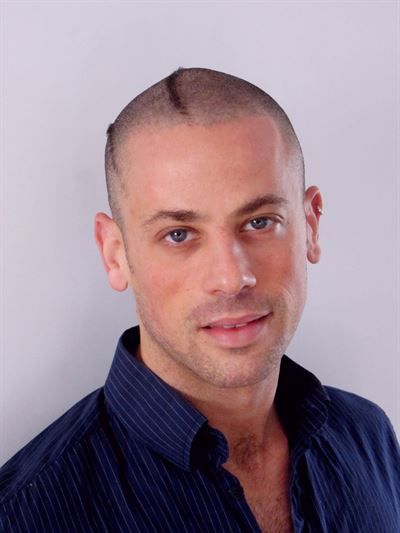
Israeli dancer and choreographer Oded Ronen
Israeli dancer and choreographer Oded Ronen presented "More than Human," a dance exploring fragility and human connections, during the 18th Busan International Dance Festival (BIDF), June 4.
On the outdoor stage in Haeundae Beach, Ronen and his dance company member Tav Zfania danced while clad in a suit and a helmet and performed highlights of the dance piece Ronen created during the pandemic.
"More than Human" is a new work by Ronen, premiered in Tel Aviv in May.
"This work is about human fragility. I started working on this in the beginning of the pandemic and it took two years to create," he said during an interview with The Korea Times at the Israeli Embassy, June 8.
"As you see the dancers are completely covered and this is originated from the suits of the medical teams in the beginning. I was very interested in the fragility of not being able to breathe and the balls in the work represent pockets of air."
Ronen took interest in this global reality and created the piece showing a deep connection between two people in a crisis.
"For the first time in history the entire world was facing the same fragility at the same time. Everyone was concerned about not being able to breathe. And this is why the work is relevant to any country and especially Korea, because the country took the measures of the pandemic very seriously," he said.
Ronen was trained in the United Kingdom and danced in many countries including Greece, Portugal and the U.K., but he returned to Tel Aviv and founded his own company, where he dances in his own works.
"When I lived abroad for a long time, I found myself yearning to come back to Israel all the time. Since I'm back in this environment, which is very unique culturally and still struggling. It has this human hybrid of tension and survival and high level of artistry. I find my inspiration there and then I can take it to other places."
The Israeli choreographer said he is open to opportunities to collaborate with Korean dance companies or dancers.
"Each dancer brings their own language and style and inspiration and imagination. I'm not the kind of choreographer who brings movement and tells dancers to do the movement. I bring a concept and each dancer brings their way of interpreting and they are always right," he said.
"There is an under-the-surface tension in Korea with its neighbors. It's something you don't feel on the street, but it exists in the soul of Korea. I'm interested in this energy of Koreans. From what I saw, they are very collected and very open, but still facing this ground, shaking underneath their feet, just a tiny bit all the time. This is something I would like to explore physically with Korean dancers."
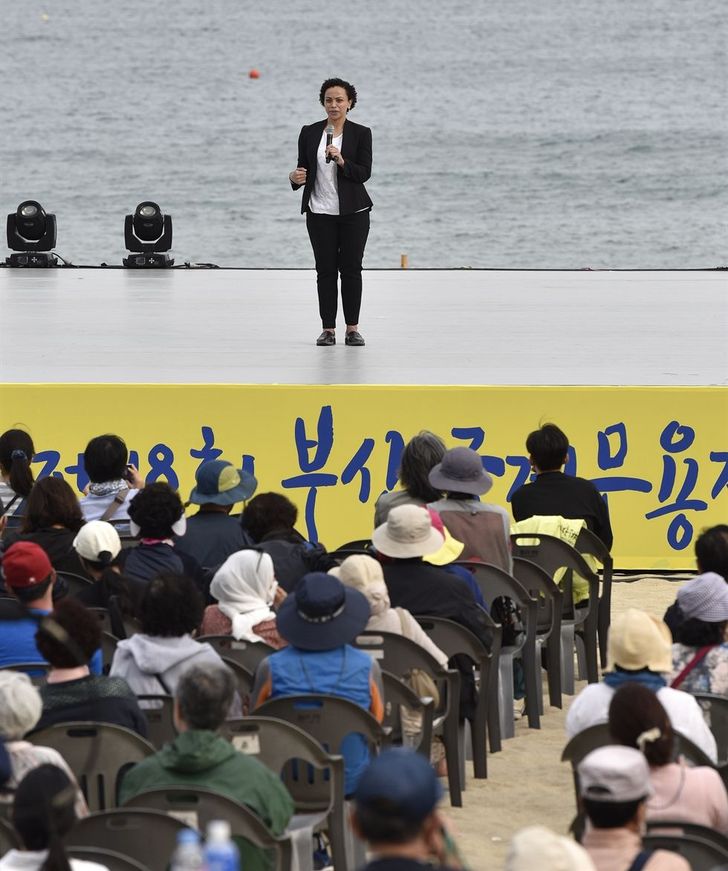
Rasha Atamny, deputy chief of mission at the Embassy of Israel in Korea, introduces Israeli dance in Haeundae, Busan, June 4. Courtesy of BIDF and Ha Bonggeol
Power of Israeli dance
Israeli dancers and dance companies are staple to dance festivals in Korea. Especially this year, more dancers from Israel are visiting Korea on the occasion of the 60th anniversary of diplomatic ties between Korea and Israel.
The International Modern Dance Festival (MODAFE), running from June 3 to 26, offers the Israel Focus section this year. Sharon Eyal and Gai Behar's L-E-V was chosen to open the festival with "Chapter 3: The Brutal Journey of the Heart" and received enthusiastic responses from Korean audiences.
Ronen described contemporary Israeli dance as a hybrid of movement that is raw.
"There's something very raw about Israeli dance, which means that the body really sticks in motion. And under constant threat, there's a sense that the body needs to speak out something about survival. I think this appeals to many countries, especially Korea, which seems to artistically anchor itself in the past and look forward to the future at the same time," he explained.
Rasha Atamny, deputy chief of mission at the Embassy of Israel in Korea, agreed with Ronen.
"I think about contemporary dance in Israel as the representation of the fabric of the country. It is a young country, so you see this excitement. Also in the Israeli dance, you see determination, which is a major factor in having a new country," Atamny said.
"Another aspect that I would like to add is that in Israel, multicultural communities are an asset. When Israel was established, Jewish communities from all around the world came to Israel and all of these dances met together in Israel. The more styles you see, the more creative your process becomes. This kind of integration between your own history incorporates itself into the new history, which is Israel."
More Israeli dance will be presented in Korea later this year. In September, “Shape on Us” by Vertigo Dance Company and Shahar Binyamini's “Evolve” will be presented during the Seoul International Dance Festival. The Avshalom Pollak Dance Theater will present “Antu” and “Cocoon” in collaboration with a Korean dance company at the Busan International Dance Market.
Atamny said culture is something that constantly represents a country while governments and politicians change all the time.
"From my perspective, also as a diplomat, if I want to learn about a nation, the first thing I study is culture. In a certain performance or a certain piece of art, there's a piece of the soul of that nation and you can transcend the barrier of language," she said.
"We're trying to showcase the richness of arts and culture in Israel to celebrate the 60th anniversary of Israel-Korea relations as much as we can. There's harmony and synergy between these two countries and we want it to come to light and we want to share the celebration.”