Japanese artist remembers war time sex slavery

Yoshiko Shimada, right, gives a performance during a weekly demonstration against Japan's wartime atrocities. The artist represents the Japanese victims of Japan's wartime sex slavery, next to the state of a girl symbolizing Korean victims in front of the former Japanese Embassy building in Seoul, May 1. Courtesy of Yoshiko Shimada
By Bahk Eun-ji
The brutality of Japan's sex slavery came to light when late former sex slave Kim Hak-soon, then 67, publicly testified about her experience for the first time in 1991.
When Yoshiko Shimada, a trailblazing Japanese artist, first heard the testimony in 1992, it was the moment she decided to pay tribute to “comfort women,” the term used for the hundreds of thousands of women who were forced into sex slavery by Imperial Japan before and during World War II.
During the period, women from a number of countries, mostly Korea, China and the Philippines, were forced to provide sex to Japanese soldiers, and the legacy of the issue has continuously been a source of trauma, shame and anger.
“I felt strong sympathy to her as a woman, but at the same time, I felt tremendous guilt as a Japanese,” Shimada said during a recent email interview with The Korea Times.
“What really bothered me was Japanese' turning a blind eye to the inconvenient reality.”
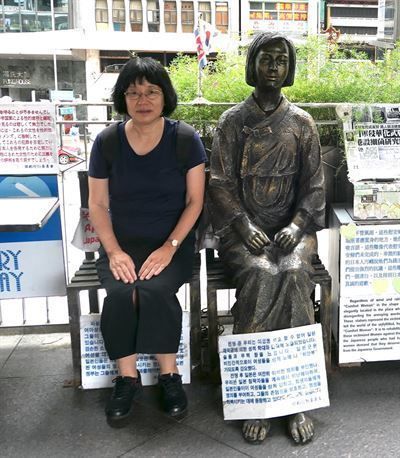
Yoshiko Shimada /Courtesy of Yoshiko Shimada
While grappling with the uncomfortable wartime legacy of Japan, especially related to women, she came to know in the late 1990s that there were Japanese comfort women, who were mostly “sold” to brothels by their poor parents. But their existence has been ignored until recently, and Japanese right-wingers have not recognized them as sex slavery victims.
Those on the Japanese right keep insisting the Japanese sex slaves were mere prostitutes and therefore there was no need for compensation, and they use this logic for foreign comfort women as well, claiming they ― including Koreans ― were also prostitutes, not slaves, Shimada said.
“However, I think all of the comfort women, Japanese or otherwise, forced or not, were all slaves, as they had no freedom to quit or move, and I believe the Japanese government must apologize to them as well for violating their human rights.”
But she said she acknowledges there are differences among comfort women and is not lumping them all together, especially Korean and Japanese.
Shimada has been doing guerrilla performances as the statue of a girl, which symbolizes comfort women.
“It is a gesture to remember their existence,” she said.
On May 1, she had a performance of “being a statue of a Japanese comfort woman” in Seoul, and she said she would like to perform in Korea again if she has an opportunity.
Recently Shimada has been encouraging artists and civic activists around the world to upload photos of themselves imitating the statue, after one such statue on display at the Aichi Triennale International Contemporary Art Festival was removed last month following opposition from far-right groups in Japan.
The movement was started by Mexican feminist Monica Mayer, a participant in the exhibition, when she sent Shimada a photo of herself posing like the statue in protest of the censorship.
“We have received nearly 100 photos from artists and activists from abroad including Korea, Mexico and Italy. There will be a conference in the U.S. about the censorship, and I hope to present them in some form,” she said.