North Korea provides unprecedented, nearly real-time reports on typhoons

A North Korean journalist reports on Typhoon Haishen which passed along the country's east coast, on location in the typhoon-hit city of Kimchaek, North Hamgyong Province, for the state-run broadcaster Korean Central Television (KCTV), Monday. / Yonhap
By Park Han-sol
A journalist stands in a flooded street, his umbrella helplessly turned inside out in the strong wind, as he continues an onsite report about the effect of Typhoon Haishen amid a torrential downpour.
With North Korea being hammered by consecutive typhoons in just three weeks, its state-run broadcaster Korean Central Television (KCTV) took the unprecedented step of having live onsite reporting and staying on air throughout the night to deliver nearly real-time reports of storm damage. Such reporting was a big divergence from the country's normally rigid schedule and style of broadcasting, where only pre-organized, overly-edited messages and images are delivered.
On weekdays, KCTV typically broadcasts from 3 p.m. to 10:30 p.m. However, a noticeable change took place Aug. 26, when Typhoon Bavi hit the North's southwestern region. Throughout the day, multiple warnings from the State Hydro-Meteorological Administration were aired on the typhoon's projected path and its impact.
Instead of signing off according to its usual schedule, the broadcaster continued to air overnight, with typhoon updates on wind speed and affected regions in the form of “breaking news” repeatedly interrupting or appearing as subtitles during screenings of movies and other programs.
Real-time onsite reports were also given ― reporters in soaked raincoats spoke about the typhoon's latest developments while finding themselves knee-deep in water and being battered by torrential rain in various regions including Pyongyang, Ongjin, Nampo, Sariwon and Wonsan. The clips depicted a disastrous mess of damaged houses and bridges, fallen power lines, and trees uprooted by the typhoon. Such reports are similar to storm coverage seen outside the regime, including South Korea.
KCTV's atypical broadcasting and live updates during its usually off-air hours took place again from Sept. 2 to 3 when Typhoon Maysak pounded the country and on Monday when Typhoon Haishen arrived.
As to the changes in reporting, Go Myong-hyun, a senior fellow at the Seoul-based Asan Institute for Policy Studies, said the North was trying to rely on a more technologically advanced and modernized system.
“It seems the regime is trying to show its people more modern scenes that are usually seen in other countries,” Go said. “It is the Kim Jong-un regime's consistent policy: showing the modernization of the country and a vision of the future, portraying him as a leader who cares for the people.”
However, he said that while showing the situation to the people may be better than blocking their access to information outright, it doesn't always guarantee transparency. “Like other authoritarian countries, it allows people's access to information but at the same time it can always manipulate and distort the information.”
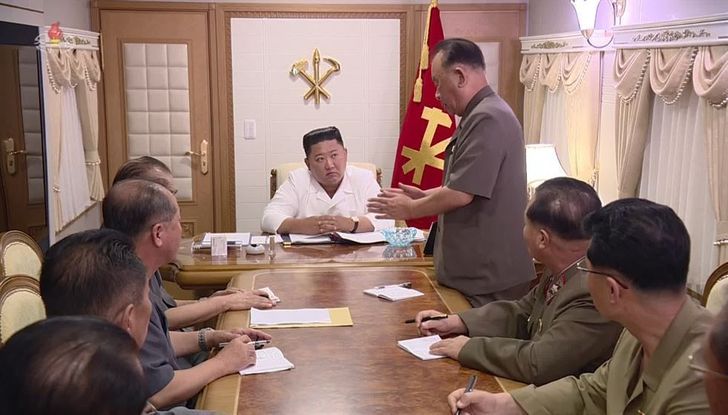
North Korean leader Kim Jong-un presides over a Workers' Party meeting in typhoon-hit South Hamgyong Province to discuss recovery efforts, Saturday, according to the KCNA. / Yonhap
North Korea's active response to typhoon damage has extended beyond the KCNA's real-time broadcasts as its leader Kim Jong-un has been visiting storm-hit regions since Typhoon Bavi. On Saturday, he even presided over a ruling Workers' Party meeting during a visit to South Hamgyong Province and discussed recovery efforts, according to state media.
During the meeting, Kim dismissed the chairman of the party's committee in charge of the province for failing to take proper measures to deal with the typhoon. In an open letter to party members in Pyongyang, Saturday, Kim noted that he had dispatched 12,000 elite party members to two affected provinces to help in recovery and reconstruction efforts.
Some experts viewed the North's handling of the recent series of natural disasters to be a part of Kim's carefully constructed image as a leader who cares for his people.
“Typhoons directly affect the everyday lives of the people. By rebuking party officials who remain apathetic and complacent and urging them to actively respond to the natural disasters, Kim is presenting himself as a leader who pays attention to the lives of his people,” said Lim Jae-cheon, a professor of Korean unification, diplomacy and security at Korea University.