Koreans have high life expectancy, but don't think they are healthy
Summary
Koreans had the fifth-highest life expectancy among OECD member countries in 2017, but only 29.5 percent said they were healthy. The Ministry of Health and Welfare said newborns in 2017 were expected to live 82.7 years, helped by medical checkups, education, and developed medical services. Korea also had high hospital use, but relatively few doctors and nurses compared with the OECD average.
Key Facts
- Babies born in 2017 in Korea were expected to live 82.7 years, up 3.5 years from 2007.
- Korea had 29.1 MRI devices and 38.2 CT machines per 1 million people, both above the OECD averages.
- Korea had 2.3 doctors per 1,000 people and 6.9 nurses per 1,000 people, both below the OECD averages.
- Koreans visited hospitals 16.6 times a year on average in 2017, more than twice the OECD average of 7.1.
- Korea's suicide rate was 24.6 per 100,000 people in 2016, and suicide was the leading cause of death for people in their 20s.

By Bahk Eun-ji
Koreans have the fifth-highest life expectancy among Organization for Economic Cooperation and Development (OECD) member countries, but few of them think they are healthy, according to a government report.
The report released by the Ministry of Health and Welfare, based on data from the OECD, said babies born in 2017 are expected to live 82.7 years, up by 3.5 years from 2007. This is the fifth-highest in OECD countries, with its average at 80.7. Girls born in 2017 were expected to live 85.7 years, six years longer than boys.
The health ministry said the extended life expectancy was due to the improved health awareness with a higher level of education and government policies on medical checkups. Developed medical services is also one of the reasons for the hike, as Korea has 29.1 magnetic resonance imaging (MRI) devices and 38.2 computed tomography (CT) machines per 1 million people, higher than OECD average of 17.4 and 27.8, respectively.
Koreans visit hospitals most frequently among the OECD countries with an average of 16.6 times annually in 2017, more than twice the OECD average of 7.1. Koreans who were hospitalized also stayed at hospitals for 18.5 days on average in 2017.
But despite the frequent visit to hospitals, the number of doctors and nurses in Korea was smaller than the OECD average.
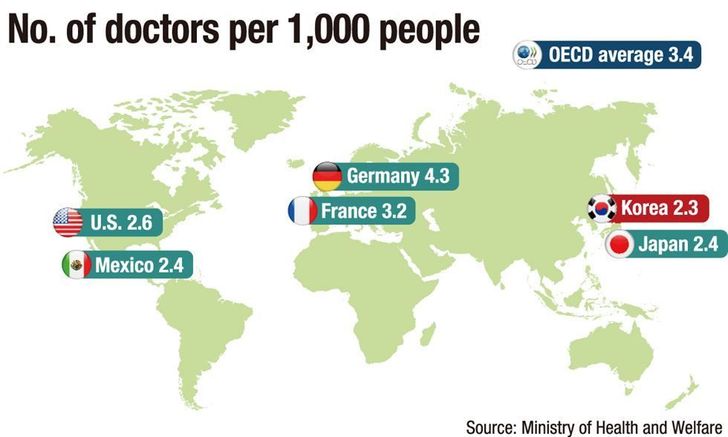
Korea had only 2.3 doctors per 1,000 people, which ranked at the bottom among OECD members, whose average is 3.5. The number of nurses per 1,000 people in Korea stood at 6.9, lower than the OECD average of nine. The number of sickbeds per 1,000 people was 12.3, the second-largest following Japan's 13.1.
The mortality rate due to major diseases such as cancer and heart diseases were also lower than the OECD average. In 2016, 165.2 per 100,000 people died from cancer here, lower than the OECD average of 200. About 147 Koreans died from circulatory problems, compared to the OECD average of 279.7. The mortality rate from dementia was 12.3 for Koreans versus 24.3 for the OECD.
Koreans' lifestyle directly related to their health has also improved, the report said.
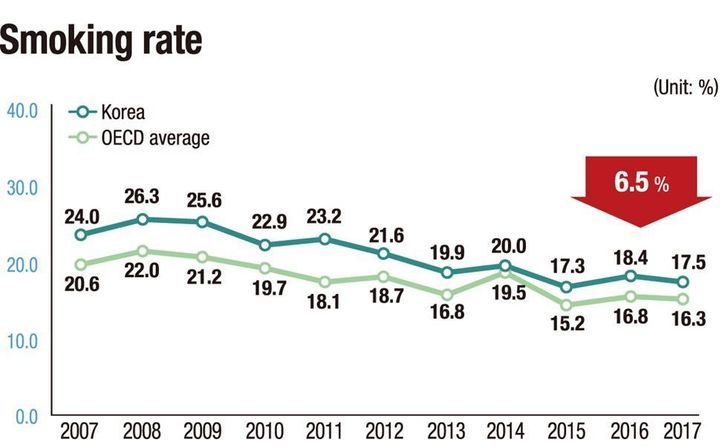
As of 2017, 17.5 percent of people aged 15 and older smoked every day, slightly up from the OECD average of 16.3 percent. The rate has been on the decline from 24 percent in 2007 to 21.6 percent in 2012 and 17.5 percent in 2017.
In the same age group, alcohol consumption per person in a year stood at 8.7 liters, slightly less than the OECD average of 8.9 liters.
The obesity rate in Korea was second-lowest among member countries, with 33.7 percent of people aged 15 or older being categorized as overweight or obese, while the OECD average was 59.3. However, the rate has been growing, as it was 31 percent in 2007 and 31.8 percent in 2012.
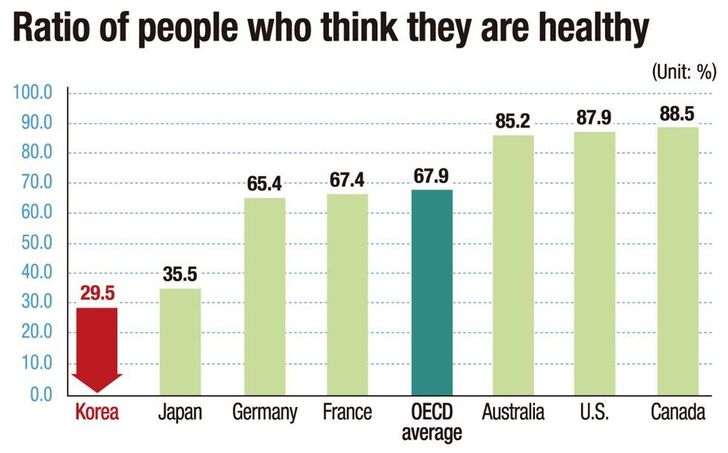
Despite better health, Koreans don't think they are in good health, as only 29.5 percent think they are healthy. The ratio was the lowest of OECD countries. Contrary to Korea, 88.5 percent of people in Canada and 87.9 percent in the United States think thought they were healthy.
Korea's suicide rate ranked second, with 24.6 out of every 100,000 people in 2016, after Lithuania with 26.7.
Although the overall suicide rate is on the decline ― the rate being continuously downward since 33.8 in 2009 ― suicide was still the leading cause of death for people in their 20s, accounting for 44.8 percent of all deaths in the age group.
Explore More
- Q.
- Q.
- Q.