Lawmakers from South Korea, US, Japan seek cooperation amid trade spat

A delegation of South Korean lawmakers, on the right, attend a trilateral meeting with their counterparts from the U.S. and Japan in Washington to seek to boost cooperation and resolve a trade dispute between Seoul and Tokyo, July 27. Yonhap
Lawmakers from South Korea, the United States and Japan met in Washington, Friday, to seek to boost trilateral cooperation and resolve a trade dispute between Seoul and Tokyo.
The biannual meeting, organized by The Maureen and Mike Mansfield Foundation, came at a time of tense relations between the two U.S. allies over Japan's adoption of stricter control of exports to South Korean companies earlier this month.
The controls, which affect the export of key materials used in the production of semiconductors and display panels, have been denounced by Seoul as retaliation for South Korea's Supreme Court's rulings ordering Japanese firms to pay compensation to South Koreans forced to work for them without pay during wartime.
Speaking to reporters after the meeting, the South Korean delegation said the differences in opinion between Seoul and Tokyo were made clear at the talks. The Japanese side, they said, argued that the measures were not retaliation but a result of Seoul's lax export controls, which allegedly caused some of the sensitive materials to end up in North Korea.
A South Korean lawmaker retorted that it was Japan that allowed that to happen.
"In any case, I believe the two countries reached a consensus that this issue is most appropriately dealt with through dialogue and negotiations," said Rep. Lee Sang-don of the minor opposition Bareunmirae Party. "We agreed that a cooperative regime among the U.S., Japan and South Korea is incredibly important for the three countries' prosperity and security."
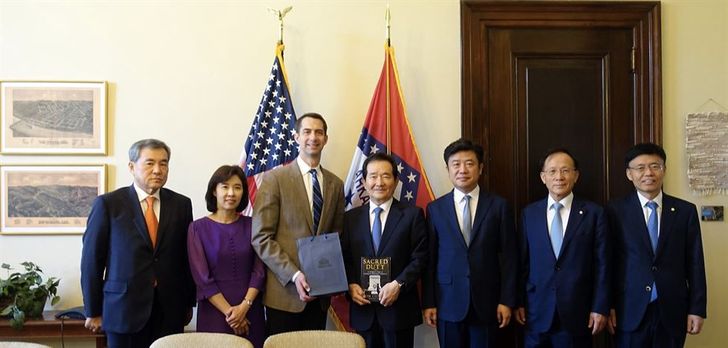
Members of a South Korean delegation to a Washington meeting with lawmakers from the U.S. and Japan, pose for a photograph July 25. Korean delegation leader, Rep. Chung Sye-kyun of the ruling Democratic Party, stands fourth from left, with Tom Cotton, the U.S. senator from Arkansas. News1
South Korea's bipartisan delegation was led by Rep. Chung Sye-kyun of the ruling Democratic Party, a former National Assembly speaker, and was made up of the ruling party's Park Kyung-mee and Lee Soo-hyuck; Kim Se-yeon and Choi Gyo-il of the main opposition Liberty Korea Party, and Yoo Ui-dong and Lee Sang-don of the minor opposition Bareunmirae Party.
The Japanese side included Masaharu Nakagawa, an independent, and Naokazu Takemoto of the ruling Liberal Democratic Party, both members of the House of Representatives. The U.S. side included Rep. Mark Takano (D-CA).
"Having met with members of the U.S. Senate and House of Representatives, as well as with U.S. government officials, I think the U.S. position is consistent: They will not be a mediator, but they are united in hoping for a smooth resolution to (South Korea-Japan) ties," said Choi of the main opposition LKP.
The South Korean delegation shared with their U.S. and Japanese counterparts a resolution passed this week by the National Assembly Foreign Affairs and Unification Committee calling on Japan to scrap the export curbs.
"By informing them of what we as South Korean lawmakers think, and what decision was made in South Korea, we want to relay South Korea's stance so that it can be a reference when the Japanese lawmakers talk with Japanese government officials," Chung told reporters earlier. "I think this is in our national interest."
He also described the current impasse with Japan as a "national crisis."
Other items on the meeting's agenda included North Korea's denuclearization and national security issues. (Yonhap)