Yun Hyong-keun exhibit recognized in Venice

Visitors have a look around "Yun Hyong-keun, a Retrospective" at Palazzo Fortuny in Venice. Courtesy of MMCA
By Kwon Mee-yoo
"Dansaekhwa" (Korean monochrome painting) artist Yun Hyong-keun (1928-2007) is considered one of the masters of Korean modern art, who lived through Korea's tumultuous modern history.
Yun's distinctive style used a wide brush to create thick strokes in a single color on hemp or linen canvases. He mainly used dark blue, or ultramarine, representing heaven and umber symbolizing earth.
"Yun Hyong-keun, a Retrospective," being held at Palazzo Fortuny alongside the 58th International Art Exhibition of La Biennale di Venezia, is co-presented by the National Museum of Modern and Contemporary Art, Korea (MMCA) and the Civic Museums of Venice and features over 60 works by the late artist.
The exhibit was first held in Seoul last year and attracted over 316,000 visitors. The Venice museum took interest in the retrospective and invited the MMCA to bring the art works for display during the world's largest contemporary art biennale.
The Venice exhibit became a favorite among art writers who came to see it during the biennale's preview in early May.
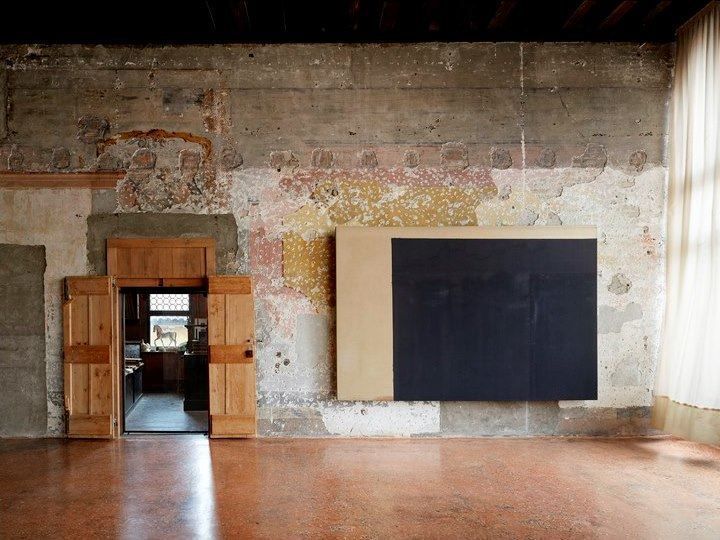
Installation view of "Yun Hyong-keun, a Retrospective" at Palazzo Fortuny in Venice. Courtesy of MMCA
Forbes included Yun's retrospective in the "Twelve Essential Offsite Exhibitions Of The 2019 Venice Biennale," describing how large earth-colored canvases from the 1960s to the 80s are "thoughtfully hung throughout all the floors of the impressive Gothic palace."
Selections, an art quarterly distributed in the Middle East, picked the exhibit as one of the "3 Major Shows Not to Miss in Venice" along with the Jannis Kounellis exhibition at Fondazione Prada and Sean Scully's "HUMAN" at the Church of San Giorgio di Maggiore.
Selections focused on how the artist's works relate to key events in Korea's modern history including Japanese colonial rule, the Korean War (1950-53) and the post-war dictatorships.
"The exhibition explores Yun's painterly investigations into the relationship between beauty, pain and suffering with his signatory monolithic oil on linen paintings. ... each section gives an insight to Hyong-keun's lifelong quest to master simplification in his painting practice and his experimentation with variant shades of black painted with wide brush-strokes on large-scale linen or cotton canvases," Selections wrote.
The British periodical included the Yun retrospective as one of the best fringe events of the Venice Biennale, held at the former home of the Spanish fashion and textile designer Mariano Fortuny. "With their muted colours and bold shapes, these canvases reflect the turbulent life of an artist who survived four terms in prison for his beliefs," Marcus Field wrote.
Contemporary art magazine Frieze's senior editor Pablo Larios described the exhibit as "a hauntingly moving show of paintings."
"My heart almost stopped when I entered the Palazzo Fortuny, where Hyong-keun's elongated, deeply gloomy abstractions demonstrate an almost religious commitment to reduction. Hyong-keun's works are spare, yet mean so much: his are hollow paintings, realized in umber and ultramarine, which seem to stare at you with a sense of apocalyptic blankness. It's not too much to read overtones of death given that Hyong-keun's life was marked by the historical calamities of the Korean War," Larios wrote in an opinion piece.
Apollo magazine also introduced Yun's retrospective, which is separate from the biennale. "After all the earnestly issue-led art I have seen today, it is a treat to dwell on these impressive paintings," Emma Crichton-Miller wrote on Yun's works with a peculiar intensity of expression.
The exhibit runs through Nov. 24 alongside the 2019 Venice Biennale.