VIDEO Taiwanese envoy defiant on China, optimistic on future

Daniel D. W. Tang, representative of the Taipei Mission in Korea, pauses during an interview with The Korea Times at his office in downtown Seoul, April 11. Korea Times photo by Shim Hyun-chul
By Oh Young-jin
A little fuss occurred at the office of Daniel D. W. Tang, representative of the Taipei Mission in Korea, in downtown Seoul last week, as a flag was moved behind him before an interview.
Obviously, it is uncommon for the “ambassador of Taiwan” to have a full-fledged interview with a media outlet. Tang wanted to make sure his national flag was included in photos and video for this meeting with The Korea Times.
Perhaps that flag best captured the story of Tang's country ― often considered a lost cause amid the onslaught of China, once the rival of the island state that has grown too big and powerful. But at the interview's end, a couple of surprises emerged that made the story of Taiwan not one of despair or defiance but one of hope with a future. It was attributed in no small part to the ambassador's narrative skills.
Tang finally felt satisfied with the flag's position. Before the first question, we found each other looking at it ― one that has a white disc symbolizing the sun, with 12 triangles for rays emanating from it, on the blue canton against a red background. It was the flag of Sun Yat-sen, the father of modern China, adopted by the Republic of China in 1928 after his Nationalist Party of China (Kuomintang) consolidated control of the country through subjugating regional warlords in the 1926 Northern Expedition.
“It is the flag of revolution,” Tang said. He obviously meant the one by Sun, who brought about the end of nearly 300 years of rule by the Qing, the last in the dynastic lineage of the Middle Kingdom, if the current rule by Xi Jinping, president of communist China for life, is not included.
But that statement by the chief representative of the mission could sound as if it was a regretful reference in hindsight to another revolution, one by the communists, who formed an alliance as a junior partner with the nationalists and forced Chiang Kai-shek, leader of the Kuomintang and the Republic of China (ROC), out of mainland China and into exile in Taiwan in 1949.
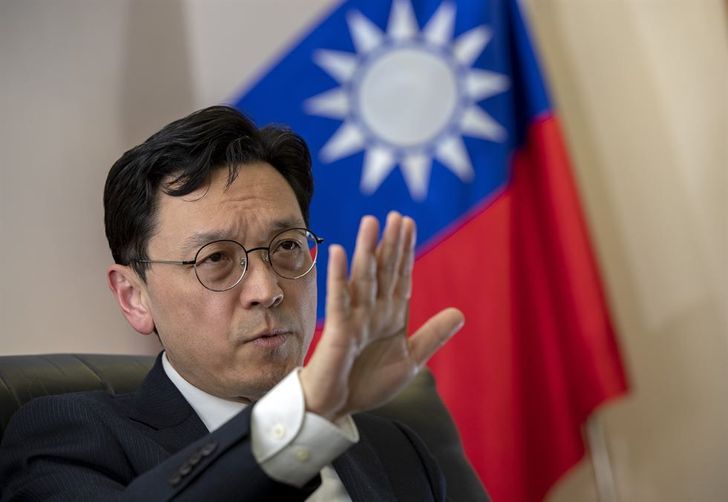
Ambassador Tang, representative of the Taipei Mission in Korea, speaks. Korea Times photo by Shim Hyun-chul
The success of the communist revolution came as a result of a strategy of winning the hearts and minds of the people and alienating imperialistic rival Chiang from them. It was the beginning of Taiwan's sad story.
Only 17 countries, most of them small, still maintain diplomatic ties with the island state. Many others have ditched ties under pressure from Xi's communist People's Republic of China or established links with it. Korea switched its diplomatic ties to China in 1992 ― the last Asian country to do so. Before his Korea post, Tang was ambassador to the Marshall Islands, one of the 17.
Despite its apparent reduced international standing, Tang said Taiwan was ready to go toe-to-toe with its bigger rival.
“Not for a single day has the ROC been part of the People's Republic of China,” he said, dismissing Beijing's claim that the island is a renegade province. He also rejected an arrangement for coexistence similar to Hong Kong in the formula of one country, two systems.
“Coexistence is only possible on an equal footing and in a peaceful manner,” Tang said. Since the 2016 inauguration of current President Tsai Ing-wen of the Democratic Progressive Party, China has been on the offensive against Taiwan.
All Cross-Strait official and semi-official contacts have been put on hold. Five countries have severed ties with Taiwan under Beijing's pressure. Chinese warships frequently appear near the island as a show of force. Late last month, two Chinese jet fighters made threatening flights across the “median line,” the border. Also, Chinese visitors peaked in 2015, before Tsai took office, at 4.5 million. That figure has now dropped to 2-2.5 million.
The day before the interview, marking the 40th anniversary of the U.S.'s Taiwan Relations Act, Tsai made a defiant vow that she wouldn't yield an inch of territory to China. She received a U.S. delegation led by an assistant secretary of state.
On April 15, Beijing sent a fleet of bombers, fighters, electronic warfare and surveillance aircraft on a long-range Air Force drill near Taiwan, causing Tsai to say that she was not impressed.
“President Tsai wants the status quo, which means peace,” Tang said. “China is trying to change that.” Tsai's party represents a break from the old Kuomintang and a majority of Taiwanese who don't see themselves as Chinese. The Taiwan National Security Survey graph shows two-thirds or more think they are Taiwanese, not Chinese, for most of the 2008-2016 period. That trend is believed to prevail.
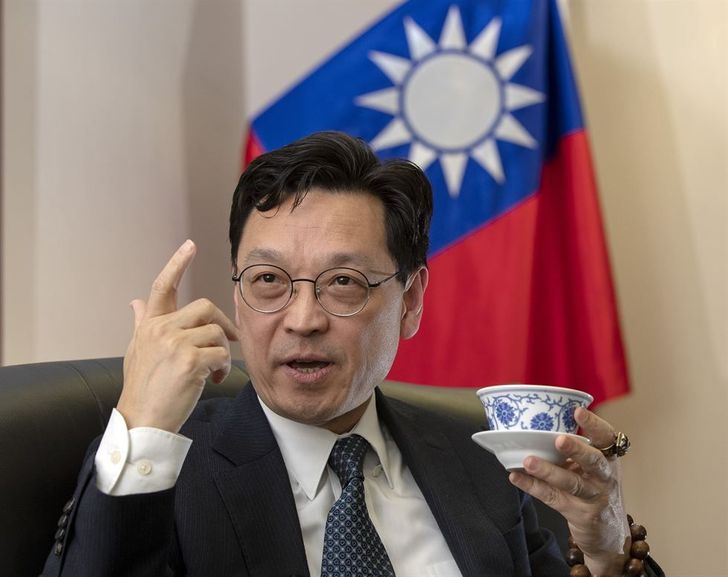
Daniel D. W. Tang, representative of the Taipei Mission in Korea, makes a gesture. Korea Times photo by Shim Hyun-chul
Taiwan relies on the U.S. to countervail Chinese pressures. It has bought U.S. weapons to the tune of billions of dollars and is trying to purchase F-16 fighter jets, among others.
“We appreciate the U.S.'s support,” Tang said. Asked whether he feels the U.S. is using Taiwan as leverage against China, making his country a pawn in a Thucydides' contest between the two superpowers, he said: “Bilateral relationships should benefit both parties.” This question reflected the anxiety of Koreans in its alliance as a junior partner with the U.S. as denizens of the battleground of big powers but Tang struck a practical tone, maybe it being part of his Chinese DNA.
But he promptly added that what keep Taiwan vibrant under fire was the sense of sharing the same basic universal values that tie it together with the U.S., Europe, Korea and other democracies.
That value-sharing between Taiwan and Korea has helped bilateral ties recover after the 1992 diplomatic cutoff. “In 2013, when I worked in Busan, the number of two-way visitors stood at 800,000,” Tang said. “It rose to 2.1 million last year.”
Korea is Taiwan's fifth-largest trading partner, while Taiwan is Korea's sixth. What cements their bilateral ties is K-pop and K-dramas, which Tang's family enjoys. “I don't watch much TV,” he said.
I asked Tang whether he would propose meeting the Chinese Ambassador in Seoul, Qiu Guohong. But Tang said Qiu wouldn't accept his invitation. “They always check whether we are coming,” he said.
It is said that a minister in the Czech Republic was fired after envoys from China and Taiwan were invited and attended the same event. The Taiwanese was asked to leave after the Chinese protested.
Finally, Tang talked about the correct name of his country, because to those who are not Taiwanese, at least a couple are competing with each other. “Our official name remains the Republic of China. Taiwan is the geographical name of the island we reside on, so it is our name as well.”
Obviously, Chinese Taipei is the name used to enable its Olympic athletes to participate in the Games, as requested by the International Olympic Committee (IOC). But doesn't the Olympic Charter declare the quadrennial festival free from politics?