Can forgiveness be Korea's ultimate revenge on Japan?

Bridges are built and the unpredictable occurs when perpetrators and victims meet in the “spirit of humanity.” From Unsplash
By Amanda Price
When an elderly woman stood behind the podium to speak at Germany's Biomedical Sciences symposium, few were prepared for what they would hear.
The elderly woman was Eva Mozes Kor.
As a young Romanian girl, Eva, her parents and three sisters were forced at gunpoint on to a cattle train and taken to the infamous Nazi death camp, Auschwitz.
Eva was 10 years old at the time. She was also a twin.
This meant she and her twin sister, Miriam, would soon become human guinea pigs for the infamous Nazi scientist, Dr. Josef Mengele.
Eva described in painful detail her heart-wrenching experiences: how she was wrenched from her mother's arms once she was identified as a twin, how her parents and two older sisters were killed in the gas chambers, and how she fought to stay alive after being tortured and injected with lethal bacteria.
Before Mengele, “the Angel of Death,” was able to kill her, the war ended and Eva and her twin sister were saved by members of the Soviet Army. Of the 1,500 sets of twins that Mengele had abused in his experiments, only 200 survived.
After 10 years in the Israeli army, Eva became an advocate for the victims of the Nazi experiments. Through her tireless efforts she found the surviving twins and founded the organization CANDLES (Children of Auschwitz Nazi Deadly Lab Experiment Survivors).
Like all Holocaust victims, Eva had no reason to forgive those who had tortured her and murdered her family. The loss was unimaginable, and for years she struggled with anger.
But eventually, Eva did what no-one could have imagined possible. She forgave the Nazis who had turned her life into a living hell.
Understandably, other Holocaust victims spoke out against her. Many understood the negative impact of living with unrelenting anger. But to forgive? To choose to release these vile men from lifelong condemnation? This was foolish extremism.
But to Eva, this choice meant liberty and power. In her symposium speech to German doctors and scientists, Eva described her turning point. “I realized that 'I' had the power to forgive. No one could give me this power, and no one could take it away,” she said.
Having worked through her loss, she let go of resentment.
“I felt a burden of pain was lifted from my shoulders,” she explained. “I was no longer a victim of Auschwitz. I was no longer a prisoner of my tragic past. I was finally free.”
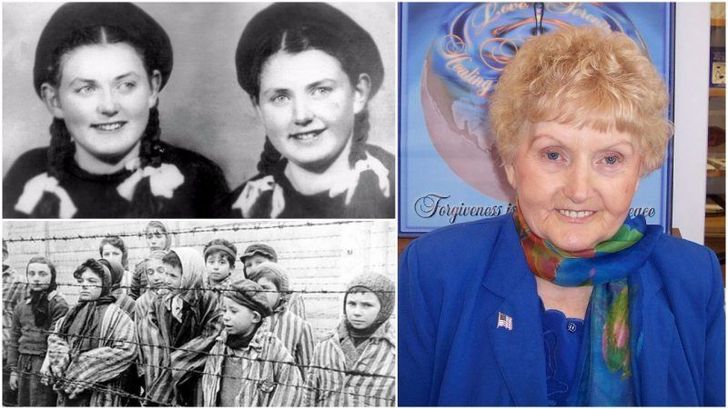
Top left: Eva Kor and her sister. Right: Eva Kor, who decided to forgive her tormentors. From CANDLES Holocaust Museum and Education Center's website
Eva's remarkable action led her to meet Nazi war criminals, and even a doctor who assisted Mengele in his monstrous experiments.
Although these meetings were unthinkable to most, their immediate effect was to silence those trying to deny or revise the history of the Jewish Holocaust.
As Eva was willing to forgive, the perpetrators who needed forgiveness came forward, testifying to the truth once told only by the victims.
In this sense, forgiveness was Eva's ultimate revenge on the Nazis. She had chosen literally to look her enemies in the face, and do the perfect opposite of what they had done to her.
Forgiveness as a form of revenge is somewhat of a bizarre oxymoron. The two words are nearly the polar opposite, yet in a world where the remarkable happens from time to time, these two words have become mysteriously bonded.
Few others in history have made a choice to forgive before forgiveness has been sought. Among those few are Jacob DeShazer, a prisoner of war, who returned to Japan and became lifelong friends with the pilot who had led the attack on Pearl Harbor; Louis Zamperini, whose life was told in the movie “Unbroken”; Kim Phuc who forgave the American soldiers who incinerated her village with napalm; Corrie ten Boom, a Dutch survivor from the Jewish Holocaust, and Immaculee Ilibagiza, who forgave the men who slaughtered her family in the Rwandan Genocide.
For those who have chosen a higher path than retribution and unrelenting anger, there seems to be no regret. Quite the opposite, these individuals seem liberated in ways that are difficult to fathom. Even more surprisingly, their choices have led to long-lasting social change, and to justice, not just for themselves but for thousands of others.
Using forgiveness to bring about justice seems at odds with human reasoning. Justice is often far more punitive, demanding an eye for eye and a tooth for a tooth. Those who wrong us must know the weight of their crimes and feel the shame of their actions. According to many belief systems, there are crimes that must never be forgiven, criminals who must never be allowed to forget the depths to which they have sunk.
We expect that releasing perpetrators from their guilt and shame would cause their crimes to be forgotten, yet the reverse occurs. Instead of the past drifting into the dark recesses of history, it is brought into the spotlight in unforeseen ways. Victims' voices, once strained from convincing the world of their pain, are replaced with the voices of perpetrators, now testifying on behalf of victims. It is an environment in which the unpredictable occurs.
Eva Mozes Kor described just such an occurrence when a convicted Nazi doctor hugged her.
“Everything he is accused of, he did,” she said. “I told him my forgiveness did not prevent me from accusing him, or from him taking responsibility for his actions … His response to me (the hug), however, is exactly what I was talking about when I said you cannot predict what will happen when someone from the victims' side and someone from the perpetrators' side meet in a spirit of humanity.”
Forgiveness is our most courageous and noble response to suffering. It validates our pain while ensuring our pain does not define us. Forgiveness shifts our focus upon ourselves as victims to victors. Not victors over our enemy, but victors over the hate that keeps us chained to a perpetual cycle of anger and resentment.
South Korea and Japan stand opposite each other in an unflinching face-off. International pundits and critics predict that Japan will never be sorry enough, and South Korea will never be satisfied with Japan's apologies. If history holds a hand in this game of chance, then the odds are backing the critics who insist that no-one will ever back down.

This image of rival speedskaters, Japan's Nao Kodaira and South Korea's Lee Sang-hwa, went viral. Is this an example of the future or just a momentary exception? Yonhap
So, in this stalemate what is really happening?
The answer is obvious: pain is prolonged ― the pain that comes from latent anger or deep-seated shame, or a belief that the past will never be resolved. Even apathy can be a form of pain.
When Eva Mozes Kors began to speak out publicly, she vented her frustration at world leaders who focused only on justice.
“As I understand it, most governments and world leaders bear a heavy burden in trying to keep the world at peace,” she said. “In my opinion, they have failed miserably by not advocating, encouraging and facilitating survivors of tragedies such as the Holocaust to forgive their enemies, which is an act of self-healing.”
South Korea continues to shake the lofty tower in which Japan likes to hide. As a result, stones are falling all around. Astonishingly, no-one seems to care where they are falling or on whom they are falling. Both in Japan and South Korea men and women die every day without closure, without the peace of seeing past wounds healed.
Everyday a legacy of unforgiveness is past from grandparents to parents and then on to children. And so, the wheel keeps turning. Japan will not budge and South Korea will not forgive. The bridge that could bring both nations together remains unbuilt.
Eva, and others who have forgiven, were not being sentimental, they were pragmatic. Anger and resentment not only close doors, they bolt them shut. The willingness to forgive opens doors, and sticks a wedge inside to make sure they can never close.
Every South Korean has within them the power to forgive those who once oppressed them. Crimes will not be washed away; the past will not be diluted; and no-one will forget the pain that was once endured. Accountability will remain. Restitution will still be paid. Only resentment and hatred will be done away with.
When Eva attends the Auschwitz memorial service, she never fails to dance. She says it is her way to reclaim the joy that was once stolen from her. She says it is the way in which her parents would want to be remembered.
Eva is now the adopted grandmother of the grandchild of an SS officer. He came to her and asked if she would adopt him. She helps him deal with his anger so he can one day forgive his grandfather, and be free of his own shame.
At the CANDLES museum, thousands of visitors are taught about the human experiments and how easy persecution becomes genocide. But they are also taught that the power of forgiveness is the only means through which we enter into new beginnings, the only way we shut the darkness of the past out and let joy return.
Forgiveness may be South Korea's most meaningful revenge on Japan. Whatever happens, while “the spirit of humanity” survives there is hope that healing will come to both those who suffered and those who caused it.
The past will not be wiped away, but a new beginning will unfold; not one built on past tragedies, but on future hopes.
Let us not listen to those who think we ought to be angry with our enemies, and who believe this to be great and manly. Nothing is so praiseworthy, nothing so clearly shows a great and noble soul, as clemency and readiness to forgive.
Marcus Tullius Cicero
Amanda Price is the former Director of Hillcrest College's International Student Department. She is the founder of Griffith University History Readers and now writes full time. She can be reached at amanda-price@bigpond.com.