PyeongChang aims to keep Olympic legacy through annual forum on SDGs

Gangwon Province Governor Choi Moon-soon speaks during a Korea Times interview on Wednesday at the PyeongChang Alpensia Resort in Gangwon Province. Courtesy of the Office of Governor Choi Moon-soon
By Jung Da-min
PYEONGCHANG ― The governor of Gangwon Province, where the PyeongChang 2018 Winter Olympics host cities are located, on Wednesday vowed to carry on the Olympic legacy through the city's annual forum.
The PyeongChang Forum 2019 is being held from Feb. 13 to 15 ― under the title “At the Limit of Our Knowledge, Staring into the Future” ― at the PyeongChang Alpensia Resort. It is the second annual event that focuses on discussing ways to achieve the U.N.'s Sustainable Development Goals (SDGs) through community effort.
Gov. Choi Moon-soon said the forum will provide common ground for countries around the globe to share the Olympics spirit of peace by discussing human values.
“There have been discussions centering on the hardware of the Olympics such as sports stadiums and grading of the sports performances,” Choi told The Korea Times during an interview after the forum's opening ceremony. “But we wanted to focus more on the 'human legacy' of the Olympics.”
The PyeongChang Forum is one of three forums held in the city on the themes of peace and humanity. PyeongChang Global Peace Forum (Feb. 9-11) and PyeongChang Disability Forum (Feb. 11-12) were the others.
Choi said PyeongChang is a symbolic city representing the value of peace, especially in that it hosted North Korean athletes, while the city had been one of the most ferocious battlefields during the 1950-1953 Korean War.
“Next year, 2020, is the 70th anniversary year of the Korean War and I was struck with the fact as one of the foreign guests at the PyeongChang Peace Forum yesterday said, '70 years are enough,'” Choi said.
Choi said he also hopes peace discussions at the PyeongChang forums will expand in the future, to the 2020 Tokyo Olympics and the 2032 Seoul-Pyongyang Olympics, which the two Koreas are biding to jointly host.
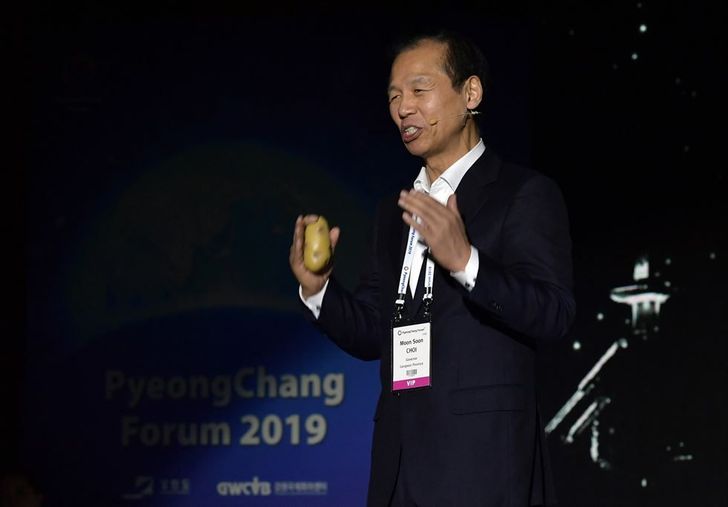
Governor Choi Moon-soon delivers a welcome speech at the PyeongChang Forum 2019, at the PyeongChang Alpensia Resort, Gangwon Province, Thursday, on the first day of a three-day forum. Yonhap
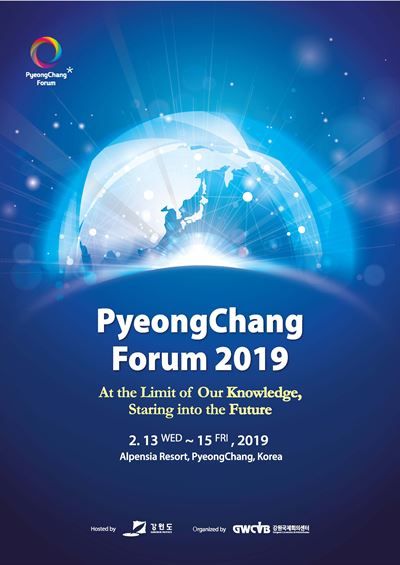
The poster for the forum / Courtesy of PyeongChang Forum 2019
The PyeongChang Forum, hosted by the Gangwon Province government and organized by the Gangwon Convention Bureau, is an international event cooperating with the PyeongChang Forum R&D center at Seoul National University. It aims to serve as a global platform that brings experts and the public together on various issues such as the environment, science and sustainable development goals.
About 1,000 people, including scholars, officials of the United Nations and other NGOs, the press and public have registered for the forum.
On Wednesday during the “Young Scientists Session,” prominent physicists Paul Davies, from Arizona State University, and John Barrow, from the University of Cambridge, gave a lecture on the universe. Lee Sang-mook, a professor from Seoul National University and chairman of the Organizing Committee of the PyeongChang Forum 2019, moderated the session that preceded the opening ceremony.
National Assembly Vice Speaker Joo Seung-yong officially declared the forum open.
Choi Yang-hee, a professor in the School of Computer Science and Engineering at Seoul National University and former Minister of Science, ICT and Future Planning, delivered a keynote speech titled “Digital is Power.”
The professor called for the need to consider seriously the social, political and economic impacts of the transformation fueled by the digital revolution with the invention of semiconductor devices, telecom networks and the internet, computers, mobile phones, software and artificial intelligence (AI).
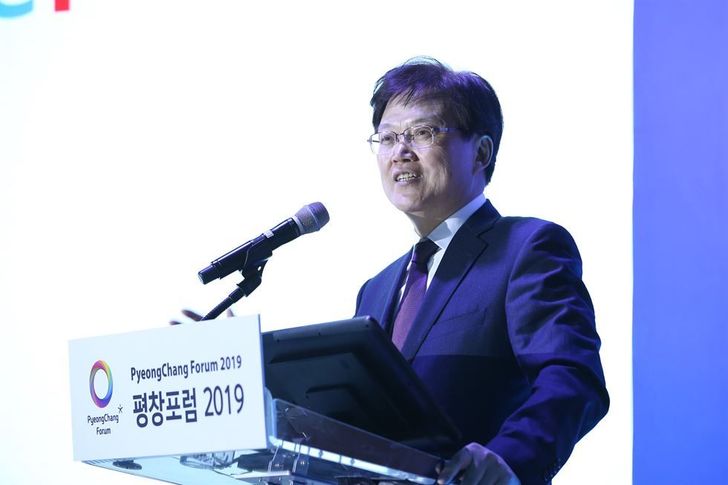
Choi Yang-hee, a professor in the School of Computer Science and Engineering at Seoul National University and former Minister of Science, ICT and Future Planning, delivers a keynote speech titled “Digital is Power,” at the PyeongChang Alpensia Resort, Gangwon Province, Wednesday. Courtesy of PyeongChang Forum 2019
“In the digital era, powers have been allocated to many stakeholders including the government, the National Assembly, local governments, industries, press, social networks, civil societies and labor unions,” he said. “It is important to set proper policies after precisely identifying them, so we can maximize the merits of the digital era such as direct democracy with new consensus-building procedures while setting a new set of rules and regulations in accordance with changes.
“At the same time, setting safety nets such as universal income to prevent the risk from the shortage of jobs and punitive damages to root out problems like fake news are also important.”
The following first session, “Existence and Meaning,” moderated by Prof. Suh Kyung-ho from Seoul National University, introduced psychologist Nicholas Humphrey from the London School of Economics, anthropologist Terrence Deacon from the University of California, Berkeley, and Mary Evelyn Tucker, Yale University's Forum on Religion and Ecology co-director.
Three sessions will be held over Thursday and Friday ― “U.N. Global Citizenship: Leadership for Coexistence in Our Changing World” and “Abrupt Climate Changes” on Thursday, and “Emerging Technology and Complexity” on Friday.
Speakers include scholars from the U.S, the U.K., China, Japan and Korea and officials of the U.N. and other NGOs, including Maher Nasser, director of the Outreach Division in the U.N.'s Department of Global Communications who also made a congratulatory speech at the opening ceremony.
Special events are being held in tandem with the forum. The VR Zone offers the opportunity for people to experience winter sports at the 2018 Games and tour historic spaces, as well as space and earth, using virtual reality devices. The trick art photo zone, face painting, buskers and a photo exhibition add to the event's fun.