Trump sees 'decent' chance of denuclearization

U.S. President Donald Trump speaks in the Rose Garden of the White House in Washington, Jan. 25. AP-Yonhap
By Kim Yoo-chul
U.S. President Donald Trump dubbed senior U.S. intelligence officials “extremely passive” on North Korea and dismissed their assessment of threats from Pyongyang after they contradicted his views in testimony to the Senate.
“Decent chance of denuclearization,” Trump tweeted early Thursday (KST). “Time will tell what will happen with North Korea. A decent chance. That, folks, is what people in the political world call moving the goalposts.”
Trump admitted a threat remained and that it was not guaranteed to go away anytime soon.
The annual “Worldwide Threat Assessment” report, which was released early Wednesday (KST), by the chiefs of the FBI, CIA, National Security Agency (NSA) and many other federal agencies, stated that North Korea “is unlikely to give up all of its (nuclear) stockpiles, delivery systems and production capabilities,” adding that “North Korean leaders view nuclear arms as critical to regime survival.”
Regarding the presidential tweet, South Korea's Cheong Wa Dae declined to comment.
Working-level discussions aimed at narrowing differences between negotiators of the United States and North Korea are underway ahead of a much-anticipated second summit between Trump and North Korean leader Kim Jong-un.
President Moon Jae-in is said to have taken a role in mediating and facilitating the denuclearization talks, which have seen slow progress since an agreements reached by Trump and Kim at their first summit in Singapore last June.
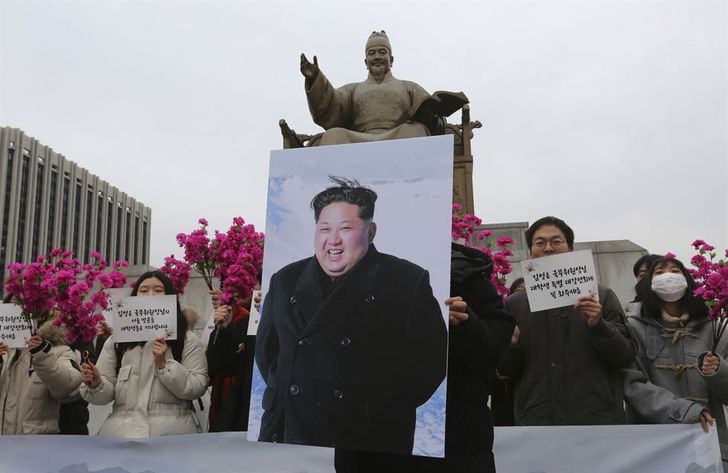
South Korean college students stand with a portrait of North Korean leader Kim Jong-un during a rally to welcome his possible visit to Seoul, Jan. 31. AP-Yonhap
Sources inside Cheong Wa Dae said the negotiations were dealing with how North Korea would present a detailed and concrete dismantlement timeline as well as plans to allow international inspectors into the North. They would seek details of the regime's nuclear program and an inventory of its intercontinental ballistic missiles (ICBMs), which Washington believes are a direct threat to the U.S. mainland.
Pyongyang is said to have requested Washington to lift economic sanctions placed on the country, as a key condition to accept these demands. Seoul is hoping to see an early normalization of stalled inter-Korean business projects such as the reopening of the Gaeseong Industrial Complex.
Trump said he was looking forward to meeting the North Korean leader “shortly,” and added “progress being made ― big difference.”
Political analysts in Seoul said despite the contradicting views on the North between Trump and U.S. intelligence officials, it's highly likely Washington will pursue a “small deal” with North Korea as a “diplomatic win” to defend Trump's assessment of the matter.
“Unlike South Koreawhich wants to see real progress on the North Korea issue at the Trump-Kim summit, it's unlikely the two will reach a major agreement on denuclearization as U.S. negotiators will remain pragmatic,” said Shin Bum-cheol, the director of the Center for Security and Unification at the Asan Institute for Policy Studies in Seoul.
“South Korea is in a different situation as vague measures toward dismantling North Korea's nuclear program, if any, may cause another delay in the denuclearization talks,” said Yang Moo-jin, a professor at the University of North Korean Studies in Seoul.
President Moon said earlier the primary goal of the talks was to bring a lasting peace to the Korean Peninsula through complete denuclearization.