Air Busan IPO plan runs into turbulence

Air Busan CEO Han Tae-keun.
By Park Jae-hyuk
Air Busan has been grappling with a series of unfavorable factors ahead of its planned initial public offering (IPO) in December, according to industry analysts Sunday.
The difficulties the Asiana Airlines subsidiary is facing include intensifying competition in the nation's low-cost carrier (LCC) market and criticism of the measure it took when heavy fog prevented its plane from landing at Gimhae International Airport on Nov. 25.
After bad weather forced a diversion to Incheon, the budget carrier kept passengers on the plane for seven hours rather than letting them wait inside the airport.
Air Busan said it had expected the fog over Gimhae Airport to clear.
But its controversial decision led the Ministry of Land, Infrastructure and Transport to investigate the company, which has raised its brand awareness with punctuality and quality of service.
“The success of Air Busan's IPO is uncertain, due to the worsening conditions in the nation's stock market and the government probe,” said a securities analyst, who declined to be named.
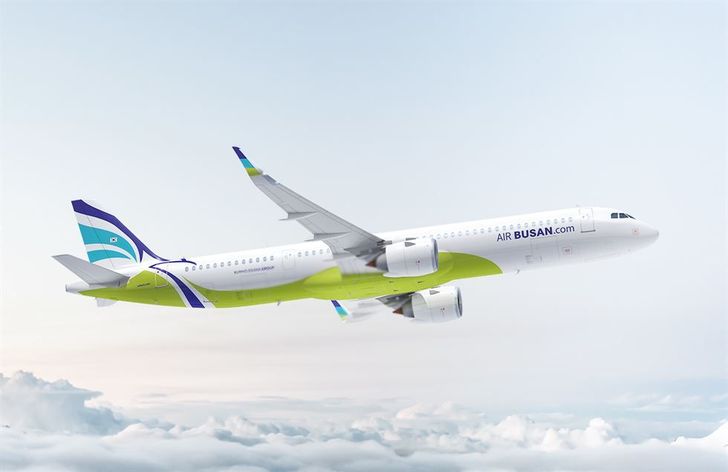
Air Busan will operate the Airbus A321neoLR from 2019. / Courtesy of Air Busan
In addition to service issues, analysts say newcomers seeking entry to the market will weigh on Air Busan.
Four budget airlines ― Fly Gangwon, Air Premia, Aero K and Air Philip ― applied to the land ministry in November for licenses to fly international routes in 2019.
If one of them gets such a license, Korea will have seven budget carriers, the same number of budget carriers that there are in China. If all four companies get licenses for international flights, Korea will have nine budget carriers, the same number as in the US.
Amid the fierce competition, T'way Air, which was listed on the main KOSPI bourse in August, set 12,000 won ($10.71) as its IPO price. This was lower than the company's desired price range of 14,600 won to 16,700 won.
“Korea is facing a sluggish growth rate in the number of people who depart from the country, so fears are growing about the oversupply of budget carriers,” said HMC Investment Securities analyst Bae Se-jin. “The competition is expected to become fiercer next year because several more budget carriers will join the market.”
Asiana IDT's failure to attract investors in the KOSPI market is another unfavorable factor facing Air Busan, according to analysts.
Shares in Asiana Airlines' IT service unit, which was listed on Nov. 23, closed at 11,900 won on Nov. 30, lower than the 15,000 won IPO price.
Asiana Airlines, which holds a 100 percent stake in Asiana IDT, tried to avoid a liquidity crisis through the IPO.
Analysts say Asiana Airlines will struggle to overcome the liquidity crisis if Air Busan also fails to attract investors. The full-service carrier, which holds a 46 percent stake in Air Busan, is the budget carrier's largest shareholder.
Air Busan failed to go public in 2014 and 2015, due to opposition from the Busan Metropolitan Government, company's second-largest shareholder.
Meanwhile, the land ministry said it would carry out an overall safety inspection of Air Busan, because the number of planes the company owns surpassed 25.
Jeju Air and Jin Air were subject to safety checks in April 2017 and March 2018, respectively.